Tekever Adds Edinburgh to Its British Map, Absorbing the Engineers Behind Its 200-Kilogram Drone
The Portuguese group has bought Flowcopter of Edinburgh, whose hydraulic transmission lets the new AR6 carry 200 kilograms over 500 kilometres. It is Tekever's second acquisition in two months, and it sits inside a 400 million pound British investment programme.
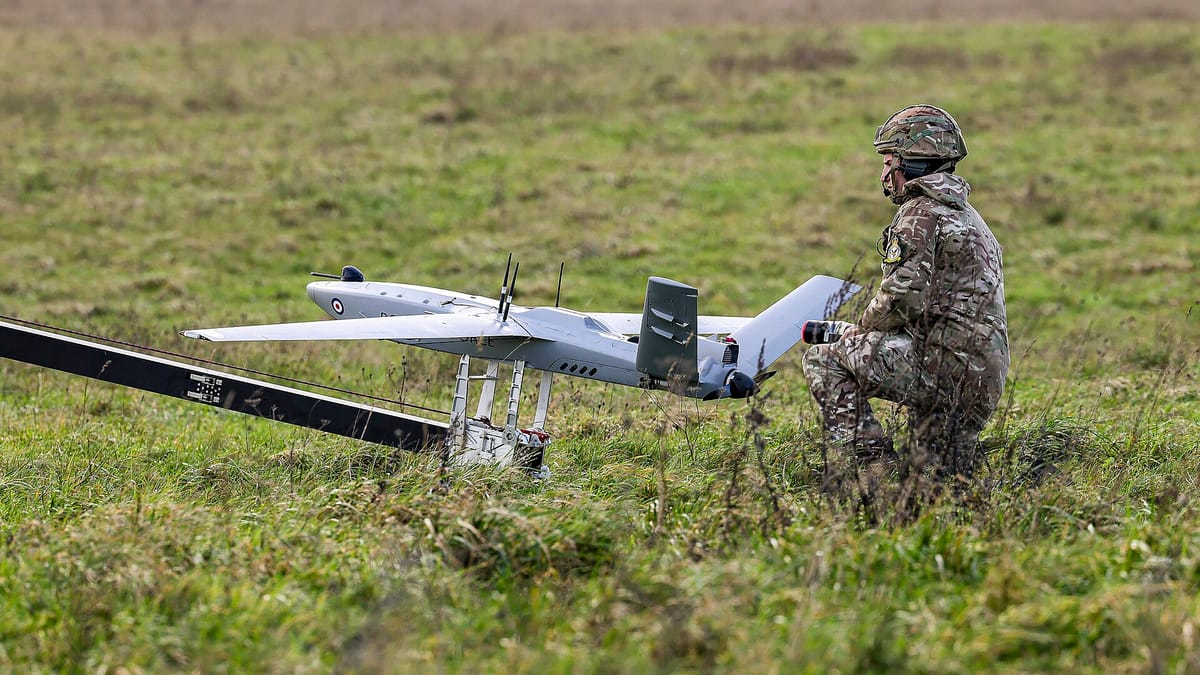
Tekever has bought Flowcopter, the Edinburgh engineering company whose hydraulic transmission sits inside the Portuguese group's newest and largest drone. The announcement came out of Tekever's Bristol office on Tuesday morning. Neither side disclosed a price.
Flowcopter is a small, deeply specialised firm. What it makes is a hydraulic transmission system for aerospace propulsion, an approach that lets an unmanned aerial system carry a heavier payload over a longer distance than a conventional platform of the same size can manage. The two companies were already working together: the AR6, the first aircraft in the heavy-lift family Tekever unveiled at the Farnborough International Airshow in July, uses Flowcopter's transmission, and is rated to carry at least 200 kilograms over 500 kilometres.
Buying the supplier
This is the second acquisition Tekever has announced in two months, after it absorbed the Portuguese artificial-intelligence software firm Cloudsweep in July. The pattern in both cases is the same: rather than license a capability it depends on, the company is buying the team that built it.
"Having already worked closely together on the AR6 programme, we have seen first-hand the value of their expertise and the transformative potential of their hydraulic transmission system," Ricardo Mendes, Tekever's chief executive, said in the announcement. He described Flowcopter as having built "an outstanding reputation for engineering innovation" around technology that "addresses some of the most demanding challenges in uncrewed aviation".
Peter McCurry, Flowcopter's managing director, framed the sale as an acceleration rather than an exit: combining the transmission work with Tekever's autonomy stack and international reach, he said, "will enable us to accelerate development and bring new capabilities to customers faster than ever before". Flowcopter's engineering operation stays in Edinburgh, under the Tekever brand.
The applications Tekever lists for the resulting heavy-lift, long-endurance platforms are notably split between military and civil work: forward logistics, casualty evacuation, offshore operations, search and rescue, disaster relief, and crewed-uncrewed teaming, the concept of flying manned and unmanned aircraft together as one formation.
Edinburgh joins a British footprint that keeps growing
The deal adds Scotland to a British map that already runs to six locations. Tekever employs more than 300 people in the United Kingdom, with offices, factories and test facilities in London, Bristol, Southampton, West Wales, Lydd and Swindon. Karl Brew, who directs the UK arm, tied the purchase to rising demand for systems "capable of operating further, carrying more, and delivering greater mission flexibility" across both government and commercial customers.
The acquisition sits inside Overmatch, Tekever's long-term investment programme in the UK, which the company puts at 400 million pounds and describes as an effort to build sovereign autonomy capability there. That is a substantial commitment for a group whose headquarters remain on Lisbon's riverfront, and it follows a run of British contract wins including the surveillance programme the company was selected for by the British Army in early August.
Tekever has been moving quickly on several fronts at once. In August it was reported to be sounding out investors for 500 million euros at a 5.5 billion euro valuation, up from about 1.2 billion, with acquisitions named as one of the uses for the money. Closer to home, the Força Aérea Portuguesa (Portuguese Air Force) contracted for AR5 aircraft to patrol Portuguese Atlantic waters, with first deliveries due this month. The group also has operations in France, Ukraine, Estonia and the United States.
Its aircraft have been tested in the least forgiving conditions available. In August, Russia claimed to have shot down one of the company's drones over the Black Sea, an unusually public acknowledgement that a Portuguese platform was flying in that theatre.
What this means for you
- Watch the payload class, not the headline: a 200 kilogram, 500 kilometre unmanned aircraft is a different commercial product from the surveillance drones Tekever built its name on, and it opens civil markets such as offshore logistics and disaster relief.
- The British investment is now the larger story: at 400 million pounds and more than 300 staff, Tekever's UK operation is on a scale that will shape where the group's engineering centre of gravity sits.
- If you fly drones here, the rules are separate: nothing about this deal changes Portuguese operating requirements. Our guide to flying a drone in Portugal sets out ANAC registration and the geozones.
- No price, no valuation read: because the consideration was not disclosed, the acquisition tells you nothing directly about whether the 5.5 billion euro funding round has closed.