Sixty Years of the 25 de Abril Bridge: How Lisbon's Steel Crossing Outlived the Dictator It Was Named For
Opened on 6 August 1966 as the Ponte Salazar and renamed after the 1974 revolution, Lisbon's red suspension bridge turns 60 — a 2,227-metre icon that now carries more than 300,000 people a day by road and rail.
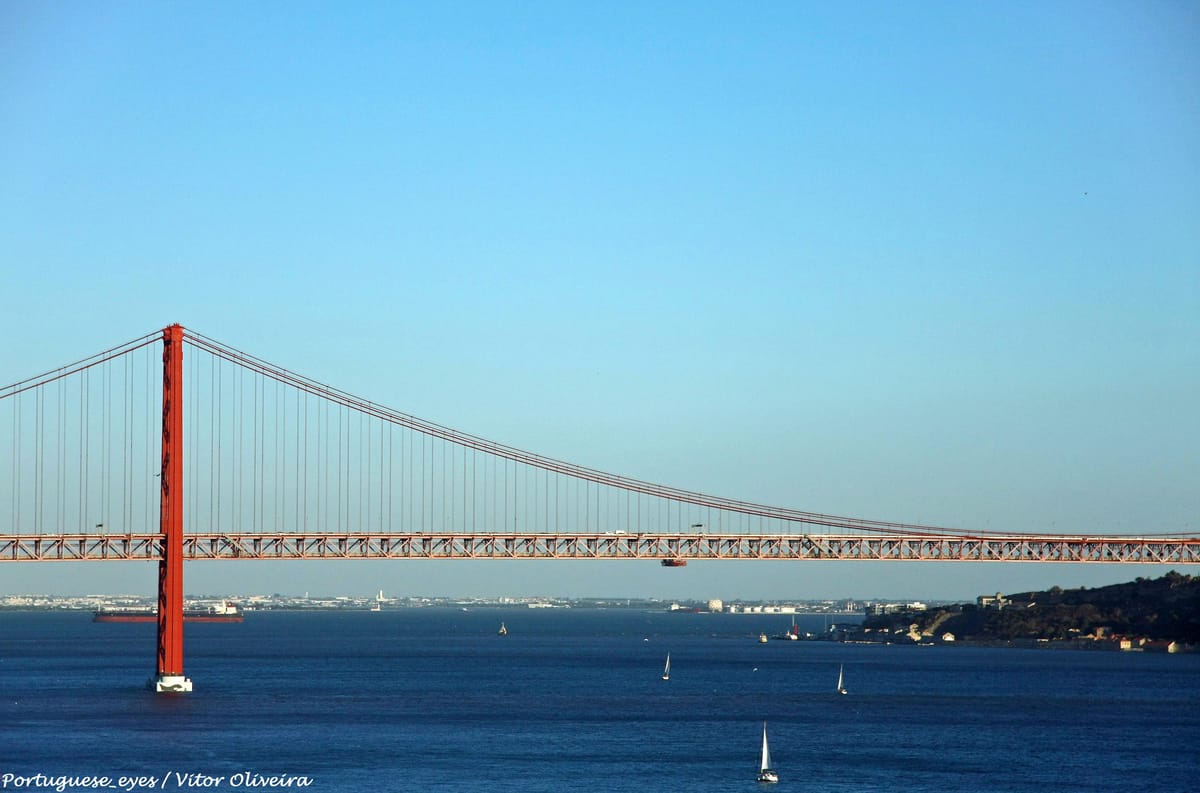
Sixty years ago today, on 6 August 1966, a red steel giant opened over the Tagus and, for the first time, joined Lisbon to Almada by road. It was christened the Ponte Salazar (Salazar Bridge), after the dictator whose Estado Novo (New State) regime had built it. It would not keep that name for long.
Today the same crossing is the Ponte 25 de Abril (25 April Bridge), renamed after the Carnation Revolution of 25 April 1974 swept the dictatorship away and Lisboners, almost overnight, tore down the old name. The bridge that was meant to be a monument to authoritarian Portugal became, instead, a monument to the day the country freed itself — a rare piece of infrastructure whose very name records a change of regime.
An engineering feat of its age
The numbers still impress. The suspension bridge's main span stretches 1,012.88 metres between its two towers, which rise 190.5 metres above the water; from anchorage to anchorage the structure runs 2,227.64 metres. It was raised in under four years by roughly 2,500 workers and fourteen construction firms, with the American steelwork and the unmistakable international-orange paint drawing inevitable comparisons to San Francisco's bridges across the bay.
When it opened, it was among the longest suspension bridges in Europe, and it remains, by its managers' reckoning, the continent's largest suspension bridge carrying both road and rail. The rail deck was a later chapter: a lower level was slung beneath the roadway and opened in 1999, letting Fertagus (the cross-river commuter rail operator) run trains between Lisbon and the southern bank — a second life that turned a car crossing into a full transport artery.
The bridge that carries a city
Six decades on, more than 300,000 people cross it every day by car and train, funnelling the commuter tide of the Margem Sul — the Tagus's southern bank — into the capital each morning and back each night. It is at once the most photographed and the most cursed structure in greater Lisbon: an icon on postcards, a bottleneck in rush hour, and the backdrop to the city's self-image whenever a film, an advertisement or a football broadcast wants to say "Lisbon" in a single frame.
For the many foreign residents who have settled on the southern bank — in Almada, Seixal or Setúbal — precisely because homes there cost less than in the capital, the bridge is not a landmark but a daily fact of life, the thing that stands between an affordable flat and a job in the city. Its rhythms shape theirs, which is why every strike, resurfacing or tweak to Lisbon's transport network lands so hard.
Sixty candles, and a drone show
Infraestruturas de Portugal (the state road-and-rail infrastructure company that manages the crossing) has built a commemorative programme around the anniversary, promising exhibitions, guided visits, digital content and immersive experiences that dig into the bridge's history and heritage. The centrepiece is a three-dimensional drone show staged over the Tagus, tracing the outline of the structure in light above the water it has spanned for two-thirds of a century.
It is a fitting way to mark a bridge that has always been about crossing over — from one bank to the other, and from one Portugal to another. The steel that a dictatorship raised to advertise itself now carries the name of the revolution that ended it, and a city that has spent sixty years arguing about its traffic pauses, for one night, to light it up. Details of the wider anniversary events run through the summer; the best current listings sit alongside the capital's other happenings in our weekly Lisboa Brief.