Seventy-Six Thousand Pipas: Inside the Douro Quota That Decides Whether a Grape Is Worth 1,000 Euros or 200
The IVDP set this year's beneficio at 76,000 pipas, a thousand more than 2025 but 28,000 below 2023. A pipa bound for Port fetches 900 to 1,200 euros; the same fruit sold for still DOC Douro wine fetches 150 to 400. The price has sat near 1,000 euros for twenty years.
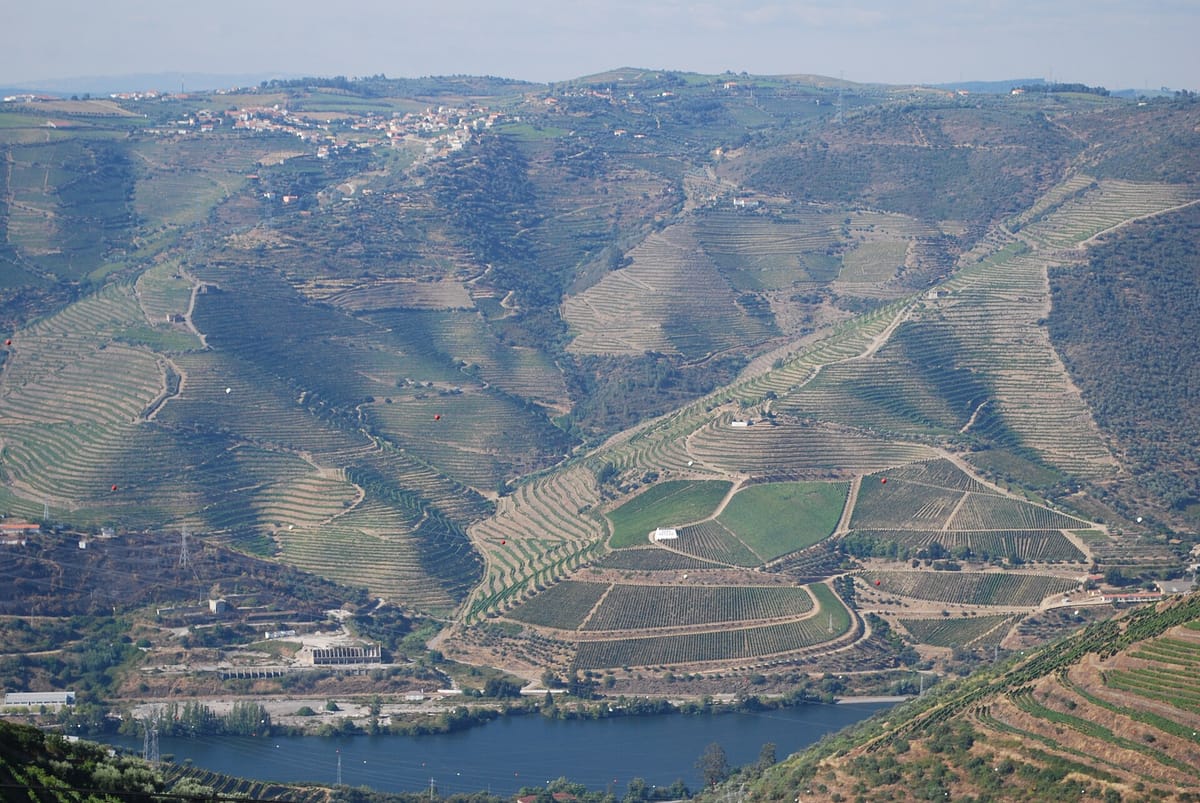
Every summer, before the pickers go out, a committee at the Douro and Port Wine Institute decides how much of the region's crop is allowed to become Port. This year it settled on 76,000 pipas, each of 550 litres, roughly 57 million kilograms of grapes. That decision, known as the benefício, is worth more to a Douro grower than the weather.
What the benefício actually is
The benefício is the maximum quantity of mosto generoso, or fortified must, that each producer in the Região Demarcada do Douro may destine for Port. The volume is fixed each year before the harvest by the Conselho Interprofissional, the advisory body of the Instituto dos Vinhos do Douro e do Porto (IVDP), where growers and the trade sit together. It is then published in the region's annual vintage communiqué.
"Basically, the benefício establishes a productivity limit for each parcel, set annually by the Conselho Interprofissional," António Filipe, president of the Port shippers' association AEVP, told ECO. The IVDP is careful to add that it is "not a licence to produce wine in general" but an annual quota of must that may be turned into Port.
The total is not distributed evenly. Vineyard parcels are scored by the IVDP on altitude, aspect, slope, grape varieties, age and yield, and graded by letter. Each letter carries a different yield per hectare. Land in the Douro that has no benefício right cannot make Port at all.
The number has been falling for three years
This year's 76,000 pipas is a thousand more than the 75,000 authorised for 2025. Set against the recent series it is still a steep descent: 104,000 pipas in 2023, 90,000 in 2024, 75,000 in 2025. That is 29,000 pipas removed in three years, the equivalent of about 16 million litres of must, in a category whose global sales have been retreating for 26 years.
The quota tracks the market rather than the vines. The Conselho weighs Port sales, market prospects and the stocks already sitting in producer and trade cellars, then converts that into a yield per hectare.
Why a single grape has two prices
Here is the arithmetic that governs a Douro household. A pipa of grapes destined for Port, 750 kilograms or 550 litres, fetches somewhere between 900 and 1,200 euros, according to the AEVP. Grapes that fall outside the quota go to still DOC Douro wines and are worth 150, 200 or at most 400 euros a pipa.
Same fruit, same slope, same picker. The benefício decides which price applies, and for most of the region's 18,000 growers it is the main source of income.
Manuel Cordeiro, mayor of São João da Pesqueira, puts the grievance sharply: the price has stayed at around 1,000 euros a pipa for two decades, while everything about producing it has become more expensive. That stagnation, and not the quota alone, is what the region's protests this month have been about.
The argument over abolishing it
Growers want a larger benefício, because Port pays better. The counter-argument is that raising it into a shrinking market would deepen the oversupply that already leaves fruit without a buyer. Some in the trade, notably Fladgate Partnership chief executive Adrian Bridge, have argued for more than twenty years that the system should go, on the grounds that it prevents the best grapes from becoming Port at the moment when the category's growth depends on higher-value styles.
Growers answer that without the quota they would lose their one guaranteed annual income and face the market unprotected, with even more grapes unsold. The debate arrives in a region already described as facing its worst crisis in decades, in a year when the national harvest is forecast to grow about 12 percent and the Douro to reclaim its place as the largest producing region. On the support now on offer to growers, the rewritten Douro non-harvest payment formula explains how Portaria 436/2026/1 reverses the calculation, caps the payment at 1,125 euros a hectare and resets the IVDP's deadline to open applications.
What This Means for Foreign Residents
- Owning Douro vines is not the same as owning Port rights. If you are buying land in the region, the benefício classification attached to the parcels is a material part of its value. Check it before, not after.
- The quota explains the protests. When growers demonstrate over escoamento, the ability to sell what they pick, the benefício is the mechanism they are arguing about.
- A bumper harvest is not good news here. More fruit in a capped system means more grapes at 200 euros a pipa rather than 1,000.
- Port and Douro wine are separate businesses. The bottle of DOC Douro on your table exists in part because the fruit in it was outside somebody's quota.