Seven in Ten Trains Ran on Time in the First Half of the Year, and Infraestruturas de Portugal Has Told the Market Not to Expect Better
The state rail and road manager's consolidated half-year accounts put network punctuality at 70 percent against an 85 percent target, and say no improvement is foreseen for the rest of the year. Train-kilometres fell 3 percent and thirteen significant accidents were logged.
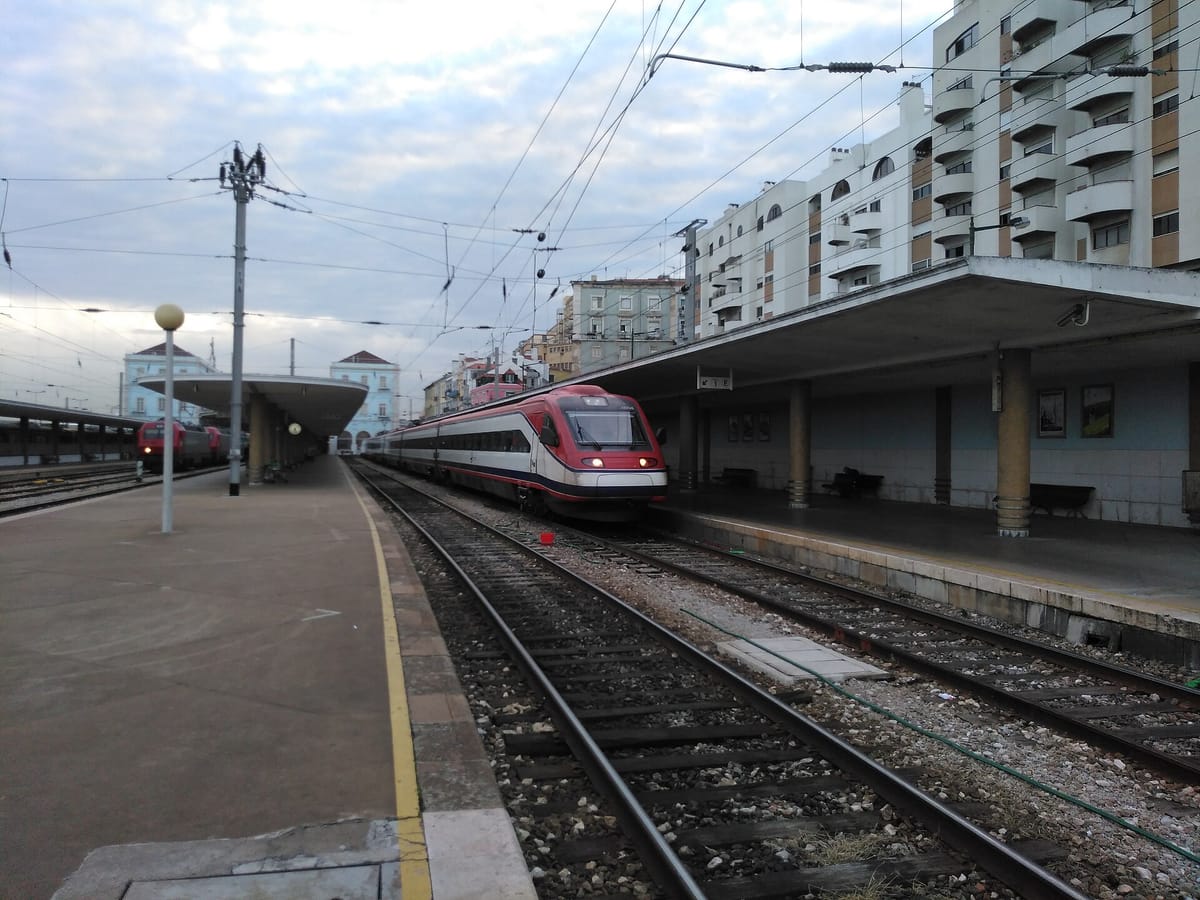
Infraestruturas de Portugal (Infrastructure of Portugal), the state company that owns and runs the national rail and road networks, published its consolidated half-year accounts on Friday. Buried inside them, in a table of the thirteen performance indicators the company is contractually measured on, is a number that will be familiar to anyone who has stood on a platform this year: rail punctuality for the first six months of 2026 came in at 70 percent.
The target for the year is 85 percent. The company's own comment on the gap is unusually blunt for a document of this kind. Despite the corrective measures it lists, it writes, "no improvements are foreseen for the coming periods when compared with the value now determined".
Three years, three steps down
The report prints the indicator as a three-year series, and the direction is the story. Punctuality across the whole network in the first half of the year ran at 82 percent in 2024, 77 percent in 2025 and 70 percent in 2026. Measured against the Contrato Programa (Programme Contract), the agreement that sets what the State pays for and what performance it expects in return, the drop from 2025 to 2026 is 7.4 percentage points.
The indicator is an aggregate across the entire network in operation, and it is measured by how late trains are on arrival rather than on departure. A single figure of this kind flattens a lot of variation, and the report says where the variation sits: the weaker performance is concentrated in the medium and long-distance services, which it names as the Alfa Pendular, the Intercidades, the Inter-regionais and the Regionais.
What the company blames
Two causes, and they are the same two. The first is speed restrictions, the stretches of line where trains are required to slow because the track underneath them is not in a condition to take full speed. The second is the engineering work itself, spread across the main axes of the network. Between them, the report says, they lengthen journey times and strip the timetable of the slack it needs to absorb a small delay without passing it down the line.
The proposed fix has two parts. Infraestruturas de Portugal says it will prioritise removing the speed restrictions that do the most damage to medium and long-distance punctuality, and it will tighten its monitoring and coordination of works in progress so that interventions are planned more efficiently. Neither is a promise of a different number this year.
Fewer trains ran at all
The volume indicator fell alongside the punctuality one. Trains ran 16,960,573 train-kilometres in the first half, against 17,559,081 in the same period of 2025, a fall of 3 percent. The annual target is 37,733,141.
The report itemises what took those trains off the network. The modernisation of the Linha do Douro (Douro Line) closed the Marco de Canaveses to Peso da Régua section from 3 November 2025 until 2 April 2026. Storm Kristin on 28 January, and the persistent heavy rain that followed through February, produced what the company estimates at more than 650,000 lost train-kilometres and around 1.7 million euros of forgone revenue. Partial closures stayed in place afterwards on the Linha da Beira Baixa between Mouriscas-A and Rodão, and on the Linha do Oeste between Mira-Sintra/Meleças and Caldas da Rainha, for the heavier repairs. The general strike of 3 June cost a further 178,000 train-kilometres and about 0.6 million euros, and CP strikes around Coimbra ran from 20 to 30 June.
Of the train-kilometres that did run, CP took 79 percent, the freight operator Medway 11 percent, Fertagus 7 percent and Captrain 3 percent.
Thirteen significant accidents, eleven of them from outside the railway
The safety indicator moved the wrong way too, from 0.561 significant accidents per million train-kilometres in the first half of 2025 to 0.764 in 2026. Because the measure is a ratio where lower is better, that is a 36 percent deterioration, though it still sits inside the 0.848 the company is allowed for the year.
Behind the ratio are thirteen significant accidents. Eleven of them, the report says, came from the activity or behaviour of third parties: three involving people on the open line, five in stations and three at level crossings, producing two collisions and one person struck. Two were attributed to Infraestruturas de Portugal itself, both collisions with an obstacle inside the loading gauge, involving trees and, in one case, a barrier as well.
One indicator that improved
Network availability, the share of time the infrastructure was open to traffic, rose from 78 percent to 87 percent, against a target of 91. Supplementary times, the padding written into timetables to reflect planned speed restrictions, fell from 68 to 43, comfortably below the 70 allowed. Asset management held flat at 65 percent, which is exactly its target.
Rail revenue came in at 48.8 million euros against 62.5 million budgeted, an execution rate of 78 percent, which the company attributes directly to the shortfall in train-kilometres. Maintenance spending went the other way, up 8 percent to 52.4 million euros.
The wider accounts
The group closed the half with a consolidated net profit of 43.8 million euros, against 78.5 million a year earlier. EBITDA fell from 267.6 million to 227.3 million. Operating income of 706.2 million was roughly 4 million below last year, held down by a 17.7 million euro fall in receipts from the Contribuição de Serviço Rodoviário (Road Service Contribution) and 10.7 million less in operating subsidies, partly offset by 9 million more in tolls. Operating costs rose 41.5 million to 592.6 million, much of it repair work after the winter storms.
Investment in the networks the company manages directly reached 281 million euros, 11 percent more than a year earlier. Rail took 171.5 million of that, down 6 percent as the Ferrovia 2020 programme winds up and the PNI 2030 projects start; road took 76.1 million, up 13 percent, with the Plano de Recuperação e Resiliência (Recovery and Resilience Plan) funding 84 percent of it. Financial debt fell 85.4 million to 3,130 million euros, and the State injected 527.8 million of fresh capital over the six months.
What it means on a platform
The gap between a 70 percent punctuality figure and an 85 percent target is not an accounting matter for passengers who have a connection to make. It also lands in the same season as the passenger compensation rules that took effect at the start of October, which give travellers a defined claim when a train is badly late. A network that expects no improvement for the rest of the year is a network that has told its regulator, its shareholder and its passengers to plan accordingly.