Seagrass Restoration Moves Toward Portugal's Voluntary Carbon Market: a Method Proposed by Airport Operator ANA Is Open for Comment Until 22 November
A proposed methodology would let projects that restore or protect seagrass meadows earn carbon credits in Portugal, over 10 to 30 years. The technical committee backs it but wants changes, and the public can comment until 22 November.
Projects that restore or protect seagrass meadows on mainland Portugal's coast could soon earn carbon credits that companies buy to offset their emissions. The rules that would allow it, a proposed methodology for the Mercado Voluntário de Carbono (Voluntary Carbon Market), went out to public consultation on 23 October. Anyone can comment on the Participa portal until 22 November.
The method was proposed by ANA Aeroportos de Portugal, the airport operator owned by the French group VINCI, with support from the consultancy NBI (Natural Business Intelligence), the Centro de Ciências do Mar (CCMAR, Centre of Marine Sciences) at the University of the Algarve and Spain's Instituto Mediterráneo de Estudios Avanzados (IMEDEA, Mediterranean Institute for Advanced Studies). The Agência para o Clima (Climate Agency) is running the consultation. According to the proposal, it would be the market's first methodology for marine and coastal ecosystems.
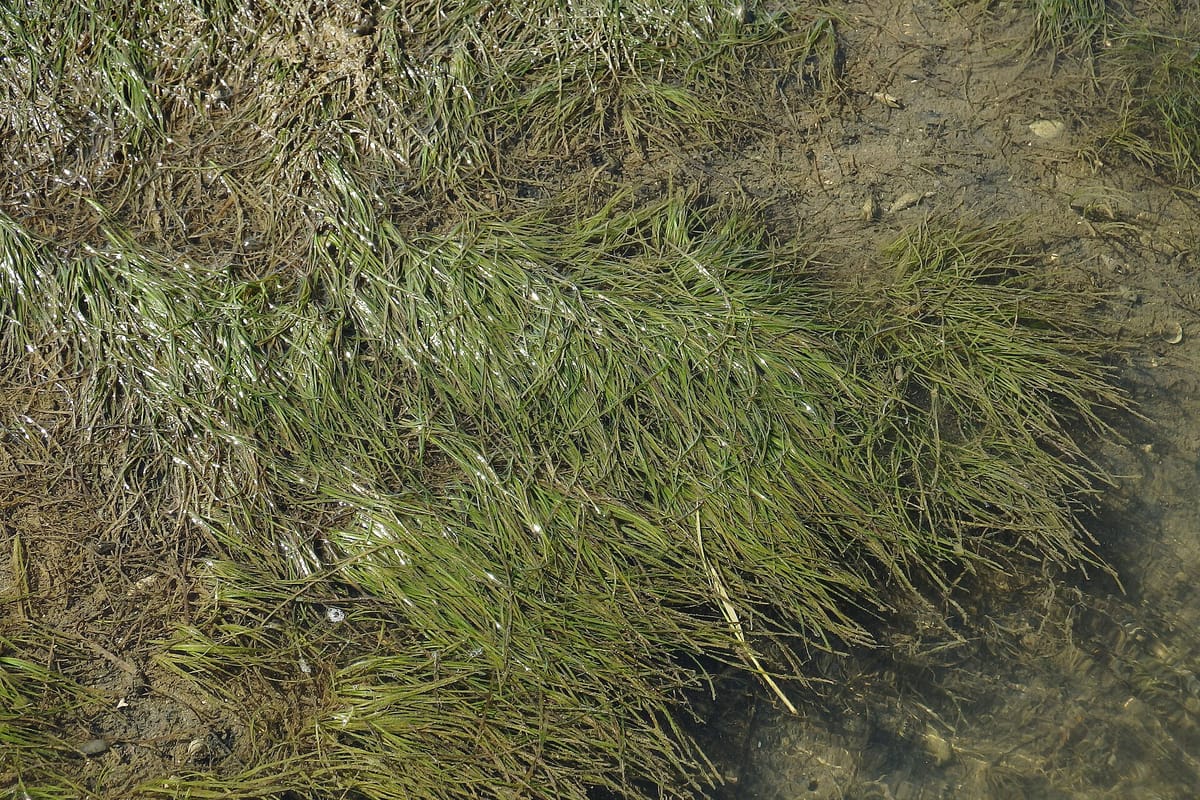
Seagrass meadows store carbon in the seabed and shelter fish and shellfish. The proposal says Portugal's meadows have suffered large losses in recent decades, mostly from human activity such as dredging, shipping and fishing.
A market in its second year
Decreto-Lei n.º 4/2024 (Decree-Law 4/2024) set up the voluntary market, in which credits are issued only for projects that follow an approved methodology. The Ministério do Ambiente e Energia (Ministry of Environment and Energy) says that after its first year the market has three approved methodologies, five projects submitted (two of them approved), 10 qualified verifiers, 30 registered users and 977 future carbon credits issued. Two of the three, for reforestation and for better management of existing woodland, were approved in early October.
What a seagrass project could do
The proposal covers two kinds of work. Restoration could include restoring tidal flow to cut-off areas, using dredged sediment where the seabed lacks it, reducing nutrient pollution, replanting native seagrass and removing invasive species. Protection could include no-anchoring zones, designated mooring areas with light equipment, patrols and awareness campaigns.
Projects would be eligible in two kinds of place:
- areas with no record of seagrass but suitable conditions, such as old coastal salt pans;
- existing meadows under human pressure, such as underwater meadows in anchorages.
Projects whose main activity is commercial are excluded, as is planting any species classed as invasive. Because most meadows lie in the public maritime domain, promoters may also need a licence for private use of the area.
The numbers in the proposal
- Length: projects run for 10 to 30 years and can be renewed in further 10-year periods, each time under the methodology then in force.
- Credits: issued only after the carbon has been measured and verified, at least once every five years. No "future" credits would be sold in advance, and carbon in the leaves and shoots above the seabed is not counted.
- Species: default values are given for the three meadow-forming species named in the proposal: dwarf eelgrass (Zostera noltei), eelgrass (Zostera marina) and Cymodocea nodosa. For dwarf eelgrass the default rate is 1.28 tonnes of CO2 a hectare a year in enclosed systems such as salt pans and 1.1 tonnes in open water. For the other two it is 0.43 and 0.37 tonnes.
- Insurance against loss: a promoter can take out its own insurance or pay into the market's guarantee pool. Paying in means 20 percent of verified credits go to the pool, or 10 percent in Natura 2000 sites and protected areas.
Projects that show extra benefits for biodiversity could earn "Carbon+" credits.
What the technical committee asked for
The market's Comissão Técnica de Acompanhamento (Technical Monitoring Committee) has published its opinion alongside the proposal. It calls the method innovative and technically credible. It welcomes the cautious choices: no future credits, leaves and shoots left out of the count, and different rules for open and enclosed waters. It also asks for changes before approval, among them:
- justifying the 10-year minimum, or raising it, especially for projects paid for loss they say they prevented;
- making renewals depend on a fresh review rather than a simple extension;
- justifying the default assumption that a threatened meadow shrinks by 3.5 percent a year without the project, since that figure drives how many credits such projects earn;
- making sure carbon already in the seabed when a project starts is never credited;
- revising the 5 percent cap on the deduction for measurement uncertainty;
- awarding Carbon+ credits for results shown on the ground, not just for measures carried out.
The committee links the method to the EU's Nature Restoration Regulation (Regulation (EU) 2024/1991), which sets restoration targets for marine habitats. Portugal has drawn up its national restoration plan under the regulation, and the Fundo Ambiental (Environmental Fund) has set aside public money for seagrass restoration, including in the Ria Formosa and the Sado estuary.
To take part, register on Participa and comment on the consultation page before 22 November. The comments will be considered before a decision on whether to approve the method.