Requests to Remove Protected Swallow Nests Grew 14% Last Year, With the Algarve's Nearly Tripling
Applications to remove swallow nests in Portugal rose from 348 to 397 in a year, and licences granted climbed 20%, ICNF figures show. The Algarve's requests nearly tripled. The nests are protected by law since 1999, and Portugal's barn swallow population has fallen 40% in two decades.
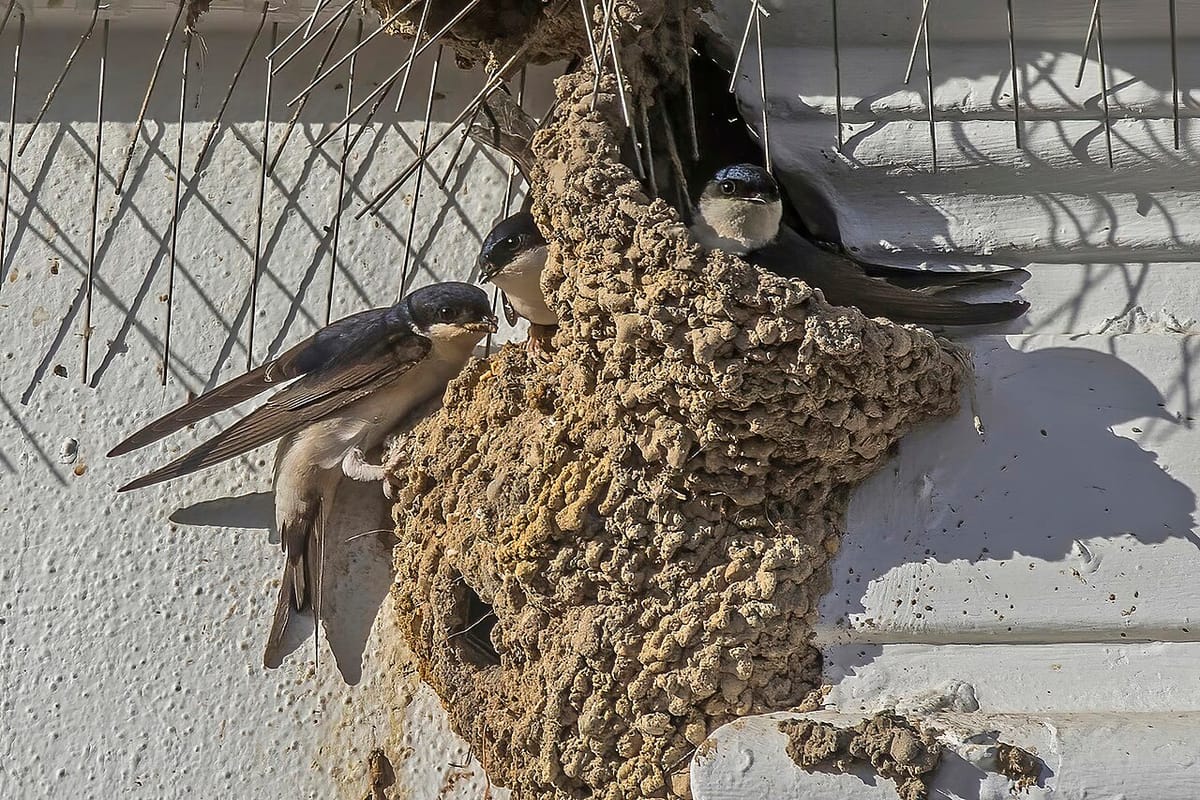
Portugal is fielding a rising number of requests to tear down swallow nests, and nowhere is the trend sharper than in the Algarve. Figures released by the Instituto da Conservação da Natureza e das Florestas (Institute for the Conservation of Nature and Forests, or ICNF) to the newspaper Público's environmental section show that formal applications to remove the nests rose from 348 in 2024 to 397 in 2025 — 49 more requests, a 14.1% increase. The authorisations actually granted grew faster still, from 309 to 371, up 20.1%.
What many homeowners may not realise is that these nests are protected by law. Portuguese legislation has shielded the nests of wild birds since 1999, and destroying, damaging or removing a nest or its eggs — even when it is empty — is prohibited. The law does allow exceptions in properly justified cases tied to public health, safety or building renovation, but those require a licence, and the ICNF stresses that authorised removals cannot coincide with the breeding season; they are generally scheduled outside the nesting period. Swallows are also covered by the Bern Convention, and destroying a nest outside the permitted circumstances can amount to a very serious environmental offence. Homeowners face the opposite duty with listed invasive species: our guide explains what Portugal's invasive species law requires you to remove.
The regional picture is uneven. The Algarve recorded by far the biggest jump: requests there climbed from 17 to 44, a rise of around 159%, while licences issued leapt from seven to 32 — an increase of 357%. Requests in the North more than doubled, from four to nine, and in Lisbon and the Tagus Valley they rose 43%, from 53 to 76. The Alentejo remained the region with the highest demand, with 200 requests and 200 licences in 2025, accounting on its own for more than half of all the authorisations granted nationwide. The Centro region bucked the trend as the only area where requests fell, dropping 25% from 91 to 68.
Enforcement runs alongside the permits. Between 2023 and 2025 the ICNF's regional directorates logged 29 formal infringement reports linked to swallow nests. The Centro region accounted for nine, all passed to the Comissão de Coordenação e Desenvolvimento Regional (Regional Coordination and Development Commission, or CCDR) because they fell outside protected areas; the Alentejo had eight, three of which became active cases; the Algarve opened seven, six still under investigation. A jurisdictional quirk explains the hand-offs: the ICNF can only investigate and penalise these offences when they occur inside protected areas or the parts of the Natura 2000 network that overlap them. Everywhere else, the CCDRs hold that power.
Behind the paperwork is a bird in trouble. Two species — the barn swallow (andorinha-das-chaminés) and the house martin (andorinha-dos-beirais) — have nested on Portuguese eaves, ledges and façades for decades, returning to the same spots year after year. But the barn swallow's numbers have fallen 40% in Portugal over the past two decades, according to the Common Bird Census coordinated by the Sociedade Portuguesa para o Estudo das Aves (Portuguese Society for the Study of Birds, or SPEA). The ICNF is keen to remind residents why the birds are worth tolerating: swallows devour large quantities of flying insects, including flies and mosquitoes, acting as a natural check on pests and on species that can spread disease. For anyone tempted to clear a nest from a balcony this summer, the message from the conservation authorities is simple — get a licence first, and wait until the chicks have flown. On the environmental licensing file, our report on the APA and ICNF restructuring reaching the Council of Ministers, with environmental impact assessment decisions moving to the centre and river basin directorates replacing the regional hydrographic administrations sets the latest reference. On the invasive insect the region is now racing to remove, our report on the twelve-month, EU-funded attempt to erase the Asian hornet from São Miguel before it does in the Azores what it has done across the north of the mainland since 2011 sets the latest reference.