Recreational Sea Fishing in Portugal in 2026 — A Practical Guide to the DGRM Licence, the €2-to-€70 Fee Table, the Three-Rod Nine-Hook Rule, the 10 kg Daily Limit and the Tail-Fin Cut You Must Make Before Leaving the Rocks
An annual shore licence costs €8; fishing without one costs €200 to €2,000. The four DGRM licence types, how foreign residents without a Portuguese bank card actually buy one, the three-rod nine-hook limit, the 10 kg daily cap, the species you must release on sight and the tail-fin cut nobody mentio
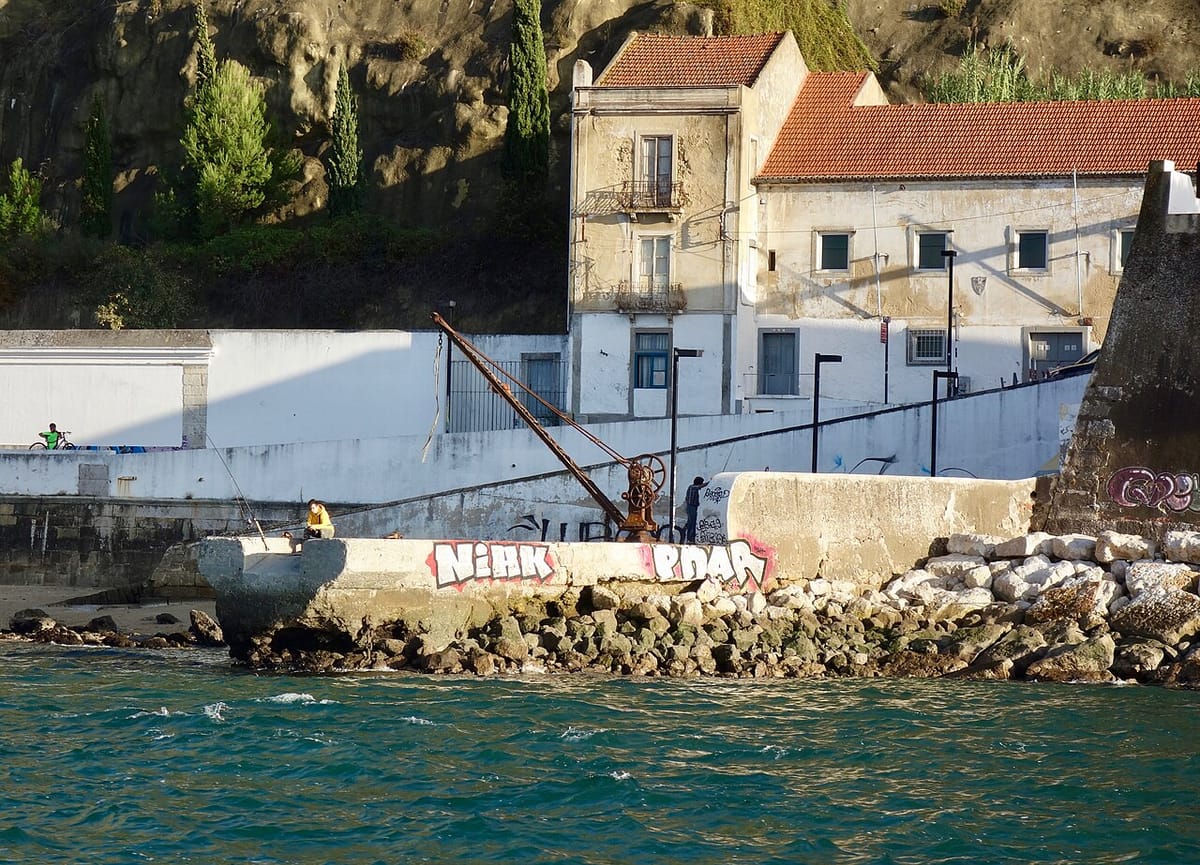
A rod, a bucket and a stretch of Atlantic rock is one of the cheapest pleasures Portugal offers. It is also licensed, and the rules are more specific than most newcomers expect: four licence types, a hard daily weight limit, a list of species you must throw back on sight, minimum distances from the next angler, and an obligation to cut the tail fin of every fish you keep before you leave the spot.
An annual shore licence costs €8. Fishing without one costs between €200 and €2,000. This guide covers the sea licence issued by the DGRM (Direção-Geral de Recursos Naturais, Segurança e Serviços Marítimos — Directorate-General for Natural Resources, Safety and Maritime Services) for mainland Portugal, which is what almost everyone fishing the coast, the estuaries and the tidal reaches needs.
Who needs a licence
Anyone practising pesca lúdica (recreational fishing) must hold one. There is one exception and one carve-out.
The exception is apanha lúdica — recreational gathering — which needs no licence at all, provided you use nothing but your hands. The moment you reach for a tool of any kind (a shellfish knife, a shrimp net, a gaff, a short-handled spade, a malhada or an arrelhada), you need a shore licence. Bags and buckets used purely to carry what you have gathered are always fine.
The carve-out is for children. Under-16s do not have to hold or produce a licence provided they are accompanied by someone who does.
Fishing without the licence you need is a contraordenação (administrative offence) carrying a fine of €200 to €2,000 for an individual, and €500 to €20,000 for a company, under article 14 of Decreto-Lei n.º 246/2000 as amended by Decreto-Lei n.º 101/2013.
The four licence types and what they cost
Portaria n.º 14/2014 of 23 January sets out four types, each valid across every capitania (port captaincy) on the mainland — there is no regional licence to worry about:
- Apeada — shore only, from dry land or isolated rock formations.
- Embarcada — line fishing from a boat. It includes the shore licence for the same period.
- Submarina — spearfishing only.
- Pesca lúdica geral — everything: shore, boat and spearfishing.
The fees, per person:
| Licence | Daily | Monthly | Annual |
|---|---|---|---|
| Apeada (shore) | €2 | €4 | €8 |
| Embarcada (boat) | €5 | €12 | €50 |
| Submarina (spearfishing) | €3 | €10 | €25 |
| Lúdica geral (all) | — | €20 | €70 |
The annual shore licence at €8 is the obvious buy for anyone who fishes more than four days a year. Note the asymmetry on the boat licence: at €50 a year against €12 a month, it only pays off from about five months of use.
There is no refund and no swap. If you buy the wrong type, the DGRM will not cancel it or return the money.
Buying one — the part that trips up foreign residents
This is where the process diverges depending on your paperwork.
Multibanco. The fastest route, available at any cash machine at any hour, but only for holders of a Portuguese Multibanco card. Insert the card, then Pagamentos → Pagamentos ao Estado → Licença de Pesca Lúdica → Pesca Águas Marítimas e Salobras, and follow the prompts. You need the civil identification number (Cartão de Cidadão or Bilhete de Identidade) of the person the licence is for — which means you can buy one for someone else if you have their number.
Over the counter. Open to Portuguese and foreign citizens alike, with a valid ID document (Cartão de Cidadão, passport or equivalent) and payment of the fee. The DGRM's head office is on Avenida Brasília in Lisbon, and the regional agriculture and fisheries directorates (DRAP) issue licences too — Leça da Palmeira for the north, Ílhavo and Gafanha da Nazaré for the centre, Setúbal for Lisbon and the Tagus valley, and Faro, Tavira, Portimão and Olhão in the Algarve.
Online through BMar. The Balcão Electrónico do Mar (Electronic Sea Desk) at bmar.pt is the route for non-resident nationals and foreign citizens paying by bank transfer. Allow a minimum of five working days for a standard request, or three for an urgent one — urgent processing doubles the fee. Plan around that if you are arriving for a fishing week.
On a charter. If you hold only a shore licence and want to spend a day on a registered maritime-tourism boat, you need a daily boat licence (€5). It is issued by the DGRM and handed to you locally by the company operating the vessel.
There is no paper licence
Since January 2015 the licence has been fully dematerialised. It exists as a record in the DGRM's database, which inspectors query on the spot. You do not need to carry anything.
Two consequences follow. First, if you registered a mobile number with the licence, you can pull up your own details — licence number, the civil ID it is attached to, the type and the expiry — by texting UPLUD to 925507447 from that phone.
Second, and this matters: the licence is only valid if the civil identification number on it is correct. Inspectors search the database by that number. Mistype it at the cash machine and, as far as any check is concerned, you do not have a licence. If it happens, write to the DGRM's Director-General — by post or to [email protected] — explaining the situation, with a scan of the payment receipt, your ID number and, if relevant, the phone number, and ask for the record to be corrected.
Where this licence does and does not work
The DGRM licence covers ocean waters, maritime interior waters and non-maritime interior waters under the maritime authority's jurisdiction, across all mainland port captaincies.
It does not cover inland waters managed by the ICNF (Instituto da Conservação da Natureza e das Florestas — Institute for Nature Conservation and Forests), which issues its own annual, calendar-year licence for rivers and reservoirs. The DGRM is explicit about the best-known boundary: on the Douro, everything upstream of the Crestuma dam — including the run to Barca de Alva — needs the ICNF licence, not this one, even though the stretch falls within the Douro captaincy's area. The under-16 exemption applies there too, again only when accompanied by a licence holder.
The Azores and Madeira run their own regional recreational fishing regimes.
Gear: three lines, nine hooks
The headline limit applies to every licence holder: up to three lines or rods, and up to nine hooks in total.
From shore you may use a hand line, a rod, a toneira (squid jig) and trolling (corrico or corripo), plus support equipment. The malhada and the hand tools listed above are shore-licence gear. From a boat: hand line, rod, toneira and trolling.
Spearfishers may carry a speargun, a shellfish knife, a gaff and an arrelhada.
Reels are unrestricted — no limit on the type of reel or rod, electric reels included. Landing nets, keep-nets that hold fish alive for release, and the cliff baskets used to haul fish up the rock face are all permitted, because none of them catches anything by itself.
Natural and artificial baits are allowed, but not fish roe and not anything that could cause environmental damage — poisonous or toxic substances and explosives are out. Groundbait is fine from shore and boat, and prohibited in spearfishing. Electric fishing — running a current through the water to drive fish to a collection point — is banned outright.
Lights may only be used with a toneira, or as buoy markers. Using a light to attract fish with any other gear is a €100–€1,000 offence for an individual. Spearfishers may carry a torch for safety; the ban is on using it to attract fish.
Spearfishing: breath-hold only
Spearfishing in Portugal must be done in apneia — on a held breath. Breathing apparatus is not permitted, and a speargun and breathing equipment may not even be carried aboard the same boat at the same time while recreational fishing is under way.
A support boat assisting spearfishers must fly the Alfa flag of the international code of signals in a visible position. Any vessel must stay at least 50 m from a floating spearfishing marker or from a boat flying the Alfa flag. Spearfishers must keep 20 m from one another unless they agree otherwise.
Distances and no-go areas
From shore, keep 5 m from the next angler — recreational or professional — who was there first, unless they agree otherwise. From a boat, keep 50 m from other vessels, from spearfishers and from set gear, including its marker buoys, which count as part of the gear.
Recreational fishing is prohibited:
- Within the delimited areas of shipyards and aquaculture installations (the latter unless the operator formally authorises it), and within 100 m of a harbour of refuge, a dock, a shipyard or an aquaculture establishment — measured on land or in the water.
- Within 100 m of a sewage outfall, where it is properly marked, active or not.
- In the water associated with beach concessions, under the terms of the applicable coastal management plans. Fishing closer than the legal distance to a concessioned beach during the bathing season carries the higher fine band, €200–€2,000 for an individual.
- From a boat, in port bars and river mouths, in access channels, approach channels, narrow channels within ports, and in buoyed channels.
Shore fishing from a breakwater at a port bar is allowed in principle, but the maritime authority can restrict or condition it by edital (public notice) where sea conditions or the time of year make it dangerous. Check with the local capitania before committing to a specific mark.
Life jackets or personal flotation aids are compulsory for everyone aboard a boat engaged in recreational fishing. Only anglers actively fishing in ocean or maritime interior waters are fined for not wearing one, but the obligation covers all on board. From shore there is currently no such requirement — the law allows one to be imposed in designated risk areas, and none has been.
Protected areas have their own calendar
Boat fishing inside the marine areas of the Parque Natural do Sudoeste Alentejano e Costa Vicentina, the Parque Natural da Arrábida, the Parque Natural do Litoral Norte and the Reserva Natural das Berlengas is permitted only from Thursday to Monday and on public holidays. That restriction does not apply between 1 June and 30 September, and does not apply to maritime-tourism vessels at all.
Shore fishing in the Costa Vicentina park follows the professional closed seasons: sargos (white and common two-banded seabream) are closed from 1 February to 15 March, and bodião (ballan wrasse) from 1 March to 31 May.
The daily limit — 10 kg, and stop
This is the rule most often broken and most easily proved. Per person, per day:
- 10 kg of fish and cephalopods in total, not counting the single heaviest specimen. For spearfishing the figure is 15 kg, again excluding the largest fish.
- 2 kg of marine organisms other than fish and cephalopods.
- On top of that 2 kg: 3 kg of mussels (Mytilus spp.), 5 kg of oysters (Crassostrea spp.) and 5 kg of Japanese clam (Ruditapes philippinarum).
- 0.5 litres of worms and similar annelids, cocoons not counted. Scraping them off rock surfaces is prohibited.
- Where more than three anglers are fishing from the same recreational boat, the boat total may not exceed 25 kg, excluding one largest specimen per angler. This cap does not apply to spearfishing or to pesca turística.
Once you reach the limit you must stop fishing — it is not a take-home cap you can keep fishing past by releasing. And it does not accumulate: two days on the rocks does not entitle you to 20 kg in one haul. The exception is registered sporting competitions, where specimens must be kept alive and returned to the water.
The tail-fin cut
The rule that surprises most new licence holders: every specimen you keep must be marked with a cut in the caudal (tail) fin, in the pattern shown in the annex to the portaria, before you leave the fishing spot if you are fishing from shore, or before landing if you are on a boat. Spearfishing is exempt.
The point is to make recreationally caught fish visually distinguishable from commercial catch, so it cannot quietly enter the trade. In the same spirit, the catch may only be transported by the person who caught it.
Size limits and species you must release
Minimum sizes are the same as for commercial fishing. Anything undersized must go back in the water immediately, even if it is already dead. Where no minimum size is set for a species, any specimen may be kept. Measurement follows EU and national rules, including Portaria n.º 27/2001. Sporting competitions are treated differently.
You also may not target species during the closed seasons or in the areas where commercial fishing is suspended for biological reasons, nor species banned from commercial fishing — the DGRM publishes the current position on its site.
A separate list of species may never be caught or kept in any form of recreational fishing, and must be released immediately if hooked accidentally. It includes:
- Rays and sharks: undulate ray, white skate, bluntnose sixgill shark, great white shark, basking shark, silky shark, oceanic whitetip, porbeagle, bigeye thresher and spurdog.
- Other fish: ocean sunfish, European eel, groupers (Epinephelus), lamprey, salmon, allis shad and twaite shad. Bluefin tuna is prohibited except under a specific annual DGRM authorisation for registered tourist-fishing vessels, capped nationally at 500 kg a year and a minimum size of 125 cm.
- Invertebrates: spiny lobsters (Palinurus), European lobster and the flat oyster.
- Protected wildlife: all seabirds, all seahorses and pipefish, all corals, all marine mammals and all sea turtles.
Certain large specimens are classed as troféus de pesca (fishing trophies) with their own minimum dimensions and a per-boat, per-day landing cap.
Boats: recreation or maritime tourism only
You may fish only from a boat registered for recreation or operating as a maritime-tourism vessel. Chartering a commercial fishing boat for a weekend with friends is not allowed. The only route around it is a sporting competition, where the port captain may authorise the use of fishing vessels — and only in ocean or maritime interior waters, only if the absence of alternatives is properly justified, and only on a request filed at least 30 working days in advance. A fishing boat authorised to support a competition may not fish commercially during it or keep non-recreational gear on board.
Maritime-tourism companies and their staff are also barred from keeping or selling any specimen caught during pesca turística. What the clients catch is the clients'.
What the fines look like
Two bands run through the regime, for individuals:
- €100 to €1,000 — keeping, transporting or landing undersized specimens; fishing inside the prohibited distances or in banned areas; fishing closer than 5 m to another angler or 50 m to another boat without agreement; using lights to attract fish outside the permitted case.
- €200 to €2,000 — fishing without a licence; using a boat without the right registration or authorisation; carrying non-recreational gear aboard during a competition; fishing too close to a concessioned beach during the bathing season.
Companies pay €250–€10,000 and €500–€20,000 respectively.
The short version
- Buy the annual apeada licence for €8 if you fish from shore — four days of daily licences already costs the same.
- Portuguese card at a Multibanco: two minutes. No Portuguese card: BMar online with five working days' notice, or a DGRM/DRAP counter with your passport.
- Get your civil ID number right. A typo makes the licence unfindable at inspection.
- Three rods, nine hooks, 5 m from your neighbour, 100 m from outfalls and harbour structures.
- 10 kg a day, largest fish excluded, then stop. Cut the tail fin before you leave the rocks.
- Check the local capitania's editais before fishing an unfamiliar breakwater, and the park rules before a boat trip into Arrábida, the Berlengas, the Litoral Norte or the Costa Vicentina.
- Above the Crestuma dam on the Douro, and on rivers and reservoirs generally, you need the ICNF licence instead.
The rules are set by Decreto-Lei n.º 246/2000 as amended and republished by Decreto-Lei n.º 101/2013 of 25 July, and by Portaria n.º 14/2014 of 23 January. The DGRM maintains a detailed FAQ, last updated in March 2026, which is where most of the edge cases in this guide are answered.
If your interest in the water runs commercial rather than recreational, our coverage of Portugal's 2026 fishing year tracks where the fleet is winning and losing. For another permit regime that catches out newcomers in much the same way, see our guide to flying a drone in Portugal.