Going to the Beach in Portugal
When lifeguards are on duty, what each beach flag means, which beaches allow dogs, the fines, and how to check water quality before you swim.
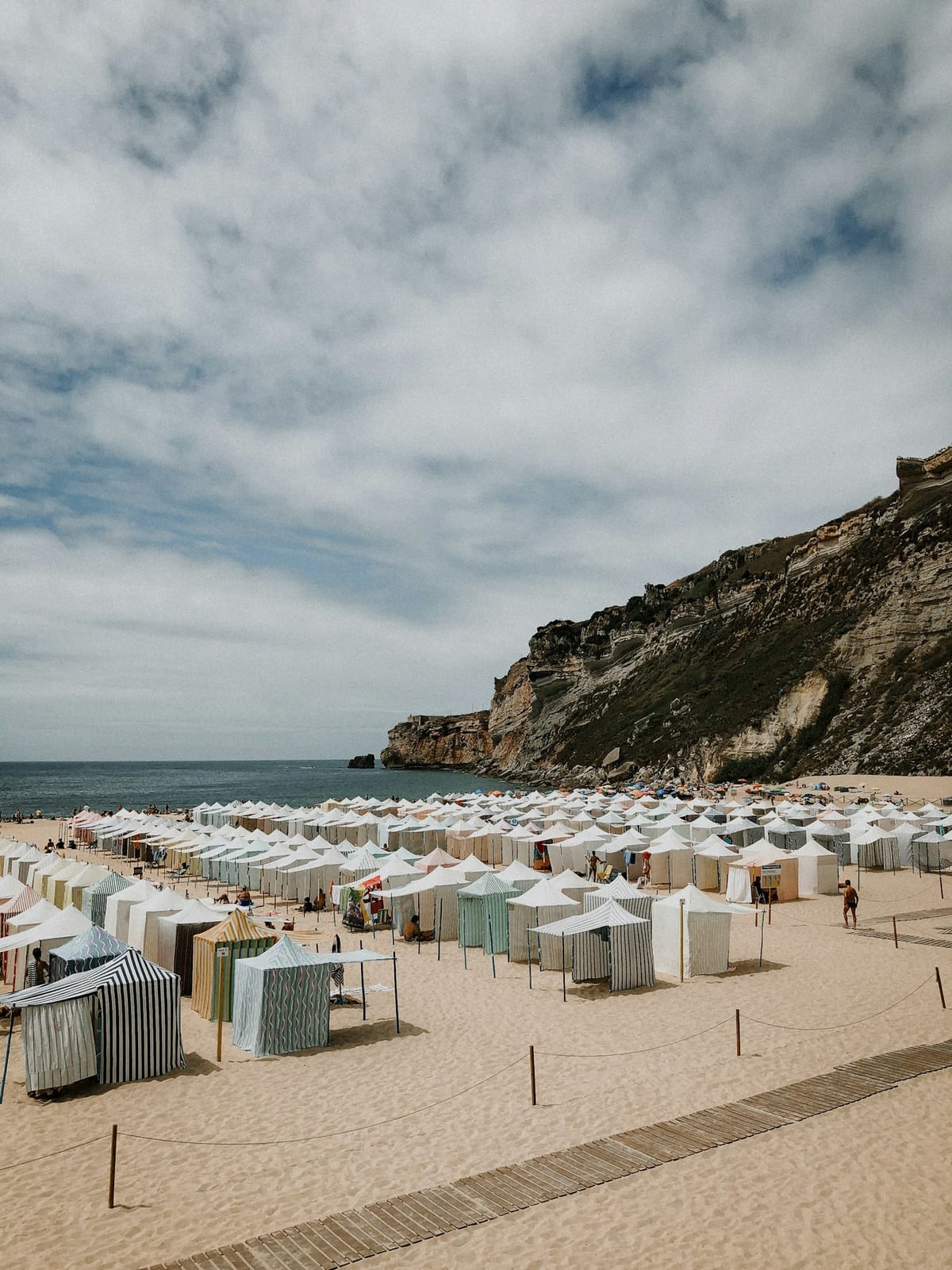
Last verified: September 2026.
Who this is for
- Residents and new arrivals, EU or non-EU, planning beach days on the mainland, the Azores, or Madeira.
- Swimmers, parents, and dog owners who want the flag rules, lifeguard hours, and fines.
- People with reduced mobility looking for beaches with ramps, adapted toilets, and amphibious chairs.
Not for you if: you want surf lessons, surf spots, and wetsuit advice. Read "Surfing in Portugal" instead.
Updated September 2026. Season dates, flags, and fines now follow the 2026 official lists, and most lifeguard seasons have already ended.
Every beach in Portugal is free to use. You pay only for sunbeds, parasols, and food. The rules that matter are simple. Lifeguards work only during each beach's official bathing season, which is set every year and differs from beach to beach. A red flag means you may not enter the water, and a yellow flag means you may paddle but not swim. Ignoring a flag or a lifeguard can cost €55 to €550. Dogs are banned from most staffed beaches during the season.
When lifeguards are on duty
Each beach has its own bathing season (época balnear). The government sets the dates every spring, beach by beach. Outside those dates nobody is watching the water, even on a hot day.
In 2026 the main patterns on the mainland are:
- Cascais coast: 1 May to 30 September.
- Albufeira: 15 May to 15 October.
- Lagos, Loulé, Tavira, and Costa da Caparica: 1 June to 30 September.
- Sintra coast: 30 May to 13 September.
- Porto and Matosinhos: 13 June to 13 September.
- Nazaré: mostly 1 July to 31 August.
The islands follow their own dates. Porto Moniz in Madeira runs from 15 April to 15 October, and parts of Porto Santo to 31 October. Most Azores beaches run from June to late September or early October. No beach in Portugal has lifeguards all year.
During the season, lifeguards work every day, usually from 9:00 to 19:00. Between 11:30 and 13:30 they take lunch in turns, so fewer are on the sand. The beach notice (edital de praia) at the entrance or the lifeguard post shows the exact hours for that beach.
A beach with a named lifeguard service is called a "praia de banhos". Some listed bathing areas have no lifeguard at all, even in season. If you see no tower and no flag, assume you are on your own.
What the beach flags mean
The lifeguard raises a flag on a pole at the lifeguard post. The national beach notice defines five:
| Flag | What it means for you |
|---|---|
| Green | You may bathe and swim. |
| Yellow | Take care. You may go in, but swimming is forbidden. Stay where your feet touch the bottom. |
| Red | Danger. You may not enter the water at all. |
| Chequered (black and white) | The beach is temporarily without a lifeguard. |
| Striped | Marks the safest zone for bathing. |
The flag is a rule, not advice. The Maritime Police and other police forces enforce it, and a lifeguard's instructions carry the same weight.
Some beaches also fly a purple flag to warn of jellyfish or Portuguese man o' war. It is not one of the five official flags. Treat it as a strong warning and ask the lifeguard.
The Blue Flag you see at many beaches is different. It is an environmental award, not a safety signal. It tells you nothing about today's sea.
Blue Flag and accessible beaches
In 2026, 396 Portuguese beaches won a Blue Flag (Bandeira Azul). The award also went to 21 marinas and 21 tourist boats. The Portuguese Blue Flag association runs it each year for the international Foundation for Environmental Education.
A Blue Flag beach has to meet standards for water quality, environmental management, safety, and services. In practice that means lifeguards in season, toilets, and clear information boards. It is a useful first filter when you do not know a stretch of coast.
The "Praia Acessível, Praia para Todos" (Accessible Beach, Beach for All) programme recognised 239 beaches in 2026. An accessible beach must have:
- reserved parking;
- a step-free route from the car park to the sand;
- adapted toilets.
Many also lend amphibious chairs (cadeira anfíbia) and walkers that work on sand, with staff to help. The yearly list is on the website of the Institute for the Rights of Persons with Disabilities (IDiPD), which replaced the former National Rehabilitation Institute. Your council's beach page usually says which local beaches have chairs and when to book.
How to check the water before you swim
The Portuguese Environment Agency (APA) monitors every official bathing area during the season. In 2026 it listed 523 bathing areas on the mainland: 364 on the coast or in estuaries and 159 inland. Across the mainland and islands there are 671.
Each area gets a yearly rating: excellent, good, sufficient, or poor. The vast majority of coastal sites rate excellent.
During the season, APA can advise against bathing or a health authority can ban it. In June 2026, 95.4% of mainland sites had no restriction at all. The problems were mostly bacteria at river beaches after heavy rain, plus a few safety closures. For example, APA advised against bathing at Praia do Camilo in Lagos as a precaution because its access stairs were unstable.
To check a beach:
- Look at the notice board at the beach entrance. Restrictions must be posted there.
- Check APA's "Época balnear" page or its Info Água map before you leave home.
- After heavy rain, give urban and river beaches a day or two.
Storms early in 2026 affected some beaches. APA publishes notices on any site where conditions were still affected at the start of the season.
Staying safe in the Atlantic
The Atlantic is colder and rougher than the Mediterranean. Summer sea temperatures run roughly:
- North coast (Porto, Viana do Castelo): 14 to 17°C.
- Centre and west (Peniche, Nazaré, Ericeira): 15 to 18°C.
- Lisbon coast: 16 to 19°C.
- Alentejo coast: 17 to 20°C.
- Algarve south coast: 19 to 23°C.
- Madeira and the Azores: about 17 to 23°C.
The south-facing Algarve is sheltered from the north wind (nortada) and is the warmest. Elsewhere most people swim for a short time.
The main hazards are:
- Rip currents. They are common on open west-coast beaches. If one pulls you out, do not swim against it. Swim parallel to the shore until the pull stops, then swim back at an angle. If you cannot, float and raise an arm.
- Shore break. Waves can dump hard on the sand, even on calm-looking days.
- Rocks. Many Algarve coves have submerged rocks and sea urchins near the cliffs. Reef shoes help.
- Falling cliffs. Stay out of marked zones under and on top of cliffs. They are closed for a reason.
- Sun. The UV index in summer often reaches 8 to 10. Use high-factor sunscreen and reapply it often.
In an emergency, call 112. Tell the operator the beach name and the nearest lifeguard post or car park. Before a trip in rough weather, check the IPMA (the weather service) warnings for sea conditions.
Dogs on the beach
For dog owners, the national beach notice bans animals from bathing areas during the season, except in zones where the council allows them. Trained and certified assistance dogs are always allowed.
How it works in practice depends on the council:
- Cascais bans animals from all its beaches from 1 May to 30 September, day and night. The fine is €55 to €550.
- Outside the season, most councils allow dogs on a lead or harness, with waste picked up.
- Some councils name specific dog-friendly beaches, even in summer.
Check the sign at the beach entrance and your council's website before you go.
What you cannot do, and the fines
The national beach notice lists what is banned on staffed beaches. You may not:
- swim against a flag or ignore a lifeguard's instructions;
- enter closed or danger zones, or climb over barriers;
- light a fire or barbecue;
- camp or sleep on the beach overnight;
- play ball games outside marked areas;
- fish for leisure in the bathing area between sunrise and sunset;
- surf, kitesurf, or windsurf in the swimming area;
- play loud music;
- take rocks, sand, plants, or animals;
- drive or park a vehicle on the sand, dunes, or cliffs;
- leave rubbish or glass outside the bins.
The fines for individuals are:
| What you did | Fine |
|---|---|
| Entering a closed zone or crossing a barrier | €30 to €100 |
| Ignoring a flag, sign, or lifeguard | €55 to €550 |
| Breaking the rules for boats, jet skis, or other water sports | €55 to €550 |
| Damaging or moving signs or barriers | €250 to €1,000 |
| Driving or parking on the beach, dunes, or cliffs | €250 to €2,500 |
| Dropping a cigarette end on the ground | €25 to €250 |
Topless sunbathing is legal and common, especially in the Algarve and around Lisbon. Full nudity is allowed only on designated naturist beaches.
Where to go
Algarve. The warmest water and the longest season. The cliff coves near Lagos and Carvoeiro, such as Praia da Marinha and Praia do Camilo, are the famous ones. The sandbar islands off Tavira and Faro have long, gentler beaches. Buses and the Algarve train line connect the main towns, but a car is easier for the coves.
Costa Vicentina (west Algarve and Alentejo). Wild, cold, and uncrowded. Arrifana, Amado, Bordeira, and Castelejo are surf beaches with fewer lifeguards.
Lisbon coast. The Cascais train from Cais do Sodré stops beside Carcavelos, Estoril, and Cascais beaches. Guincho and the Sintra coast (Praia Grande, Praia das Maçãs, Adraga, Ursa) are wilder, with strong currents. For Costa da Caparica, take the ferry from Cais do Sodré to Cacilhas and then a bus, or drive.
Arrábida and Comporta. Calm, clear water in the Arrábida bays south of Setúbal, and long quiet beaches around Comporta and Tróia. Parking in Arrábida is limited in summer.
Silver Coast (Setúbal to Aveiro). Nazaré, Peniche, Figueira da Foz, Mira, and Costa Nova. Cooler water and strong currents.
Green Coast (Porto to Caminha). The Porto metro reaches Matosinhos beach. Espinho, Esposende, and Moledo are further out. Expect water around 15°C.
River beaches. The mainland has 159 official inland bathing areas, mostly river and lake beaches (praias fluviais), many with lifeguards and some with a Blue Flag. Inland water is often warmer than the sea in summer. Serra da Estrela, the Gerês, and the Alentejo lakes are good places to look.
Madeira and the Azores. Mostly rock and black sand, with natural rock pools such as Porto Moniz. Porto Santo has the islands' one long golden beach.
What it costs
- Beach access: free everywhere.
- Sunbeds and a parasol: usually €10 to €20 a day for two, more at popular Algarve and Comporta beaches.
- Parking: free at many beaches, paid at busy ones in summer. Arrive before 10:00 in July and August.
- Showers and toilets: usually free at staffed beaches; some concessions charge.
Sources
- Diário da República, Portaria n.º 204-A/2026/1 of 30 April 2026: https://files.diariodarepublica.pt/1s/2026/04/08401/0000200039.pdf (2026 bathing areas and season dates for every beach; national concession period of 15 April to 31 October; note on storm-affected beaches)
- Autoridade Marítima Nacional, Edital de Praia template for the mainland and Madeira (printed February 2026): https://www.amn.pt/Documents/Editais%20Praia/Edital%20de%20Praia%20-%20Continente%20e%20Madeira%20-%20Lingua%20portuguesa.pdf (flag meanings, banned activities, fines under Decreto-Lei n.º 159/2012 and Decreto-Lei n.º 96-A/2006)
- Autoridade Marítima Nacional, Capitania do Porto de Cascais, Ofício Circular n.º 176/2026, Época Balnear 2026: https://www.amn.pt/DGAM/Capitanias/Cascais/Lists/Documentos_AMN/Oficio%20Circular%20Epoca%20Balnear%202026_signed.pdf (lifeguard hours 09:00 to 19:00, lunch period, lifeguard staffing; Lei n.º 44/2004 and Lei n.º 68/2014)
- ABAAE, Bandeira Azul 2026: https://bandeiraazul.abaae.pt/our_news/bandeira-azul-2026/ (396 beaches, 21 marinas, 21 boats)
- Agência Portuguesa do Ambiente, Época balnear 2026: https://apambiente.pt/apa/epoca-balnear-2026 (bathing water information and Info Água)
- Agência Portuguesa do Ambiente, Época Balnear 2026 ponto de situação em junho: https://apambiente.pt/sites/default/files/_A_APA/Comunicacao/Epoca_balnear/comunicado_junho2026_qualidadeab.pdf (523 mainland bathing areas, June restrictions; classification under Decreto-Lei n.º 135/2009 and Directive 2006/7/EC)
- IDiPD, Programa Praia Acessível, Praia para Todos: https://idipd.mtsss.gov.pt/programa-praia-acessivel (239 beaches in 2026, requirements, 671 bathing areas)
- Câmara Municipal de Cascais, Permanência de animais nas praias: https://www.cascais.pt/permanencia-de-animais-nas-praias (dog ban dates and fine)
- Diário de Notícias, cigarette-end fines: https://www.dn.pt/pais/atirar-beatas-de-cigarros-para-o-chao-custa-passa-a-custar-entre-25-e-250-euros-de-multa-12602479.html (€25 to €250 under Lei n.º 88/2019)
- IPMA, Instituto Português do Mar e da Atmosfera: https://www.ipma.pt (sea state warnings and sea temperatures)
Last verified September 2026. Rules and fees change; check the official source before acting.