Portugal's New-Car Market Outpaces the EU, With Electrified Models at Nearly Seven in Ten Sales
ACEA data show 137,080 new cars registered in Portugal in H1 2026, up 10.5% against the EU's 5.7%. Battery-electric models took a 25.3% share — above the EU's 20.7% — while diesel collapsed to 3.7%. Some 68% of new Portuguese cars now carry an electric motor.
Portugal's new-car market is growing at nearly twice the pace of the European Union's — and electrifying faster, too. Figures released Thursday by ACEA, the European Automobile Manufacturers' Association, show 137,080 new cars registered in Portugal in the first half of 2026, up 10.5% on a year earlier. Across the EU, registrations rose 5.7% to 5.9 million.
June alone brought 26,349 Portuguese registrations, 13.7% more than in June 2025, closely tracking the EU's strong 13.6% month.
A quarter of new Portuguese cars are now fully electric
The composition of those sales tells the sharper story. Portuguese buyers took 34,706 battery-electric cars in the six months to June — up 38.7% year on year — giving fully electric models a 25.3% share of the national market, comfortably above the EU average of 20.7%. In June the surge steepened: 7,572 battery-electric registrations, 63.1% more than a year earlier, almost exactly matching the EU-wide June jump of 60.7%.
Add plug-in hybrids (19,631 units, up 22.7%) and conventional hybrids (38,929, up 30.8%) and some 68% of the new cars sold in Portugal this year carry an electric motor of some description. Plug-in models alone — battery-electric plus plug-in hybrid — account for just under 40% of Portuguese registrations, against roughly 30% across the EU.
The combustion collapse
The mirror image is a steep retreat of pure combustion. Petrol registrations in Portugal fell 15.8% in the first half, to 30,311 units and a 22.1% share. Diesel — once the default choice on Portuguese forecourts — sank 26.8% to just 5,004 cars, a 3.7% share that now trails the EU average of 7.5%. Petrol and diesel together account for barely a quarter of the Portuguese market; in the EU as a whole they hold 29.7%, down from 37.8% a year ago.
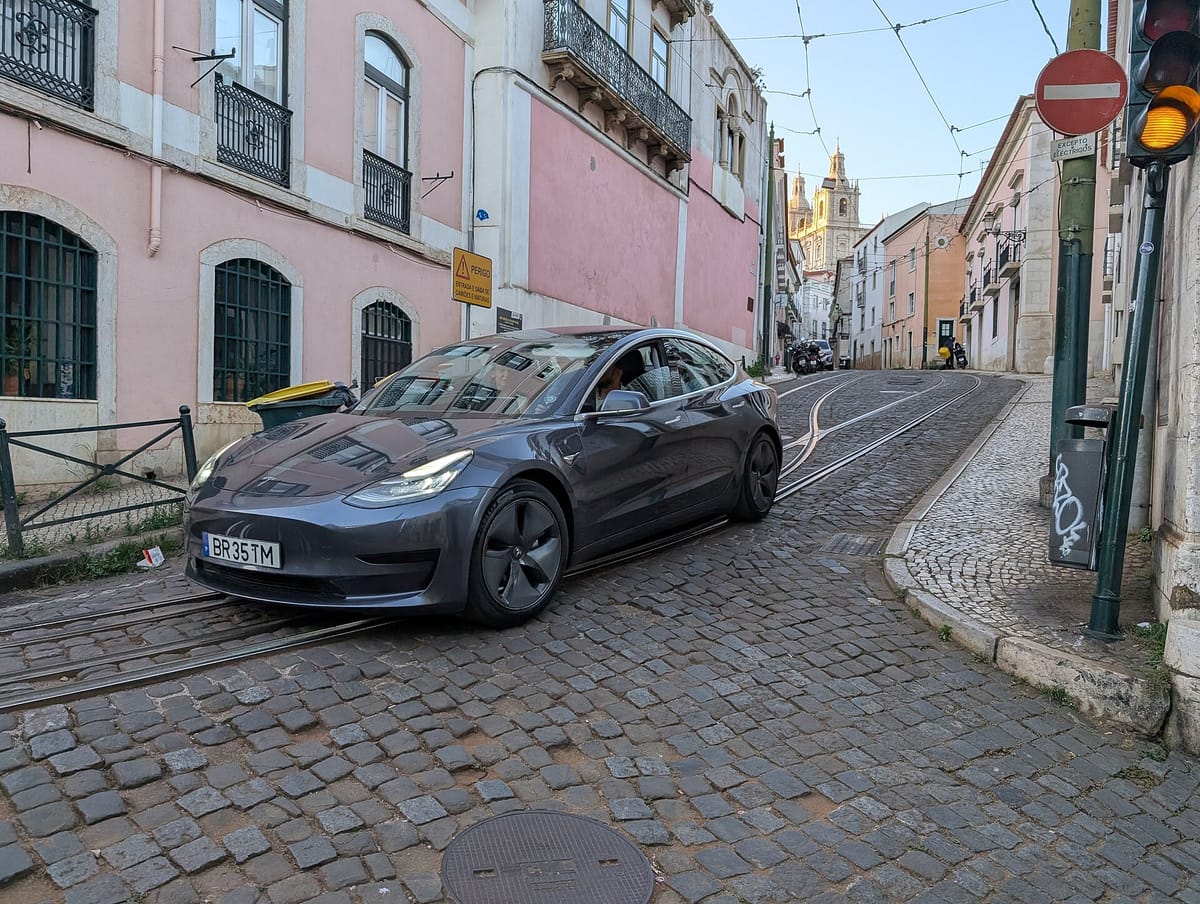
ACEA credits the EU-wide shift to robust demand for electrified technologies "driven primarily by market support measures," against a backdrop of what it calls persistent geopolitical headwinds. In Portugal the pattern shows in the badge-level data as well: June was the first month in which an electric car — the Tesla Model 3 — led the national sales table outright.
Why Portugal is ahead
Several forces push the Portuguese market up the electrification league. Company-car taxation and registration tax (ISV) rules penalise high-emission vehicles; urban buyers face expanding low-emission-zone restrictions in Lisbon and Porto; and the public charging network operated under the MOBI.E system has spread far beyond the big cities. A growing used-EV import trade has also dragged down entry prices.
The half-year numbers leave Portugal in an unusual position: a small market by EU standards behaving like one of the bloc's electrification leaders — closer to the Nordic pattern than to its Iberian neighbour. Spain's market grew 6.2% in the same period, with battery-electric cars at roughly one in ten registrations, less than half Portugal's share.