A Sintra Antenna Farm and Its 'Metal Sunflowers' Chase a Role in Europe's IRIS² Satellite Network
At Alfouvar, near Sintra, a MEO teleport of more than 60 antennas is bidding to join IRIS² — the EU's €10.6 billion secure-satellite constellation, conceived as a sovereign answer to Starlink. If chosen, MEO would add up to 25 new dishes, with certification due by the end of the year.
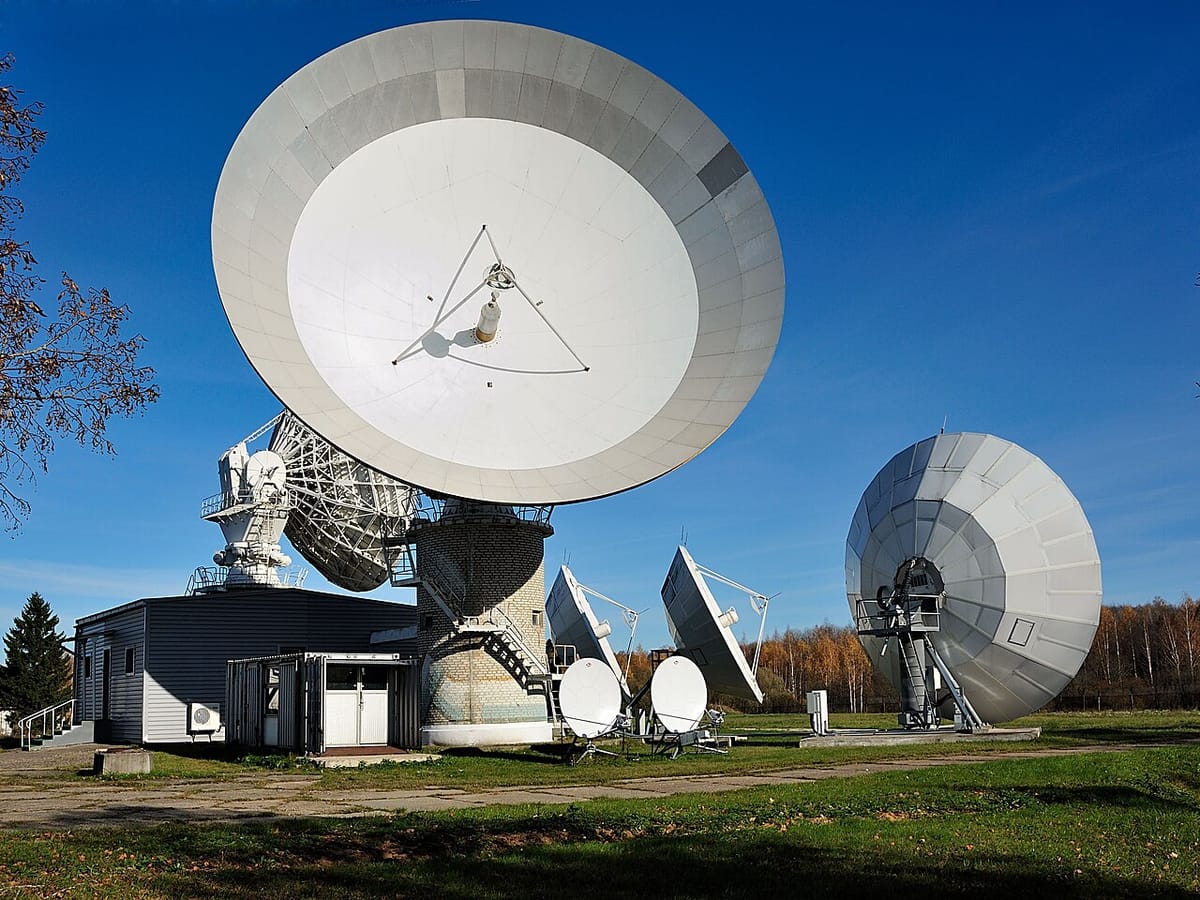
On a quiet stretch of countryside at Alfouvar, in the municipality of Sintra about 35 kilometres from Lisbon, dozens of white parabolic antennas tilt in unison toward the sky like a field of metal sunflowers. The teleport has spent decades relaying long-distance calls, beaming RTP Internacional to Portuguese emigrants and filling in coverage where fibre does not reach. Now, as ECO reported in a weekend feature, the same site is angling for a role in one of the European Union's most ambitious space projects — its own secure satellite network, conceived as a sovereign answer to Elon Musk's Starlink.
The station is run by MEO, the telecoms arm of Altice Portugal, and it is substantial: more than 60 clusters of antennas spread across roughly 12 hectares, worked by a team of about 20 people, according to ECO. Its lineage runs deep — the inactive "Sintra 1" dish measures 32 metres across, while the modern gateway dishes are a more modest 9 to 12 metres. Solar panels now cover between half and 60% of the site's energy needs, and it kept running through the national blackout that darkened much of the country earlier this year.
What MEO is chasing is a slot in IRIS² — the Infrastructure for Resilience, Interconnectivity and Security by Satellite, the EU's planned constellation for secure connectivity and, after Galileo (satellite navigation) and Copernicus (Earth observation), the bloc's third flagship space programme. The European Space Agency puts the total bill at €10.6 billion, split between about €6.5 billion of public money and more than €4 billion from private partners. The network is being built and run by SpaceRISE, a consortium led by the operators SES, Eutelsat and Hispasat under a 12-year concession from the European Commission, with a first launch slated for 2029 and full service targeted around 2030.
The design has grown as it has advanced. The ESA's original contract envisaged roughly 300 satellites in low and medium Earth orbit; more recent reporting around the programme, cited by ECO, points to an expanded fleet of some 348 spacecraft after additional units were approved in early August. Either way, the purpose is the same: to give European governments, armed forces and emergency services communications they control themselves, rather than depending on American commercial networks — with commercial maritime, aviation and connected-device services layered on top.
Portugal wants a piece of the ground segment, the earthbound web of stations that talk to the satellites. As we reported in late July, two national sites are in the running: MEO's Alfouvar teleport, and a station on the Azorean island of Santa Maria operated by the French group Thales. The ECO feature is the first close look inside Alfouvar itself. If its candidacy succeeds, MEO has proposed adding between 12 and 25 new antennas to the field, with certification expected to be completed by the end of this year.
Precise figures on Portugal's investment, and the final allocation of stations, have not been published, and most of the Alfouvar detail rests on that single ECO account. But the ambition on show is clear enough. For a country that has spent recent years trying to build a space sector almost from scratch — landing a British satellite firm in Porto, wiring Iberian constellations together, chasing what officials like to call a €3 billion market — a working teleport already pointed at the right orbits is a rare head start.
The stakes are more than industrial. IRIS² is the EU's bet that connectivity itself is now a matter of security, not just commerce: a resilient, encrypted network that stays up when undersea cables are cut or when a rival controls the alternative. Whether the antennas at Alfouvar end up carrying part of that traffic will be decided in the coming months. For the crews who keep the metal sunflowers turning, it is a chance to move from relaying television for the diaspora to underpinning the continent's next line of secure communications.