No Appeal Beyond the First Court for Drivers Who Lose Their Licence Under the Points System, the Constitutional Court Confirms for a Third Time
Ruling 775/2026 upholds the rule that a driver whose licence is cancelled after losing every point gets one court challenge and no appeal, even though the prosecutor backed the driver. What it means, and how the points system leads to a two-year wait for a new licence.
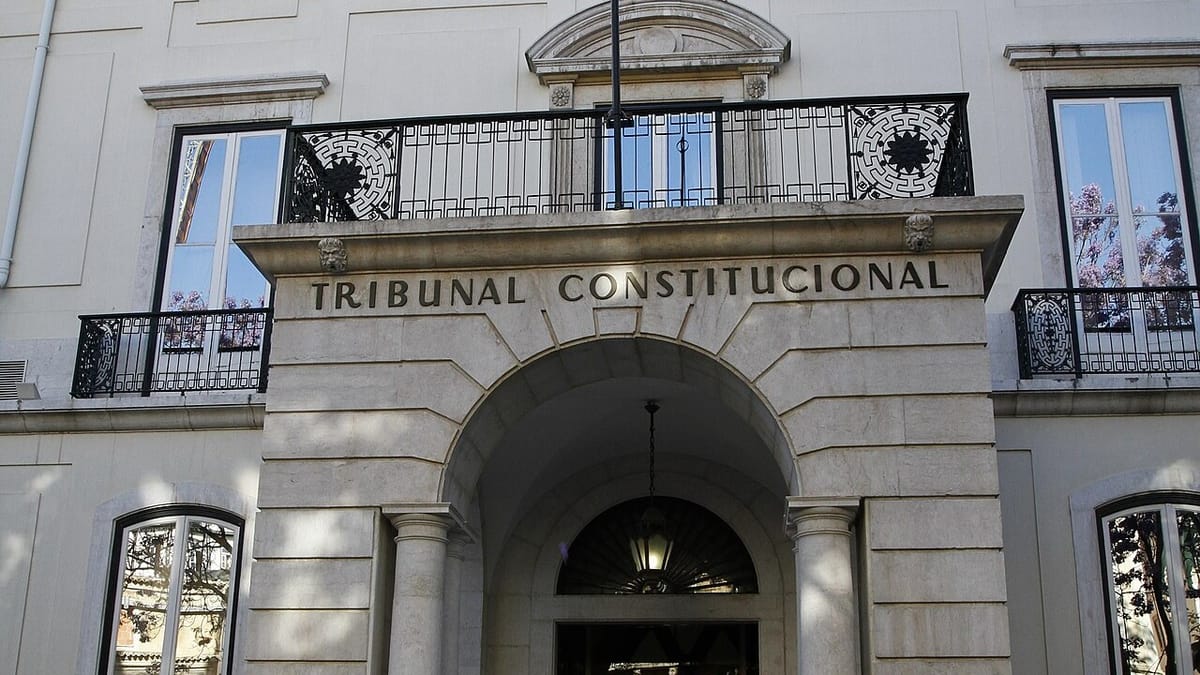
A driver who loses every point on their licence in Portugal can take the cancellation to court once, and that first court's ruling is final. The Tribunal Constitucional (Constitutional Court) has upheld that rule for the third time this year, in a ruling published in the Diário da República (the official gazette) on 22 October.
Ruling 775/2026, decided on 24 September by the court's third section, holds that it is not unconstitutional to bar an appeal to a Tribunal da Relação (court of appeal) against a first-instance judgment that confirms a licence cancellation ordered under the points system. Two earlier rulings this year, 201/2026 of 25 February and 644/2026 of 9 July, reached the same answer, and the new one adopts their reasoning in full.
The case
On 11 December 2023 the president of the Autoridade Nacional de Segurança Rodoviária (ANSR, the National Road Safety Authority) ordered the cancellation of a driver's licence, known in Portuguese as cassação. The driver challenged it in the Lisbon local criminal court, which dismissed the challenge on 27 February 2025. The appeal to the Lisbon Court of Appeal was refused, first by the rapporteur judge alone on 12 May 2025 and then by the court on 1 July 2025, on the ground that the law allows no appeal in such cases.
The obstacle is article 73 of the Regime Geral das Contraordenações (the general law on administrative offences, Decree-Law 433/82). It lists when a court's ruling on an administrative penalty can go to a court of appeal: among other cases, when the fine is above 249.40 euros, or when the conviction includes "sanções acessórias" (ancillary sanctions) such as a driving ban. A licence cancellation under the points system is not on that list.
The driver argued that this was absurd. A ban of only 30 days, or a fine of 250 euros, can be appealed, the driver's lawyers wrote, while a cancellation, after which no new licence of any kind can be issued for two years, cannot. The appeal relied on the rights to effective judicial protection and to a defence, in articles 20 and 32 of the Constitution, and on the freedom of movement in article 44.
Unusually, the Ministério Público (Public Prosecutor's Office), the other party to the case, sided with the driver. Its submission called the difference in treatment "irrazoável" (unreasonable), because the cancellation is the harsher measure, and asked the court to declare the rule unconstitutional.
Why the court said no
The judges did not accept either argument. Following its earlier case law, the court held that a cancellation for losing all points is not a penalty at all. It is an administrative measure that withdraws a licence once the driver is shown to be unfit to hold it. It follows final decisions on road offences and crimes that were themselves taken with full defence rights, including an appeal where the law allows one.
On that view, the Constitution only demands a second level of courts in criminal cases, and where a court itself is the one that restricts a fundamental right. Here the cancellation is ordered by an administrative authority and reviewed by a judge, and limiting that review to one court "inscreve-se na margem de conformação do legislador democrático" (falls within the room the democratic legislature has to decide). The appeal was rejected, and the driver was ordered to pay court fees of 25 units of account (unidades de conta).
One judge, Rui Guerra da Fonseca, referred back to a vote statement in ruling 644/2026, which backs the result and the reasoning and recalls that the same judge had signed ruling 201/2026. There was no dissent.
How the points system leads to a cancellation
Article 148 of the Código da Estrada (Highway Code) sets out the steps. Points are deducted once a decision on a serious or very serious offence becomes final: two to five points for an offence, depending on its type, and six when a criminal court bans the driver from driving. A driver with five points or fewer must attend a road safety course, and one with three or fewer must retake the theory test. Losing all points, or missing or failing the course or the test without good reason, leads to cancellation.
The cancellation is ordered in a separate procedure after the points run out, takes effect when the driver is notified, and can be challenged in the ordinary courts under the general law on administrative offences (article 148, paragraphs 10, 12 and 13). After it, no new licence for any motor vehicle can be granted for two years (paragraph 11). Our guide to the points system explains the balance and how points are earned back.
What this means for drivers
- The first court hearing is the one that counts. Three rulings this year leave little room for arguing that a further appeal is a constitutional right. Evidence and legal arguments against a cancellation need to be put to the first-instance court in full.
- The real fight is often earlier. Each point deduction follows a final decision on a specific offence. Those decisions are where a fine and the points attached to it can be contested, before the balance reaches zero.
- Watch the course and the test. Missing the road safety course or the theory test without justification, or failing either, leads to cancellation in its own right (article 148, paragraph 8).
- Move quickly on deadlines. Under the general law on administrative offences, a challenge to a fine is lodged in writing with the authority that imposed it within 20 days of learning of the decision (article 59). Anyone notified of a cancellation should take legal advice straight away on the time limit that applies.
- One narrow door remains in the statute. Article 73, paragraph 2, lets a court of appeal accept an appeal not otherwise allowed where this is "manifestamente necessário" (manifestly necessary) to improve how the law is applied or to keep case law uniform. The ruling does not address it.
Foreign residents who drive on a Portuguese licence, including one obtained by exchanging a foreign licence, are covered by the same rules. Road police have been running intensive checks this month, as we reported on 12 October and in the case of the car clocked at 292 km/h on the Vasco da Gama bridge.
Sources: Constitutional Court rulings 775/2026, 644/2026 and 201/2026; extract of ruling 775/2026 in the Diário da República, 2nd series, n.º 205; Código da Estrada, article 148, and Decree-Law 433/82, articles 59 and 73, consolidated texts on the Procuradoria-Geral Distrital de Lisboa legislation database.