Motorhomes and Campervans in Portugal in 2026: A Practical Guide to Article 50.º-A, the 48-Hour Pernoita Rule, the Coastal Ban Most People Miss, and Fines From €30 to €600
Outside protected zones you may spend 48 hours per municipality; inside Rede Natura 2000, protected areas and coastal-plan zones the ban is absolute. What counts as pernoita, why the awning is the offence, and why paying on the spot costs the minimum of the band.
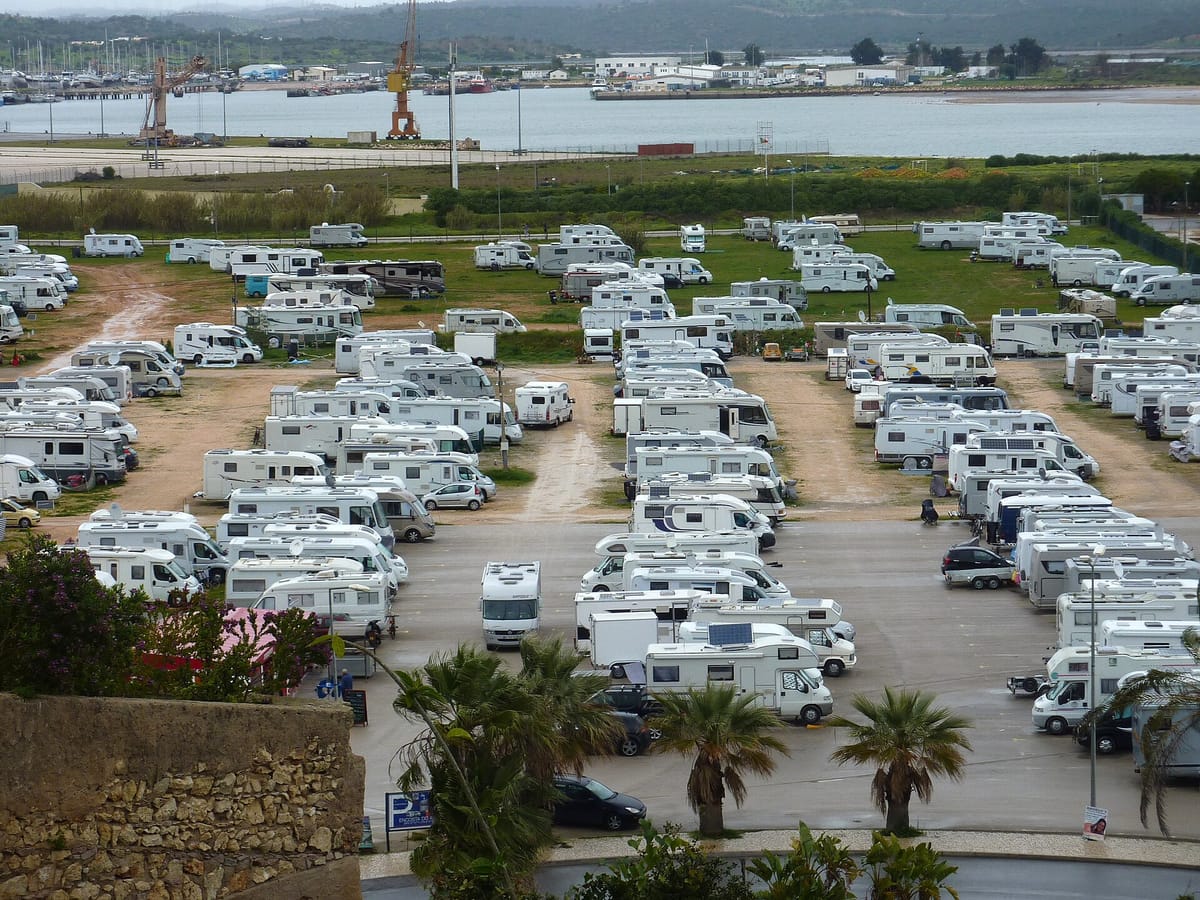
Portugal is one of the best countries in Europe to tour in a motorhome and one of the easiest in which to collect a fine while doing it. The rules are not intuitive, they changed twice in eight months, and the single most important fact about them is rarely the one people arrive knowing: the ban that matters is geographic, and the geography it covers includes almost the entire coastline.
This guide sets out what the law actually says, where you can legally spend the night, what the fines are, and the practical decisions that follow. It applies to autocaravanas (motorhomes and campervans) and to what the Código da Estrada (Highway Code) calls "similares", vehicles of a similar kind, which in practice sweeps in converted vans and caravans being lived in.
The short version
- Outside protected zones, and where the municipality has no rule of its own, you may spend the night in a homologated motorhome for a maximum of 48 hours in the same municipality.
- Inside Rede Natura 2000 areas, protected areas and zones covered by coastal management plans, spending the night is banned outright unless the spot is expressly authorised.
- "Night" means 22:00 to 07:00, with occupants inside. Parking an empty vehicle is a different question.
- Putting out a table, chairs or an awning is camping, and camping on the public highway is prohibited everywhere, whatever the 48-hour rule says.
- Fines run from €30 to €600 depending on which rule you break and where.
- Municipal regulations override the default. The 48-hour permission applies only "in the absence of a municipal regulation for the activity".
How the law got to its current shape
Until the end of 2020 the Código da Estrada said nothing specific about motorhomes. Decreto-Lei n.º 102-B/2020, of 9 December, changed that by inserting a new Article 50.º-A, and the version that took effect in the first days of January 2021 was severe: overnight stays outside places expressly designated for the purpose were prohibited across the entire national territory, which in practice meant service areas, campsites and dedicated motorhome parks and nothing else. The original text defined the overnight period as running from 21:00.
The reaction was immediate, organised and effective. Motorhome associations protested and threatened legal challenges, parliamentary groups tabled competing amendments, and within eight months the Assembleia da República (Assembly of the Republic) had rewritten the article. Lei n.º 66/2021, of 24 August 2021, in force since the following day, is the regime that governs today. It also amended the Regulamento de Sinalização do Trânsito (Traffic Signage Regulation) to create dedicated motorhome signs, which matters more than it sounds: it is the reason a municipality can now legally post a sign that bans motorhomes specifically.
Rule one: the geographic ban
Article 50.º-A(1) prohibits both pernoita (spending the night) and aparcamento by motorhomes or similar vehicles in three categories of place, "save in locations expressly authorised for the purpose":
- Rede Natura 2000 areas, the European network of Sites of Community Importance and Special Protection Areas, which covers roughly a fifth of mainland Portugal;
- protected areas, meaning the national park, natural parks, nature reserves and protected landscapes classified under the national conservation framework;
- zones covered by the Planos de Ordenamento da Orla Costeira, the coastal zone management plans (their successors are now generally called Programas da Orla Costeira).
That third category is the one that catches people out. The coastal plans blanket a strip along essentially the whole mainland shoreline. If your mental model is "the ban is about national parks, and I am parked at a beach", the model is wrong: the beach is very likely inside a coastal plan area, and the ban applies there in full force.
The same three categories appear again in Article 48(6), which prohibits motorhomes from even parking in them outside places authorised for vehicle parking. In other words, in these zones the restriction is not limited to sleeping. A marked, ordinary car park inside a coastal-plan area is a place authorised for vehicle parking and you may park there; a stretch of dirt beside a dune is not.
Rule two: the 48-hour permission everywhere else
Article 50.º-A(2) is the provision that made touring possible again. In the rest of the territory, and in the absence of a municipal regulation covering the activity, spending the night is permitted in motorhomes homologated by the Instituto da Mobilidade e dos Transportes (IMT, the Institute for Mobility and Transport), for a maximum of 48 hours in the same municipality. In places expressly authorised for the purpose, there is no limit at all.
Three details in that sentence do real work.
"Homologated by the IMT." The permission is for vehicles registered as motorhomes. A self-converted van that has not been reclassified is, on the face of the text, outside the permission. If you have built out a van, the homologation process is worth completing before a long tour.
"In the same municipality." The 48-hour clock is per concelho, not per parking spot. Moving 400 metres down the road does not reset it; crossing into the next municipality does. Portugal has 308 municipalities, so on a touring itinerary this is less restrictive than it sounds, but it does prevent settling in for a week.
"In the absence of a municipal regulation." This is the biggest practical caveat in the whole regime. Any câmara municipal may adopt its own rules, and many coastal and Algarve municipalities have. Where a municipal regulation exists, it governs, and the national 48-hour default falls away. There is no central register of these regulations. Checking the municipality's own website, or the signage at the spot, is the only reliable method.
What counts as "spending the night"
Article 50.º-A(3)(c) defines pernoita as the presence of a motorhome or similar vehicle, with occupants, between 22:00 and 07:00. Both halves matter. An empty motorhome left in a legal parking space overnight is not a pernoita; it is parking, and is judged by the ordinary parking rules. A motorhome with people sleeping in it at 02:00 is a pernoita, whether or not anything has been set up outside.
The law separately uses the term "aparcamento", which turns on occupying more space than the vehicle itself takes up. The practical translation of both concepts sits in Article 48(7), which is where most fines are actually earned.
Rule three: parking like a vehicle, not like a campsite
Article 48(7) says that motorhomes parking on the same terms as other vehicles must comply cumulatively with municipal parking and traffic regulations and with three prohibitions:
- No camping or activities associated with camping on the road or in public space;
- No discharging of organic waste or waste water outside the disposal systems provided for the purpose;
- No occupation of the road or public space beyond the perimeter of the motorhome.
Read together, these draw a clear line. You may be inside your vehicle, within your parking bay, invisible from outside. You may not deploy the awning, put out chairs and a table, run a washing line, empty the grey tank into a drain, or spread across two bays. The last prohibition is the one that decides most roadside arguments: if your setup extends past the vehicle's footprint, you have moved from parking to camping, and the exemption disappears.
The fines
| Offence | Provision | Fine |
|---|---|---|
| Camping on the public highway, dumping waste or water outside designated systems, occupying space beyond the vehicle's perimeter | Art. 48(7), penalised by 48(8) | €30 to €150 |
| Parking a motorhome in a Rede Natura 2000 area, protected area or coastal-plan zone outside authorised parking | Art. 48(6), penalised by 48(9) | €60 to €300 |
| Spending the night beyond 48 hours in the same municipality, or where a municipal regulation forbids it | Art. 50.º-A(2), penalised by 50.º-A(4) | €60 to €300 |
| Spending the night or aparcamento in a Rede Natura 2000 area, protected area or coastal-plan zone | Art. 50.º-A(1), penalised by 50.º-A(4) | €120 to €600 |
Two procedural points are worth knowing. First, after being notified of the offence you may pay voluntarily on the spot, and the law says voluntary payment at the moment the offence is verified settles the fine at the minimum of the band. Paying immediately therefore costs €120 rather than up to €600 in the worst category. Second, the law expressly directs that electronic payment methods be made available, so you should not be told that only cash will do.
Enforcement sits with the GNR (Republican National Guard), the PSP (Public Security Police), the Polícia Marítima (Maritime Police) and the municipalities. On the coast, the Polícia Marítima is the one you are most likely to meet.
The registration platform that does not exist
Article 50.º-A(7) and (8) allow the Government to make the 48-hour permission conditional on daily registration through a free electronic platform that validates geolocation and keeps the record for a maximum of 60 days, and to use the same platform to log authorised waste-water discharge points. Article 50.º-A(9) then aggravates the penalty by 50 percent for failing to use it.
That machinery has never been switched on. It is drafted as a power the Government "may" exercise, not an obligation, and no platform has been deployed. The practical consequence is that there is currently nothing to register with and the 50 percent aggravation has nothing to attach to. It is worth knowing the provision exists, because it could be activated without new primary legislation.
Where you can actually stay
Áreas de serviço para autocaravanas (ASAs). Dedicated motorhome service areas, usually municipal, with fresh water, grey and black water disposal and often electricity. Many are free or charge a few euros. These are "locations expressly authorised for the purpose", so the 48-hour limit does not apply to them.
Campsites. The most expensive option and the least restricted. Also the only one that reliably gives you showers, laundry and a legal right to put out the awning.
Private motorhome parks and farm stays. A growing sector, particularly in the Alentejo and the interior, where a landowner offers a handful of pitches. Being on private land with the owner's permission takes you outside the public-highway rules entirely, though the protected-area restrictions can still apply to the site itself.
Ordinary parking, for up to 48 hours. Legal outside the protected zones and where no municipal rule says otherwise, provided you stay inside your bay and set nothing up outside.
Practical checklist before you park for the night
- Look at the signs. Since 2021 there is a specific prohibition sign for motorhomes, with additional panels that can carry time restrictions, and a corresponding information sign for authorised motorhome parking and service areas. If a motorhome pictogram is on a red-bordered sign, the question is settled.
- Work out whether you are on the coast. If you can see the sea, assume you are inside a coastal management plan area and that the higher fine band applies, unless the spot is explicitly signed as authorised.
- Check the municipality. A quick search for "regulamento de estacionamento de autocaravanas" plus the concelho name will usually surface a local rule if one exists.
- Count the nights per concelho, not per spot. Two nights is the ceiling, then move to a different municipality or to an authorised site.
- Keep everything inside the footprint. No chairs, no awning, no washing line, nothing crossing the line of the bodywork.
- Never empty tanks anywhere but a designated point. This is both a fine and the single behaviour that has driven municipalities to adopt restrictive local rules in the first place.
What This Means for You
- If you are touring for a few weeks: plan around service areas rather than the 48-hour rule. Using ASAs removes the time limit, the geographic question and the waste problem in one move, and most of them cost less than a campsite.
- If you live in Portugal and own a motorhome: the parking rules in Article 48(7) apply to your vehicle parked outside your own home too. Occupying more than one bay, or extending past the perimeter, is an offence regardless of whether anyone is sleeping inside.
- If you have converted a van: check whether the vehicle is homologated as an autocaravana with the IMT. The 48-hour permission is written for homologated vehicles, and the paperwork is the difference between a legal night and a €300 exposure.
- If you are visiting with a foreign-plated vehicle: the rules apply to you identically, and the on-the-spot minimum payment is the sensible route if you are stopped, because contesting a Portuguese contraordenação from abroad is slow and rarely worth the sum involved. Remember that motorway tolls are a separate problem with its own solutions, covered in our guide to paying Portugal's motorway tolls with a foreign-plated car.
- If you are staying near houses: generators, music and late arrivals fall under the general noise regime, not the Highway Code. Our guide to noise and neighbours sets out the 23:00 to 07:00 rule and how complaints are handled.
The regime looks fussy written down, and it mostly is not in practice: stay off the dunes, stay inside your bodywork, move municipality every second day, and use a service area when you want to relax. The vehicles that attract enforcement are the ones that behave like a campsite in a public car park, and the law was rewritten in 2021 precisely to preserve the freedom of the ones that do not. If you are planning the rest of the trip around the coast, our guides to recreational sea fishing licences and flying a drone legally in Portugal cover two other activities where the protected-area map decides what is allowed, and Portugal's nearly 400 Blue Flag beaches are a reasonable place to start choosing where to point the van.