Maritime Police Seize a Go-Fast Boat and 600 Litres of Fuel in Jerrycans on the Tagus After It Runs Aground Fleeing a Patrol
A high-speed boat fled a Maritime Police patrol near the mouth of the Sorraia on Sunday and ran aground; 20 jerrycans of fuel were aboard. It is the fourth fast boat seized in five days, and carrying fuel in cans is now a crime under the go-fast boat law.
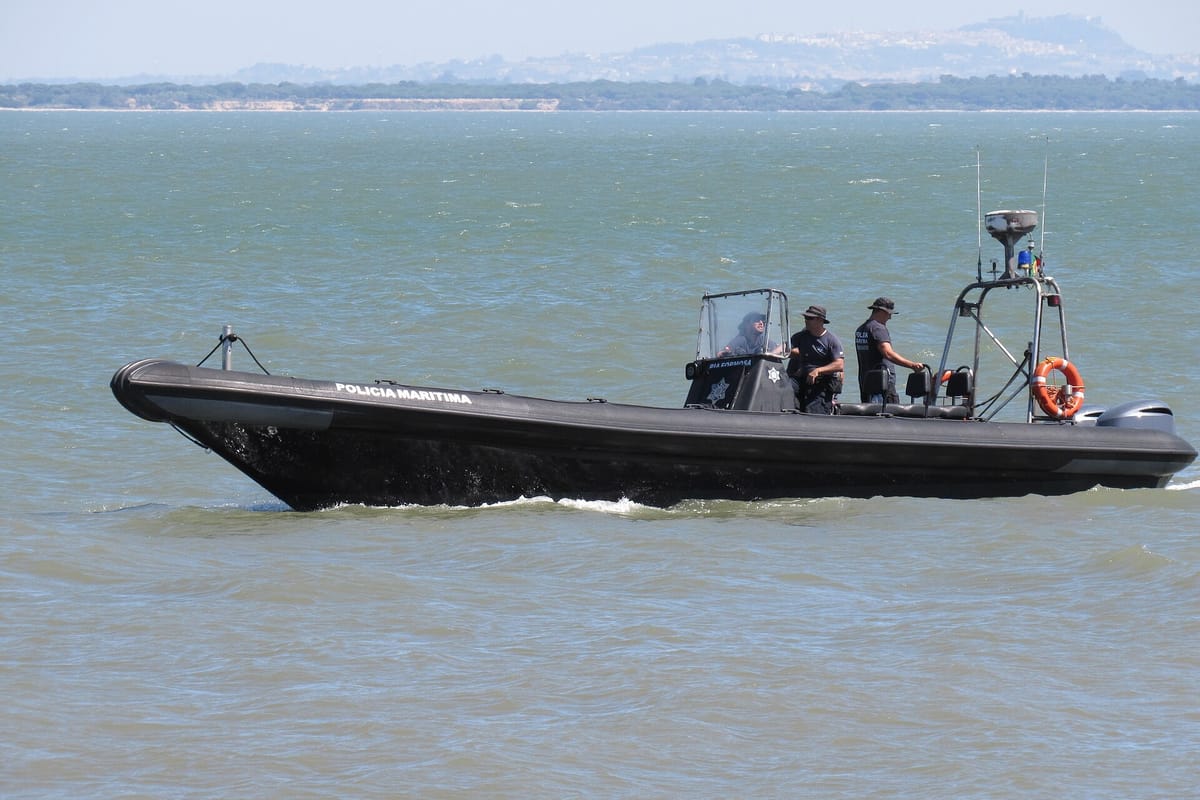
The Polícia Marítima (Maritime Police) seized a high-speed boat and 20 jerrycans holding about 600 litres of fuel on the Tagus on Sunday, near the point where the river Sorraia flows into it, in an operation against drug trafficking. According to a statement from the National Maritime Authority (AMN) reported by Lusa and carried by Notícias ao Minuto, the boat "fled" when its crew spotted officers from the Lisbon local command of the Maritime Police, and ended up "running aground on the river bank". No arrests were reported.
The authority said the boat, the fuel and other "logistical material" were seized because they were allegedly meant to refuel vessels suspected of links to drug trafficking. The Maritime Police's criminal investigation unit (UCIC) will carry out forensic examinations; the Lisbon port captaincy and the GNR's coastal control unit took part.
The fourth fast boat in five days
Sunday's seizure closes a busy week. On Wednesday a high-speed boat was found aground on the banks of the Ria Formosa in Tavira. On Thursday the Maritime Police seized a four-engine boat beached at Carvalhal, in Grândola, Lusa reported. On Friday officers intercepted a fast boat in a narrow inlet of the Berlengas nature reserve, off Peniche, and detained the four Spanish nationals aboard; three other boats with it fled, according to the AMN statement quoted by Lusa.
The pattern fits what the Polícia Judiciária has described this year: almost all the cocaine reaching Portugal arrives by sea, and seizures had already hit 42 tonnes by October.
What the go-fast boat law says
Since May, high-speed boats (embarcações de alta velocidade, or EAV) have been governed by Decreto-Lei n.º 43/2026, published on 16 February under a parliamentary authorisation (Lei n.º 63/2025, of 31 October) and in force 90 days later. It replaced a 1990 regime and, for the first time, made several uses of these boats a crime:
- Buying, owning, holding or handing over an EAV with no flag, or without its legal markings, or with them hidden or falsified: 1 to 4 years in prison. The same applies to importing, exporting or moving one without customs authorisation.
- Carrying more fuel than the boat's approved tanks hold, or storing fuel in separate containers: up to 2 years in prison. That is the rule a boat full of jerrycans falls under.
- Commanding an EAV without the proper licence: up to 2 years or a fine.
Crews must also keep an AIS tracking transponder switched on, report arrivals within an hour, stay moored between 21:00 and 07:00 unless a trip has been notified, and keep within 10 miles of the coast. The hull must carry the letters "EAV".
What it means for you
The law catches boats by engine power rather than purpose, so it is not only about traffickers. A boat with three or more engines of at least 95 kW each, or a total power above set limits for its length, counts as an EAV; boats under 4 metres, including jet-skis, are outside it. The maritime directorate DGRM decides which boats qualify, and the classification is entered in the boat's register at the port captaincy.
Owners of a boat bought before the law, or already classed as fast under the old rules, have 180 days from its entry into force, or from being notified that their boat qualifies, to fit the AIS and the markings. For boats counted from the law's entry into force in mid-May, that window runs out around mid-November. If you own a powerful RIB or speedboat, ask your port captaincy how it is classified.