Recreational Sea Fishing in Portugal
The DGRM licence, the 2 to 70 euro fee table, the three rod nine hook rule, the 10 kg daily limit, and the tail fin cut you must make before leaving the rocks.
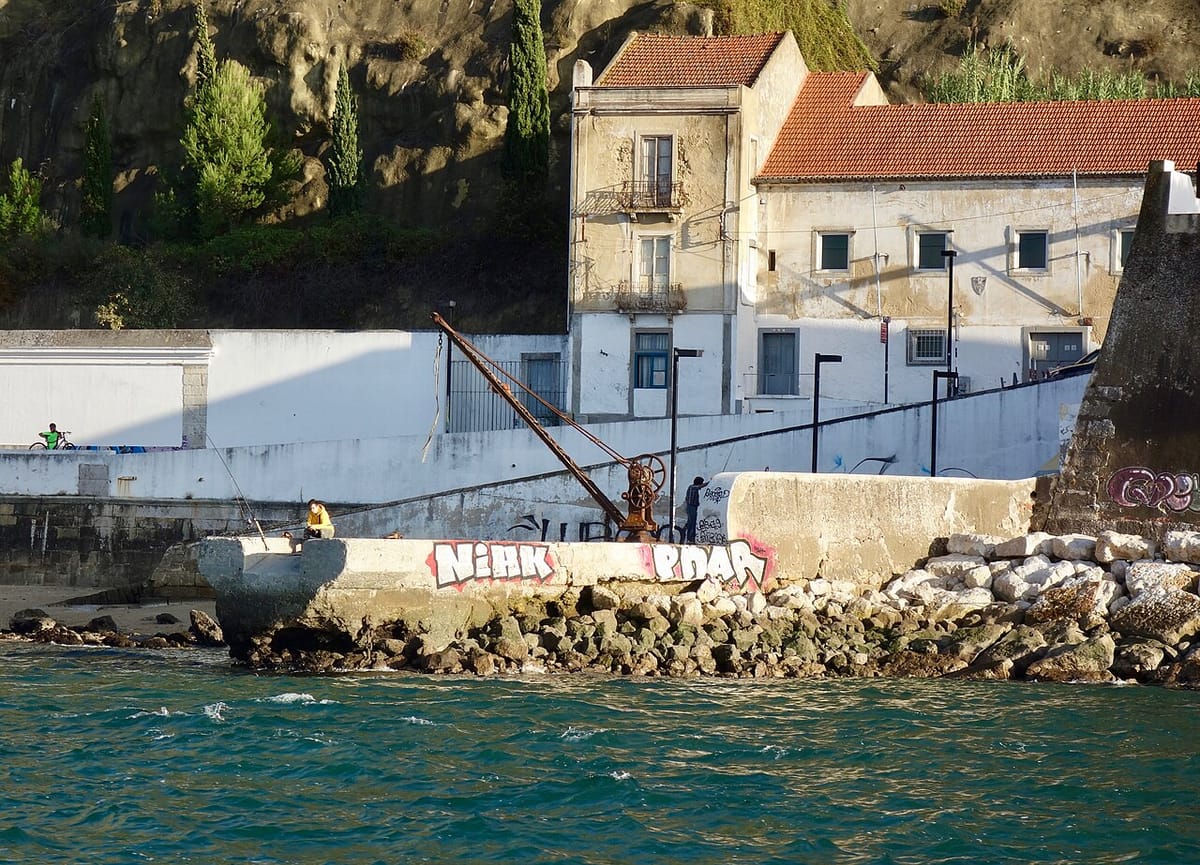
Last verified: September 2026.
Who this is for
- You fish from the shore, a boat, or by spearfishing on the mainland coast or in estuaries.
- You live in Portugal, or you are visiting, whatever your nationality.
- You want to know which licence to buy and which catch rules apply.
Not for you if: you fish in rivers, reservoirs, or the Douro above the Crestuma dam. Read Fishing Portugal's Rivers and Reservoirs instead.
Updated September 2026. Sea bass, bluefin tuna, and marlin catches must now be logged in the EU RecFishing app. The Costa Vicentina sea bream closed season now covers February only.
To fish in the sea on mainland Portugal, you need a recreational fishing licence from the DGRM, the national maritime and fisheries authority. A shore licence costs €2 a day, €4 a month, or €8 a year. Fishing without one can bring a fine of €200 to €2,000. Portuguese citizens can buy one at any cash machine. Foreign residents and visitors buy at a counter with a passport, or online at least five working days ahead. Then you follow limits on gear, distance, and daily catch.
Do you need a licence?
Yes, if you fish with any gear at all. That includes a rod, a hand line, a squid jig, a speargun, or a tool such as a shellfish knife, shrimp net, gaff, or short spade.
You do not need one in two cases:
- Gathering by hand. If you pick shellfish or other sea life using only your hands, no licence is needed. A bag or bucket to carry your catch is fine.
- Children under 16. They can fish without their own licence if an adult with a valid licence is with them.
The licence is personal. It is linked to one person's identity number and cannot be held by a company.
Which licence to buy and what it costs
There are four types. Each is valid along the whole mainland coast, so you never need a regional licence.
| Licence | Day | Month | Year |
|---|---|---|---|
| Shore (apeada) | €2 | €4 | €8 |
| Boat (embarcada) | €5 | €12 | €50 |
| Spearfishing (submarina) | €3 | €10 | €25 |
| General, all three (lúdica geral) | not available | €20 | €70 |
A few points help you choose:
- Shore anglers should usually buy the annual licence. Four day licences already cost €8.
- The boat licence also lets you fish from the shore for the same period.
- The general licence covers shore, boat, and spearfishing together.
- A day on a charter boat. If you hold only a shore licence, buy a €5 day boat licence. The tourist boat operator usually issues it on board.
The DGRM does not cancel licences or give refunds. If you buy the wrong type, you have to buy the right one as well.
How to buy your licence
Your route depends on your nationality and paperwork.
- At a cash machine (Portuguese citizens only). You need a Portuguese bank card and the Portuguese ID card number of the person the licence is for. Choose Pagamento de Serviços, then Pagamentos ao Estado, then Licença de Pesca Lúdica, then Pesca Águas Marítimas e Salobras. See Using MB Way and Multibanco in Portugal for how the machines work.
- At a counter (anyone). Bring a passport, ID card, or other valid identity document and pay the fee. Counters are open on working days.
- Online through BMar (foreign citizens and non-resident Portuguese). The Electronic Sea Desk (Balcão Eletrónico do Mar) at bmar.pt takes requests paid by bank transfer. Create an account, then request an individual licence under the recreational fishing category.
Where the counters are
- Lisbon: DGRM head office, Avenida Brasília.
- North: Porto de Leixões training centre, Leça da Palmeira.
- Centre: Ílhavo and Gafanha da Nazaré.
- Lisbon and Tagus Valley: Quinta da Várzea, Setúbal.
- Algarve: Patacão (Faro), Tavira, Portimão fishing port (Parchal), Olhão, and Alcoutim.
The regional offices in the Alentejo also issue licences. Check opening hours before you travel.
How long it takes online
Submit a standard BMar request at least five working days before you want to fish. An urgent request is issued within three working days, but it costs double. An urgent annual shore licence, for example, costs €16. If you are arriving for a fishing week, apply before you travel.
Checking your licence and fixing mistakes
There is no paper licence. Your licence is a record in the DGRM database, and inspectors check it by your identity number. You do not need to carry anything except your identity document.
If you gave a mobile number when you bought it, you can check your details by text. Send UPLUD to 925507447 from that phone. You get back the licence number, the linked ID number, the type, and the expiry date.
Your identity number must be correct. If it has a typo, inspectors will not find a valid licence, and you will be treated as unlicensed. To fix it, email [email protected] or write to the DGRM Director-General. Include:
- a scan of the payment receipt
- the correct identity number
- your mobile number, if that is wrong too
Where the sea licence works
The licence covers the ocean off the mainland, estuaries, and tidal waters under the port captaincies.
It does not cover:
- Rivers and reservoirs managed by the nature conservation institute (ICNF), which need an ICNF licence.
- The Douro above the Crestuma dam, up to Barca de Alva. It needs the ICNF licence even though the port captaincy covers it.
- The Azores and Madeira, which have their own regional rules.
On the Minho and Guadiana border rivers, a Portuguese licence covers you from the Portuguese bank. From a boat, a Portuguese or Spanish licence is valid. On the Guadiana border stretch you may not take octopus, eels, lamprey, or shad.
What gear you can use
These limits apply to every licence holder.
- Lines and hooks. Up to three lines or rods, with no more than nine hooks in total across them.
- From the shore. Hand line, rod, squid jig, and spinning or trolling. With a shore licence you may also use a malhada net, shellfish knife, shrimp net, gaff, short spade, or arrelhada fork.
- From a boat. Hand line, rod, squid jig, and trolling.
- Spearfishing. Speargun, shellfish knife, gaff, and arrelhada fork.
- Reels. Any type, electric reels included.
- Landing aids. Landing nets, keep nets for live release, and cliff baskets are allowed.
- Banned. Catapults and slingshots, electric fishing, poison, and explosives.
Bait and lights
Natural and artificial baits are allowed, but not fish roe or anything toxic. Groundbait is fine from shore and boat, but not when spearfishing.
Lights are allowed only with a squid jig, or on marker buoys. Using a light to attract fish with a rod or hand line can bring a fine of €100 to €1,000. Spearfishers may carry a torch for safety, but not to attract fish.
Spearfishing rules
You must spearfish on a held breath. Scuba or other breathing equipment cannot be used together with a speargun on the same boat. Spearfishers keep 20 metres apart unless they agree otherwise. Other boats must stay 50 metres from a spearfisher.
How far to keep from others, and where you cannot fish
If you fish from the shore, keep 5 metres from any angler who was there first, unless they agree.
If you fish from a boat, keep 50 metres from other boats, from spearfishers, and from set nets and their marker buoys.
Nobody may fish:
- within 100 metres of a harbour of refuge, a dock, a shipyard, or a fish farm
- within 100 metres of a marked sewage outfall, whether or not it is active
- inside shipyards or fish farms, unless the fish farm operator agrees in writing
- from a boat in harbour mouths, river bars, or marked shipping channels
Fishing from a harbour breakwater is allowed in principle. However, the local port captaincy (capitania) can restrict it in rough seas or certain seasons. It can also limit night fishing near beaches with lifeguard concessions in summer. Check the notices (editais) of the local capitania before fishing a new spot. Going to the Beach in Portugal explains the bathing season.
Life jackets. Everyone fishing from a boat must wear a life jacket or buoyancy aid. From the shore there is no requirement, but wearing one on exposed rocks is sensible.
Protected areas and closed seasons
If you fish from a boat in four marine parks, you may fish only from Thursday to Monday and on public holidays. The parks are Sudoeste Alentejano and Costa Vicentina, Arrábida, Litoral Norte, and the Berlengas. The restriction does not apply from 1 June to 30 September.
Each park also has zones where some or all fishing is banned. For example:
- Arrábida: no fishing in fully or partly protected zones, and no hand gathering or spearfishing anywhere in the park.
- Berlengas: no boat fishing within 50 metres of land, and no hand gathering or spearfishing.
- Costa Vicentina: no fishing in the most protected zones. In some zones only shore fishing with two rods is allowed.
- Tagus Estuary reserve: no boat fishing between sunset and sunrise.
- Algarve reef park (Pedra do Valado): you need ICNF permission to fish.
If you fish from the shore in the Costa Vicentina park, the commercial closed seasons apply:
- white and two-banded sea bream (sargos): 1 to 28 February
- ballan wrasse (bodião): 1 March to 31 May
How much you can keep each day
These limits apply per person, per day.
- Fish and squid or octopus: 10 kg in total, not counting your single heaviest fish.
- Spearfishing: 15 kg, again not counting the heaviest fish.
- Other sea creatures: 2 kg in total.
- Mussels: up to 3 kg.
- Oysters (Pacific cupped oyster): up to 5 kg.
- Japanese carpet shell clams: up to 5 kg.
- Worms for bait: 0.5 litres. Scraping them off rocks is banned.
If more than three people fish from one leisure boat, the boat's total catch cannot exceed 25 kg. Each angler's heaviest fish is not counted. This cap does not apply to spearfishing or to tourist fishing trips.
When you reach a limit, you must stop fishing. Releasing fish to keep going is not allowed. The limit does not add up across days, so two days out still means 10 kg.
Sport fishing competitions follow different rules. Fish must be kept alive and returned to the water.
Mark every fish before you leave
If you fish from the shore, you must cut the tail fin of every fish you keep before you leave the spot. If you fish from a boat, you must do it before you land. The official cut pattern is in an annex to the rules. The cut marks your catch as recreational so it cannot be sold. Spearfishing catches are exempt.
Only the person who caught the fish may carry it.
Size limits and species you must release
Minimum sizes are the same as for commercial fishing. You must return any undersized fish to the water at once, even if it is dead. If a species has no minimum size, you can keep any fish of that species. The DGRM lists current sizes and closed species on its website.
You may never keep the following. Release them at once if you hook one by accident:
- Sharks and rays: undulate ray, white skate, bluntnose sixgill shark, great white, basking shark, silky shark, oceanic whitetip, porbeagle, bigeye thresher, and spurdog.
- Other fish: ocean sunfish, European eel, groupers, sea lamprey, Atlantic salmon, allis shad, and twaite shad.
- Shellfish: spiny lobsters, European lobster, and the European flat oyster.
- Protected wildlife: all seabirds, seahorses and pipefish, corals, marine mammals, and sea turtles.
Bluefin tuna can be kept only on tourist fishing boats that the DGRM has authorised. Each fish must be at least 115 cm, and all recreational anglers together may keep no more than 500 kg a year.
Reporting catches in the RecFishing app
Since 10 January 2026, EU rules require you to report some species in the RecFishing app. It applies to anyone fishing in Portuguese waters, whatever your nationality. The species are:
- European sea bass (robalo)
- Atlantic bluefin tuna
- blue marlin, white marlin, and roundscale spearfish
Download the app from Google Play or the App Store and register with an email address. Log your catch each day, including fish you release. You record the date, place, fishing method, gear, number or weight, and length where relevant. On a charter boat or in a competition, each angler logs their own catch. The app does not replace the licence. For help, call the BMar line on +351 213 035 805 or email [email protected].
Fishing from a boat
You may fish only from a boat registered for leisure use or for maritime tourism. You cannot hire a commercial fishing boat for a day out with friends. The only exception is an approved sport competition with no other boats available. The port captain must authorise it at least 30 working days in advance.
Maritime tourism companies and their crews may not keep or sell fish caught by their clients. For skippering your own boat, see Getting a Recreational Boating Licence in Portugal.
What the fines are
Fines for individuals come in two bands.
€100 to €1,000, for example:
- keeping, carrying, or landing undersized fish
- fishing within the banned distances or in banned areas
- fishing closer than 5 metres to another angler, or 50 metres to a boat, without agreement
- using lights to attract fish, except with a squid jig
€200 to €2,000, for example:
- fishing without a licence
- fishing from a boat without the right registration or authorisation
Companies pay €250 to €10,000 in the first band and €500 to €20,000 in the second.
A quick checklist
- Buy the annual shore licence for €8 if you fish more than three days a year.
- Without a Portuguese ID card, use a counter or apply on BMar at least five working days ahead.
- Check that your identity number on the licence is correct.
- Use no more than three rods and nine hooks, and keep 5 metres from the next angler.
- Stop at 10 kg, not counting your heaviest fish.
- Cut the tail fin of every fish before you leave the rocks.
- Log sea bass, bluefin tuna, and marlin in the RecFishing app.
- Check the local capitania notices and park rules before fishing somewhere new.
Sources
This guide is written from official Portuguese and EU sources and, for prices and contact details, the providers' own websites.
- DGRM, Recreational fishing FAQ (March 2026): https://www.dgrm.pt/documents/20143/121101/FAQ-Pesca+Ludica+2026_mar%C3%A7o.pdf/97f086cc-b771-9ca7-4bd1-746e0740611b (licence types, fees, who needs a licence, buying routes and counter addresses, SMS check, corrections, where the licence works, gear, distances, protected areas, closed seasons, daily limits, banned species, bluefin tuna, fines)
- DGRM, Recreational fishing licensing: https://www.dgrm.pt/pesca-pl-licenciamento (licence types and buying routes)
- DGRM, Recreational fishing licence via BMar: https://www.dgrm.pt/licenca-de-pesca-ludica (five and three working day processing, urgent fee doubling)
- Balcão Eletrónico do Mar (BMar): https://www.bmar.pt (online licence requests)
- DGRM, RecFishing electronic catch registration: https://www.dgrm.pt/sistema-eletronico-de-registo-de-capturas-recfishing (catch reporting duty, helpline)
- DGRM, RecFishing app FAQ: https://www.dgrm.pt/documents/20143/124683/Quest%C3%B5es+Frequentes_App_Pesca+Ludica+(003).pdf/49122376-ee38-cd1f-46db-edc327e21077 (species, start date 10 January 2026, data to record, foreign anglers)
- Diário da República, Portaria n.º 14/2014 of 23 January: https://files.diariodarepublica.pt/1s/2014/01/01600/0047400479.pdf (fees, gear, daily limits, tail fin marking, life jackets, boat rules)
- Diário da República, Decreto-Lei n.º 101/2013 of 25 July: https://diariodarepublica.pt/dr/detalhe/decreto-lei/101-2013-498751 (licensing duty, under-16 exemption, fines)
- Diário da República, Portaria n.º 51-A/2026/1 of 30 January: https://diariodarepublica.pt/dr/detalhe/portaria/51-a-2026-1031484982 (Costa Vicentina closed seasons)
- EUR-Lex, Regulation (EU) 2023/2842: https://eur-lex.europa.eu/eli/reg/2023/2842/oj (EU recreational catch reporting duty)
Last verified September 2026. Rules and fees change; check the official source before acting.