Five Timed Minutes of Shower Twice a Week: A Porto Engineer Came Out of 100 Days Sealed in a Windowless Room for the European Space Agency
Diogo Paupério Abreu was the Portuguese member of SOLIS100, six volunteers confined to 130 square metres in Cologne from May to August. He is now starting a doctorate at INESC TEC in Porto.
For 100 days between May and August, a Portuguese engineer got up at seven to a white room with no windows, spoke to the outside world twice a day through a loudspeaker, and showered for five timed minutes twice a week. Diogo Paupério Abreu was the Portuguese member of SOLIS100, an isolation study run by the European Space Agency with the German aerospace centre DLR, and he has been home in Porto for a fortnight.
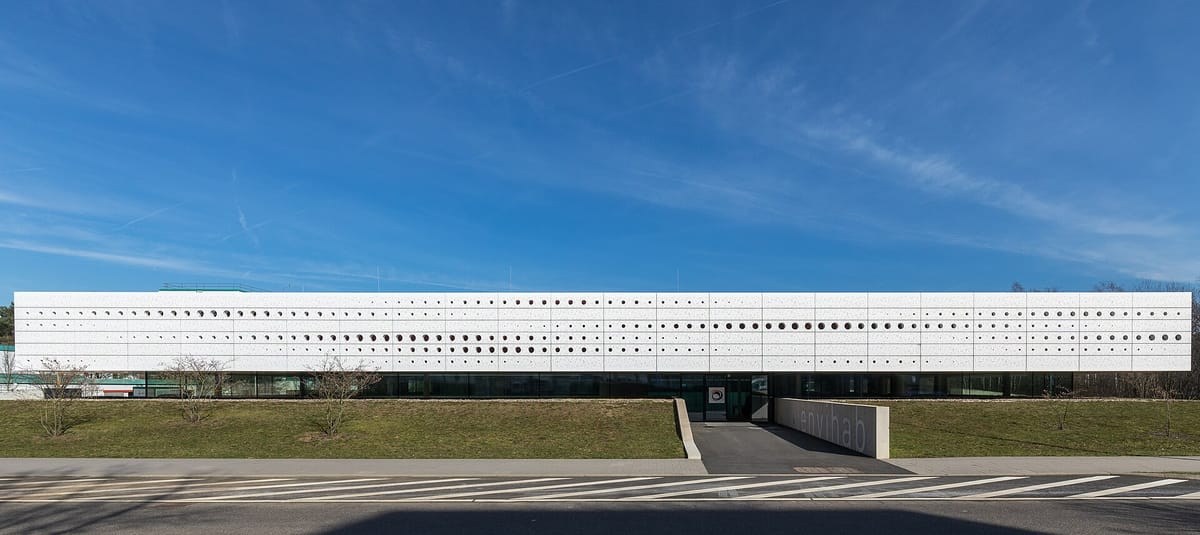
The point of the study, as he described it to Observador this weekend, was to "isolate the isolation": to take one narrow slice of a long-duration space flight, strip out microgravity, and measure what confinement alone does to a crew. Six volunteers from six countries lived in a 130 square metre room at :envihab, the DLR facility in Cologne built for this kind of work. English was the working language, so he barely spoke Portuguese for three months.
The routine was the experiment
Sleep was mandatory and eight hours long, because sleep quality was one of the measured parameters. Every ten days the crew gave biological samples: urine, faeces, blood and hair. Days 30, 60 and 90 were the heavy ones, worked morning to night. Mood, stress, cognitive performance and team dynamics were logged continuously, partly through video diaries, alongside questionnaires on how each member felt about the others.
The room held six ventilated sleeping pods, a work table where the crew also ate every meal, a wall screen for briefings and films, and a corner with an exercise bike, a treadmill and free weights. The full kitchen sat largely unused: fridge and oven stayed switched off, because the food was dehydrated and canned in the manner of the International Space Station, and only the microwaves and kettles were needed. Lighting shifted from harsh white to yellow at 20:45 and to a dim night setting from 23:00, mimicking the station's own cycle.
Crew roles were formal: a commander and a deputy, two medical officers, a data officer. Diogo was a crew member, backing up every activity, though he says the organisation was "quite horizontal". The selection process, he noted drily, "chose people who like solving problems, not creating them".
News arrived as headlines only
Each crew member received a newsletter carrying the main headlines from their own country, and nothing more. Diogo learned that Portugal had been knocked out of the football World Cup during one of the two-hour weekend video calls with his family. He describes a "lag" with internet trends on his return as proof the isolation had been real.
The crew invented their own rituals. A whiteboard carried a "Word of the Day" in seven languages, and a weekly reflection session had the six of them working out how to help one another.
A Porto route into space research
Diogo bought a telescope at 13 and still keeps it behind him on video calls. He read Electrical and Computer Engineering at the Instituto Superior de Engenharia do Porto rather than astronomy, assuming the two interests could not be combined. They were combined during his master's, when his supervisor Ana Pires, Portugal's first scientist-astronaut, brought him into a 13-day analogue mission at Monsaraz on the Alqueva, the first of its kind held in Portugal. He was flight engineer there, and it was there he heard about SOLIS100.
He has now returned to INESC TEC in Porto to begin a doctorate. His laboratory works mainly in marine robotics and is pushing into the space sector, a trajectory shared by other Portuguese groups: a Caparica laboratory is building muscle-monitoring hardware on European Space Agency money. Most of the SOLIS100 findings stay confidential until the agency publishes them.