
Councils Have Destroyed Asian Hornet Nests in All 18 Mainland Districts This Year: Who Does What, and What to Do if You Find One
The ICNF register shows nests destroyed from Braga to Faro in 2026, after about 28,500 in 2025. Autumn is when new queens leave to overwinter, so every nest found now counts. Who destroys them, how to report one, and why not to touch it.
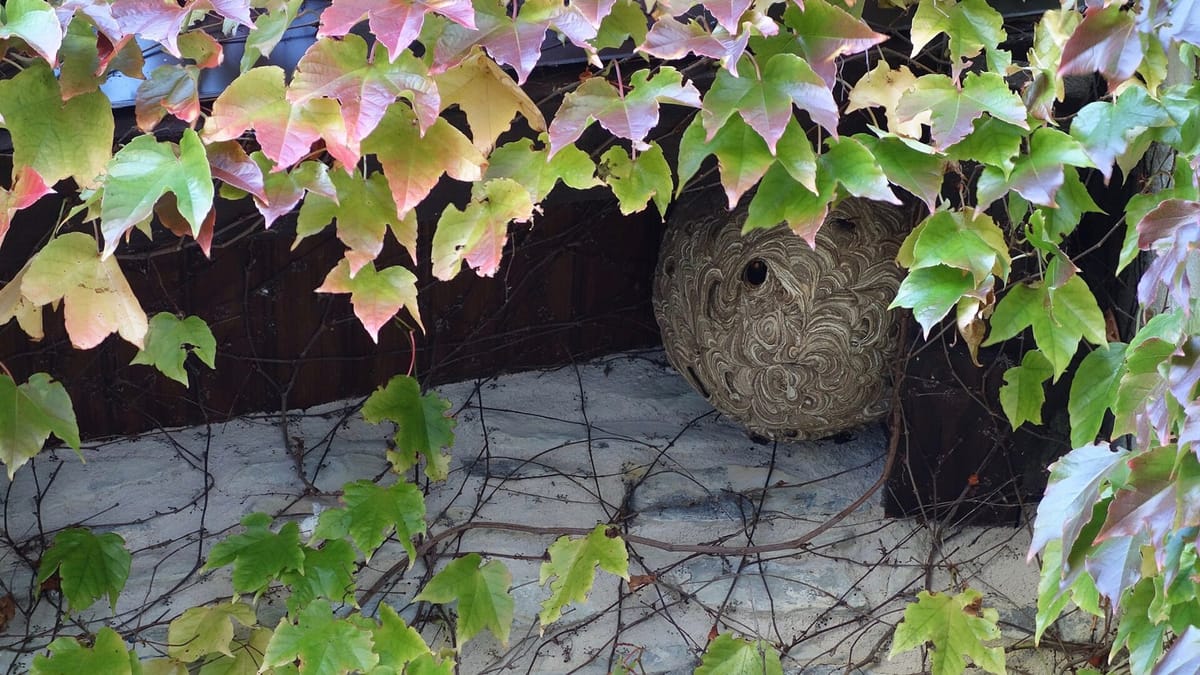
Councils have destroyed Asian hornet (Vespa velutina) nests in every one of mainland Portugal's 18 districts this year, RTP reported on Saturday, with Braga and Leiria recording the most. The species reached the Baixo Alentejo and the Algarve for the first time in 2025. The official register agrees: its first nests in Faro and Beja date from April 2025.
What the official register shows
Every nest found on the mainland is meant to be logged on STOPvespa, run by the Instituto da Conservação da Natureza e das Florestas (ICNF, the nature and forests institute). Its public data, read on 10 October, give this picture:
- 2023: 32,134 nests logged, 30,907 destroyed
- 2024: 28,857 logged, 27,894 destroyed
- 2025: 29,994 logged, 28,563 destroyed (about 95 percent)
- 2026 to 9 October: 12,391 logged, 11,612 destroyed
This year's destroyed nests are led by Leiria (2,028), Braga (1,941), Porto (1,710), Viseu (1,553) and Aveiro (1,239). The south is still thin but no longer empty: 71 in Faro, mostly around Monchique, Silves and Aljezur, 46 in Beja, all in Odemira, and three in Évora.
The 2026 total should not be read as a fall. Councils often log nests weeks after destroying them: about a quarter of the nests found in January to early October 2025 were entered after 10 October. Vila Flor shows the gap. Its mayor, Pedro Lima, told Lusa on 7 October that the council had destroyed 156 nests this year against 55 in all of 2025, and asked for "a more integrated" national response; the ICNF register holds 18 for Vila Flor so far this year.
Who is responsible for what
The hornet is on the European Union's list of invasive species of Union concern under Regulation (EU) 1143/2014. Decreto-Lei n.º 92/2019 (the invasive species decree) makes the ICNF Portugal's competent authority under that regulation. The national action plan for the surveillance and control of Vespa velutina, revised in January 2018 by a commission that includes the ICNF, the Direção-Geral de Alimentação e Veterinária (DGAV, the food and veterinary authority), civil protection and the municipalities' association, splits the work:
- Councils are responsible for destroying nests in their area, working through municipal civil protection, forestry technicians or forest sappers, or a contractor they authorise.
- The ICNF runs the national register and the reporting platform.
- The DGAV coordinates training and information, particularly for beekeepers.
Why autumn matters
The ICNF commission's good-practice manual says nests grow most from July to October, when the pressure on apiaries is greatest. From September to the end of October, the new founding queens leave to mate, then overwinter in sheltered spots until spring. The sooner a nest is destroyed, the fewer queens survive to start colonies next year. From December, the manual says, destruction no longer has a biological effect. Bare autumn trees also make high nests visible from the ground.
If you find a nest
Do not touch it or try to destroy it yourself: the action plan warns that a partly destroyed nest scatters hornets that found new ones, and crews keep bystanders about 50 metres away. Report the nest with a photo on stopvespa.icnf.pt (the old sosvespa.pt address now forwards there), to your council's civil protection service or parish council, or on the SOS Ambiente line, 808 200 520.
The DGAV and the action plan say an Asian hornet is individually no more dangerous to people than the European hornet; the risk is to anyone who disturbs a nest and to people allergic to stings. For a serious reaction (difficulty breathing, swelling of the face or throat, faintness), call 112.
The Azores are running a separate eradication effort, which we covered in September.


