Burning Garden and Farm Waste in Portugal
Researched and written with AI tools from official sources. How we make our guides
When you need council authorisation or just a notice to burn a pile of garden waste in Portugal, the days all burning stops, how to apply, and the fines.
Last verified: October 2026.
Who this is for
- You have prunings, brambles, or cut vegetation on rural land in mainland Portugal and want to burn them.
- You have just bought a smallholding or a house with land.
- You are organising a village event with a bonfire or fireworks.
Not for you if: you want the rules for clearing land around your house before the fire season. Read Preparing for Wildfire Season in Portugal instead.
Updated October 2026. Since May 2026, breaking the fire-use rules is punished under the environmental offences law, with much higher fines than before.
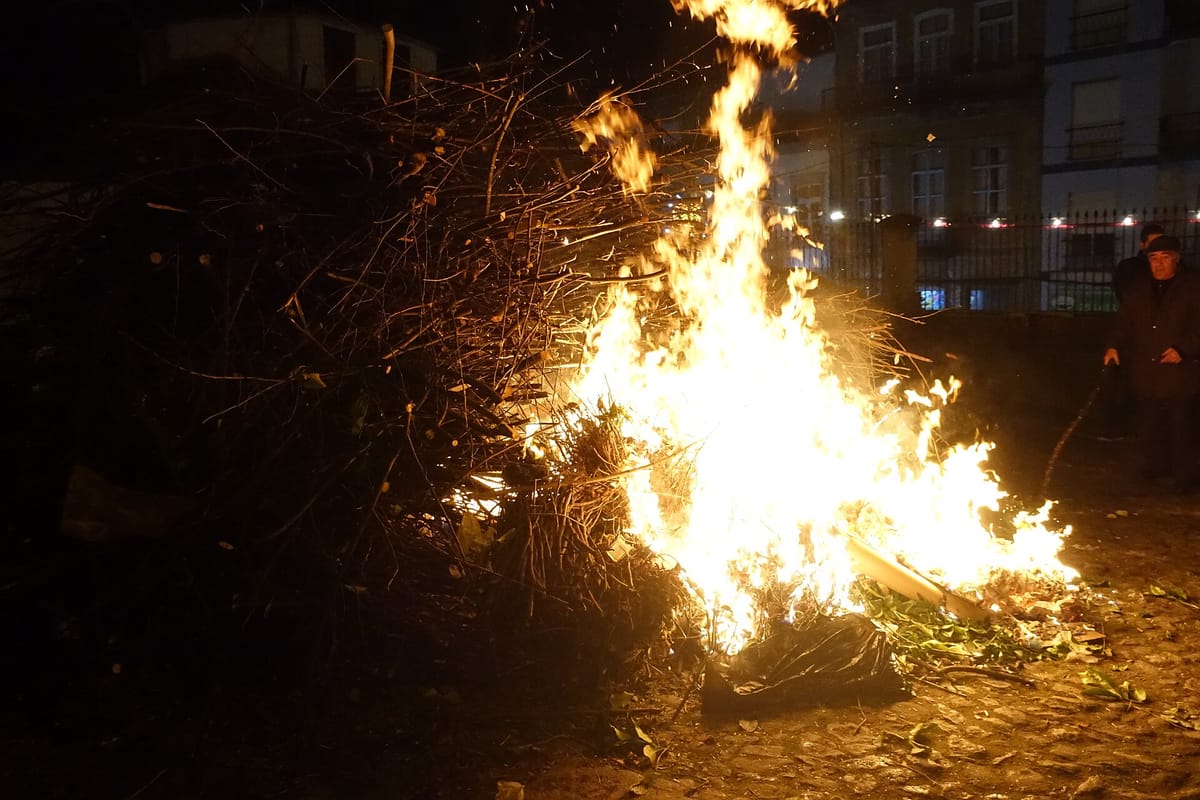
In mainland Portugal you must contact your council before you burn a pile of garden or farm waste. From 1 June to 31 October you need the council's authorisation. The rest of the year, a prior notice to the council is enough. You can do either online on the ICNF platform, by phone, or through the council. On days of very high or maximum fire danger, burning is banned unless the council authorises it. You must stay with the fire until it is fully out. Fines start at €200 and go far higher.
A pile burn or an open burn
The law has two kinds of burning, with different rules:
- Pile burning (queima de amontoados). Burning forest or farm waste that has been fully cut and piled up. The pile can cover no more than 4 square metres and be no more than 1.3 metres high. That is about 2 metres by 2 metres, no taller than your chest. Vine, olive, and fruit tree prunings are typical.
- Open burning (queimada). Using fire to renew pasture, clear stubble, or burn cut waste that has not been piled up. Fire moves across the ground instead of burning a heap.
If your heap is bigger than 4 square metres or 1.3 metres, or you plan to burn cut material where it lies, it is an open burn. Open burns have much stricter rules. If you have a lot of waste, make several small piles and burn them one at a time.
Check the fire danger first
Every rule turns on the rural fire danger level for your council (concelho) that day. The weather institute (IPMA) and the nature and forests institute (ICNF) set it daily for each council. There are five levels: reduced (reduzido), moderate (moderado), high (elevado), very high (muito elevado), and maximum (máximo).
Check your council's level on IPMA's website before any burn. Neighbouring councils can be at different levels on the same day.
When you need authorisation and when a notice is enough
Pile burning, when the danger is below very high:
- 1 June to 31 October: you need authorisation (autorização) from the council. The council sets any supervision needed, based on the fire risk in the area at that moment.
- The rest of the year: a prior notice (mera comunicação prévia) to the council is enough.
Pile burning, on very high or maximum danger days: banned, unless the council authorises it. The civil protection authority (ANEPC) says councils allow this only in exceptional cases, such as compulsory plant health burns, with supervision the council defines.
Open burning:
- On very high or maximum danger days: banned. No permission makes it legal.
- Other days: you need the council's authorisation.
- Supervision is compulsory. A technician certified in controlled fire must be present. If none is available, a team of firefighters, forest sappers, or similar official teams must supervise.
- The one exception: if certified controlled-fire technicians carry out the burn themselves, a prior notice replaces the authorisation.
How to apply
- Check the danger level for your council on IPMA's website.
- Choose how to apply: - online, on ICNF's Queimas e Queimadas platform at fogos.icnf.pt/queimasqueimadas, where you register and apply in three steps; - on an Android phone, with ICNF's Queima Segura app for pile burns (it is not on Google Play; scan the QR code on ICNF's page, with mobile data on); - by phone on 808 200 520 or 211 389 320; - through your council (câmara municipal) or parish council (junta de freguesia).
- Wait for the answer. In the summer period the council decides and may set conditions, such as supervision. Leave time to arrange them.
- Keep your proof. If the GNR stops by, you must show the authorisation or the proof of your notice.
Four councils are not on the ICNF platform: Aljezur, Castro Marim, Lisboa, and São João da Madeira. If you live in one of them, contact the council directly. For questions about the platform, email [email protected].
If you apply to the council by phone, the council must register your request on the ICNF platform itself.
On the day: how to burn safely
The official advice is:
- Do not burn in hot, dry, or windy weather. Choose cloudy, damp days.
- Keep the pile away from pasture, brambles, scrub, and trees.
- Clear a ring at least half a metre wide around the pile with a hoe, and wet it well.
- Keep water at hand, in a container or a connected hose.
- Do not burn alone, and carry a phone.
- Watch for sparks and wind changes. Put out any spark at once.
- Protect yourself from smoke with a damp cloth or a smoke mask. Most deaths linked to burning come from breathing smoke.
You must not leave until the fire is fully out and you are sure it cannot restart. This is the law, not just advice.
To finish: turn the burnt material over to find any flames or embers. Put them out with water or earth. Before you leave, check that no smoke is coming from the ashes. Only ash should remain.
If the fire gets out of control: call 112 and give the exact location. Move to a safe place and warn your neighbours.
Other bans on very high and maximum danger days
When your council is at very high or maximum danger, in rural areas:
- No bonfires for leisure or village festivals.
- Fire for cooking, and burners for light or cooking, only where expressly provided, such as equipped picnic parks.
- No sky lanterns with a lit wick and no rockets of any kind.
- Other fireworks need a licence from the council or parish, except categories F1, P1, and P2. You must get the licence at least 15 days ahead and confirm it in the 48 hours before use. Any police authorisation required by law still applies.
- No smoke or fire to fumigate or treat beehives.
- No smoking and no fire of any kind in rural areas, or on the roads around or through them.
"Rural areas" means forest and farmland, which covers most of the country outside towns.
What it costs to get it wrong
Since May 2026, fire-use offences are fined under the environmental offences law. Each offence is light, serious, or very serious:
- Light: burning a pile from 1 June to 31 October without the council's authorisation. Also an open burn by certified technicians without the prior notice.
- Serious: an open burn without authorisation or without the required supervision. Smoking or lighting a fire in rural areas on a very high or maximum danger day. Using fireworks without the required licence on those days.
- Very serious: any open burn on a very high or maximum danger day. Breaking the pile-burning and bonfire rules for those days, or leaving a burning pile before it is out. Launching sky lanterns or rockets on those days. Using fire on beehives on those days.
Fines for an individual:
| Offence | If careless | If deliberate |
|---|---|---|
| Light | €200 to €2,000 | €400 to €4,000 |
| Serious | €2,000 to €20,000 | €4,000 to €40,000 |
| Very serious | €10,000 to €100,000 | €20,000 to €200,000 |
Fines for companies are higher: €2,000 to €36,000 for light offences, €12,000 to €216,000 for serious ones, and €24,000 to €5,000,000 for very serious ones.
Carelessness is always punishable. Attempts are punishable for serious and very serious offences. For those, extra penalties can also apply, such as losing the tools used. Others, such as losing public subsidies or having licences suspended, can last up to three years.
Burning without permission counts as deliberate. The law treats an open burn without authorisation and supervision, or a pile burn without authorisation and the council's supervision, as intentional use of fire. If a wildfire follows, you can also face criminal charges.
Who enforces. The GNR, PSP, Maritime Police, ICNF, councils, municipal police, and nature wardens all check the rules. For most fire-use offences, the GNR or PSP builds the case and their national commander decides the fine.
Alternatives to burning
Before you burn, the official advice is to look for another way to get rid of the waste:
- Chip it and dig it into the soil, or use it as mulch.
- Compost it.
- Take it for biomass.
The law lets councils, parishes, and producer groups offer composting, drop-off sites for biomass, or collection from homes. Ask your council what it offers. It may be quicker than getting an authorisation. For household waste and recycling in general, see the guide to recycling and household waste.
What this means for you
- If you own rural land with a house: you must clear the strip around buildings each year, but nothing says you must burn the cuttings. Burning is one option, and the only one that needs permission.
- If you have just bought a smallholding: register on the ICNF platform before you need it, not on the morning you want to burn.
- If you keep bees: on very high and maximum danger days, you cannot use fire or smoke from fire on your hives. See Keeping Bees in Portugal.
- If you are organising a village event: the bonfire and the fireworks are separate permissions. The fireworks licence needs 15 days' notice and a confirmation in the last 48 hours.
- If you want to fell trees first: felling has its own rules. See Cutting Down a Tree on Your Own Land in Portugal.
ICNF says about 98% of rural fires in mainland Portugal have a human cause. A call to the council, or a few minutes on the ICNF platform, keeps your burn legal.
These rules apply in mainland Portugal. The Azores and Madeira have their own regional rules.
This guide is general information, not legal advice. In an emergency, call 112. Check the official source before you act.
Sources
This guide is written from official sources and, where relevant, organisations' own websites.
- Procuradoria-Geral Regional de Lisboa, Decreto-Lei n.º 82/2021, de 13 de outubro (integrated rural fire management system, mainland), consolidated, current version as amended by Lei n.º 18/2026: https://www.pgdlisboa.pt/leis/lei_mostra_articulado.php?nid=3453&tabela=leis (article 3 definitions of queima de amontoados, 4 m2 and 1.3 m, and queimada; 43 danger levels by council; 65 open burning ban, authorisation, supervision, prior notice for certified technicians, phone or ICNF platform, intentional use of fire; 66 pile burning on very high and maximum days, authorisation 1 June to 31 October, prior notice otherwise, never leave, intentional use of fire, alternatives; 67 lanterns, rockets, fireworks licence 15 days and 48 hours, beehives, smoking; 71 enforcement bodies; 72 offences and light, serious, and very serious classes under the environmental offences law; 73 GNR and PSP case handling and decision), checked 2 October 2026
- Procuradoria-Geral Regional de Lisboa, Lei n.º 18/2026, de 5 de maio: https://www.pgdlisboa.pt/leis/lei_mostra_articulado.php?nid=4009&tabela=leis (harmonises forest offence regimes, amends the rural fire law, in force the day after publication), checked 2 October 2026
- Procuradoria-Geral Regional de Lisboa, Lei n.º 50/2006, de 29 de agosto (environmental offences framework law): https://www.pgdlisboa.pt/leis/lei_mostra_articulado.php?nid=1356&tabela=leis (article 9 negligence always punishable; article 22 fine bands for light, serious, and very serious offences; article 30 extra penalties for up to three years), checked 2 October 2026
- SGIFR (AGIF), pile burning: https://www.sgifr.gov.pt/pt/queimas (authorisation and notice periods, council authorisation on very high and maximum days, platform, 808 200 520 and 211 389 320, proof for the GNR, safety advice, alternatives), checked 2 October 2026
- ICNF, Queimas e Queimadas platform: https://fogos.icnf.pt/InfoQueimasQueimadas/QUEIMASQUEIMADAS.aspx (three-step application, councils not registered, Queima Segura Android app by QR code, about 98% human cause, [email protected]), checked 2 October 2026
- ANEPC, rural fire danger preventive measures: https://prociv.gov.pt/pt/noticias/19062026-perigo-de-incendio-rural-medidas-preventivas/ (on very high and maximum days, no open burns and no pile burns except those authorised by councils, only in exceptional cases such as compulsory plant health burns), checked 2 October 2026
- IPMA, rural fire danger, mainland: https://www.ipma.pt/pt/riscoincendio/rcm.pt/ (daily danger by council), checked 2 October 2026, carried from verified guide W2D-21
Last verified October 2026. Rules and fees change; check the official source before acting.