Recycling and Household Waste in Portugal
The recycling bin colour codes, the brown bin for food waste, the new deposit return scheme, and where to drop oil, batteries, electronics, and bulky items.
Last verified: September 2026.
Who this is for
- Anyone living in Portugal, owner or tenant, who wants to sort household rubbish correctly.
- Newcomers who have just moved in and need to get rid of furniture, appliances, or building waste.
- Shoppers wondering why drinks now cost 10 cents more.
Not for you if: you want to burn garden waste. Read Burning Garden and Farm Waste in Portugal instead.
Updated September 2026. The Volta deposit return scheme started on 10 April 2026. Since 10 August, every plastic bottle and can it covers carries a 10 cent deposit.
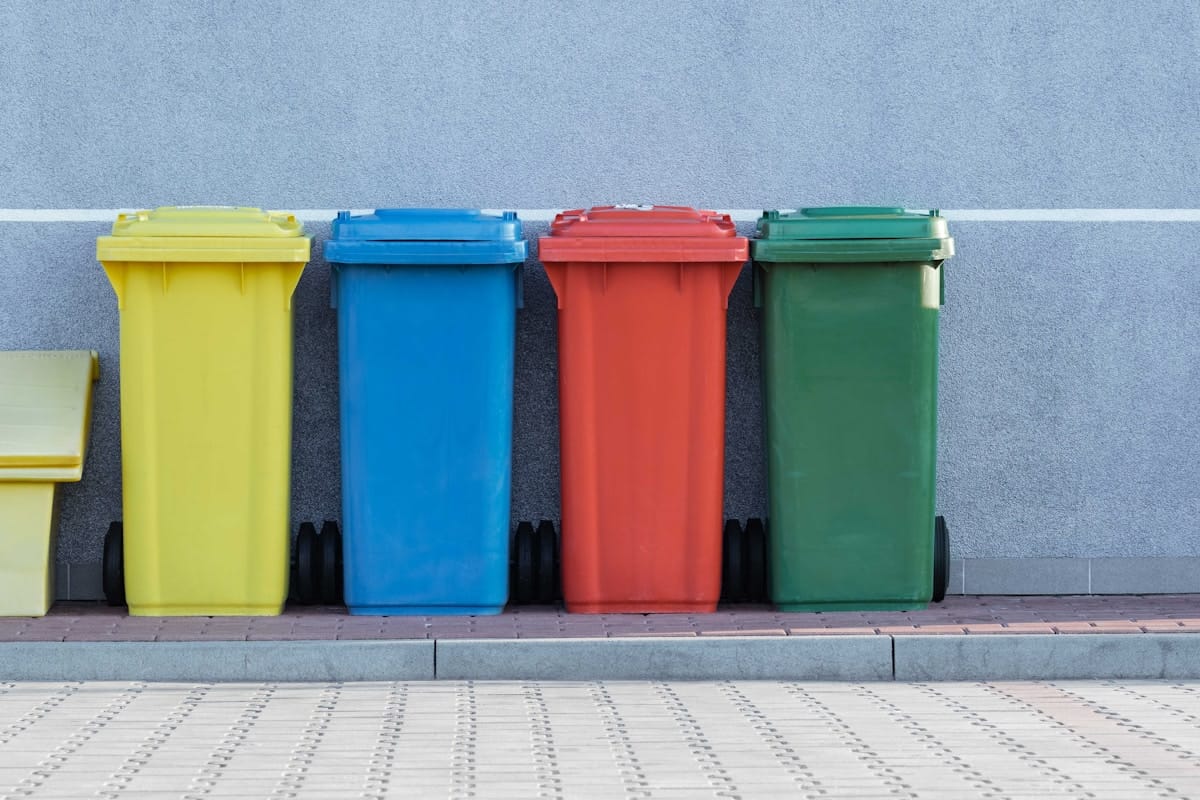
Portugal sorts household waste into street recycling bins (ecopontos) by colour. Yellow is for plastic and metal packaging and drink cartons, blue for paper and card, green for glass, and brown for food waste where your council offers it. Plastic bottles and cans with the Volta symbol carry a 10 cent deposit, refunded at supermarket machines. Oil, batteries, electronics, medicines, textiles, and bulky items each have their own drop-off. Sorting is free. You pay for collection through a waste charge, usually on your water bill.
Which bin takes what
| Bin | Takes | Keep out |
|---|---|---|
| Yellow (embalagens) | Plastic bottles, tubs, pots, trays, bags, and film; food and drink cans; aluminium foil and trays; milk and juice cartons | Pots and pans, toys, hoses, gas canisters, cooking oil |
| Blue (papel e cartão) | Newspapers, magazines, paper bags, boxes (flattened), egg boxes | Tissues, napkins, kitchen roll, greasy or wet paper, coated paper cups |
| Green (vidro) | Glass bottles and jars of any colour | Drinking glasses, mirrors, ovenware, ceramics, light bulbs |
| Brown (biorresíduos) | Food scraps, peelings, coffee grounds, tea bags, eggshells | Check your council's list; rules vary |
| Grey or general bin (indiferenciado) | Whatever cannot be sorted | Anything recyclable or hazardous |
Many ecopontos also have a small red box for household batteries (pilhão).
How to sort well
- Empty packaging, but do not wash it. Scrape out food and drain liquids. Washing wastes water, and the recycling plant cleans it anyway.
- Flatten boxes, bottles, and cartons. They take less space at home and in the bin.
- Drink cartons go in yellow, not blue. They are part paper, but they are sorted with plastic and metal.
- Empty meat or fish bags can go in yellow.
- Tip loose items into the bin. Do not put a tied bag of mixed recyclables in.
- Glass does not need sorting by colour. All glass bottles and jars go in one green bin.
- Only bottles, jars, and pots go in green. Drinking glasses, mirrors, and ovenware melt at different temperatures and spoil a whole batch.
The Volta deposit on bottles and cans
Volta is Portugal's deposit return scheme for drinks. It started on 10 April 2026. Since 10 August 2026, every covered drink must carry the Volta symbol.
What it covers: single-use plastic bottles and metal cans up to three litres, sold in Portugal and marked with the Volta symbol.
What it does not cover: glass, drink cartons, and drinks that are more than 25% milk. These still go in the ecopontos.
How it works:
- You pay a 10 cent deposit on each covered drink at the till. No VAT is charged on it.
- Keep the container empty, intact, and uncrushed, with its cap on and its barcode readable. You do not need to rinse it.
- Take it to a Volta point. There are over 3,000 machines, mostly in supermarkets, and larger kiosks in some towns. You can return containers bought anywhere.
- Feed the containers in one at a time. The machine gives you a voucher.
- Swap the voucher for cash, spend it in the shop, or donate it to charity. Vouchers last one year.
Cafés and restaurants only have to take back containers they sold you. If you eat in and pay at the end, you are not charged the deposit.
A crushed container, or one without a readable barcode, is refused and you lose the deposit. If a shop refuses a valid refund, tell the manager, because refusing is an offence.
The Volta website has a map of drop-off points.
Food waste and the brown bin
Councils have had to collect food waste separately since 31 December 2023. How they do it varies:
- Some collect a brown bin from your door.
- Some have brown bins on the street.
- Some offer home compost bins.
- Some are still rolling it out.
Check your council's website or ask at your parish council (junta de freguesia) for what is accepted and when.
Cooking oil
Never pour used cooking oil down the sink. Let it cool, pour it into a closed plastic bottle, and drop the bottle in an oil container (oleão). You find them on streets, at supermarkets, and at council recycling centres. The oil is turned into biodiesel or soap.
Batteries and light bulbs
Put household batteries in the red box on an ecoponto, or in the battery boxes in most supermarkets and electronics shops.
Larger batteries, such as car, e-bike, or power tool batteries, go to a council recycling centre (ecocentro) that accepts them.
Energy-saving and fluorescent bulbs contain hazardous substances. Never put them in the green glass bin or general waste. Take them to an electronics collection point or an ecocentro.
Electrical and electronic items
You have three options:
- Swap in the shop. When you buy a new appliance, the shop must take your old one back free if it does the same job.
- Drop small items at large shops. Shops with at least 400 m² selling electrical goods must take items up to 25 cm free, with no purchase needed. Examples are phones, chargers, and hair dryers.
- Use an ecocentro for fridges, washing machines, TVs, and computers.
If it still works, a charity may take it.
Medicines
Take unused or expired medicines and their empty packaging to any pharmacy or parapharmacy. They go in the Valormed container. This includes tablets, creams, blister packs, boxes, leaflets, bottles, and dosing spoons.
The Valormed container does not take needles, syringes with needles, dressings, mercury thermometers, batteries, or X-rays. Ask your pharmacy or health centre how to dispose of needles safely. See Using a Pharmacy in Portugal.
Clothes, shoes, and textiles
Textiles do not go in any ecoponto. Since 1 January 2025, councils must collect them separately. Use a textile container on the street, an ecocentro, a charity shop, or the collection box in some clothing shops.
Furniture, mattresses, and other bulky items
Councils must collect furniture and other bulky waste (monos or monstros) separately since 1 January 2025. You have two options:
- Book a pickup. Phone or book online with your council or, in some cities such as Lisbon, your parish council. You are given a day, and you put the items out at the stated time. Collection is usually free for households, sometimes within a volume limit.
- Take it to an ecocentro yourself. Bring proof of address, as some centres only serve local residents.
Do not leave items on the street without a booking. Councils treat it as illegal dumping and can fine you.
Building and garden waste
If a builder does your works, the builder must remove and dispose of the rubble.
If you do small repairs yourself, councils must offer a way to collect small amounts of DIY building waste. Many ecocentros accept small quantities. For larger jobs, hire a skip (contentor) from a licensed waste company. See Building Your Own Home in Portugal for bigger projects.
Garden waste: small amounts of leaves and grass may go in the brown bin if your council allows it. Branches and larger loads go to an ecocentro, or to a garden waste pickup where your council runs one.
Paints, chemicals, and other hazardous waste
Paint, solvents, garden chemicals, motor oil, and old fire extinguishers are hazardous. Councils must collect household hazardous waste separately since 1 January 2025. Take them to an ecocentro. Never put them in ecopontos, general waste, or drains.
What it costs
Sorting and drop-offs are free for households. You pay for rubbish collection through a waste charge (tarifa de resíduos). In most councils it appears on your water bill. Councils set their own charges, and they vary a lot, so check your bill. See Setting Up Water in Portugal.
Many councils offer a reduced waste charge for low-income households. Ask your council or water provider.
If collection fails
Missed collection, a full or broken bin, or dumped rubbish: report it to your council or parish council. Many councils have an app or online form for this.
Complaints about your waste bill or service that the council does not fix: complain to the provider, then to ERSAR, the national water and waste regulator.
Sources
This guide is written from official Portuguese and EU sources and, for prices and contact details, the providers' own websites.
- Government of Portugal, Volta deposit return scheme launch (10 April 2026): https://portugal.gov.pt/pt/gc25/comunicacao/noticias/volta-sistema-de-deposito-e-reembolso-de-embalagens-entra-em-vigor (start date, 10 cent deposit, scope, 90% target)
- Directorate-General for Economic Activities, Deposit return system (10 April 2026): https://dgeconomia.gov.pt/comunicacao/noticias/sistema-de-deposito-e-reembolso.aspx (deposit, return conditions, transition to 9 August 2026)
- Volta, frequently asked questions: https://volta.com.pt/perguntas-frequentes/ (containers accepted and refused, over 3,000 points, vouchers, restaurants, no VAT)
- Decreto-Lei 102-D/2020, general waste management regime, Diário da República: https://diariodarepublica.pt/dr/detalhe/decreto-lei/102-d-2020-150908012 (council duties for food waste, textiles, hazardous and bulky waste, cooking oil, DIY building waste; shop take-back of electronics)
- Lipor, recycling questions: https://www.lipor.pt/pt/perguntas-frequentes/o-poligrafo-da-reciclagem/ (what goes in each bin, no washing, glass, cartons, bulbs, batteries, textiles, cooking oil)
- Valormed: https://www.valormed.pt/ (medicines accepted and refused at pharmacies)
- Electrão: https://www.electrao.pt/ (battery and electronics collection network)
- ERSAR, water and waste regulator: https://www.ersar.pt (complaints about waste services and charges)
Last verified September 2026. Rules and fees change; check the official source before acting.