About 350,000 Civil Servants Strike Today, and Schools, Social Security Counters and Bin Rounds May Not Open
Three CGTP unions have called out the general careers of central, regional and local government for 24 hours. Minimum services cover a handful of island flights, and pay talks resume on Tuesday.
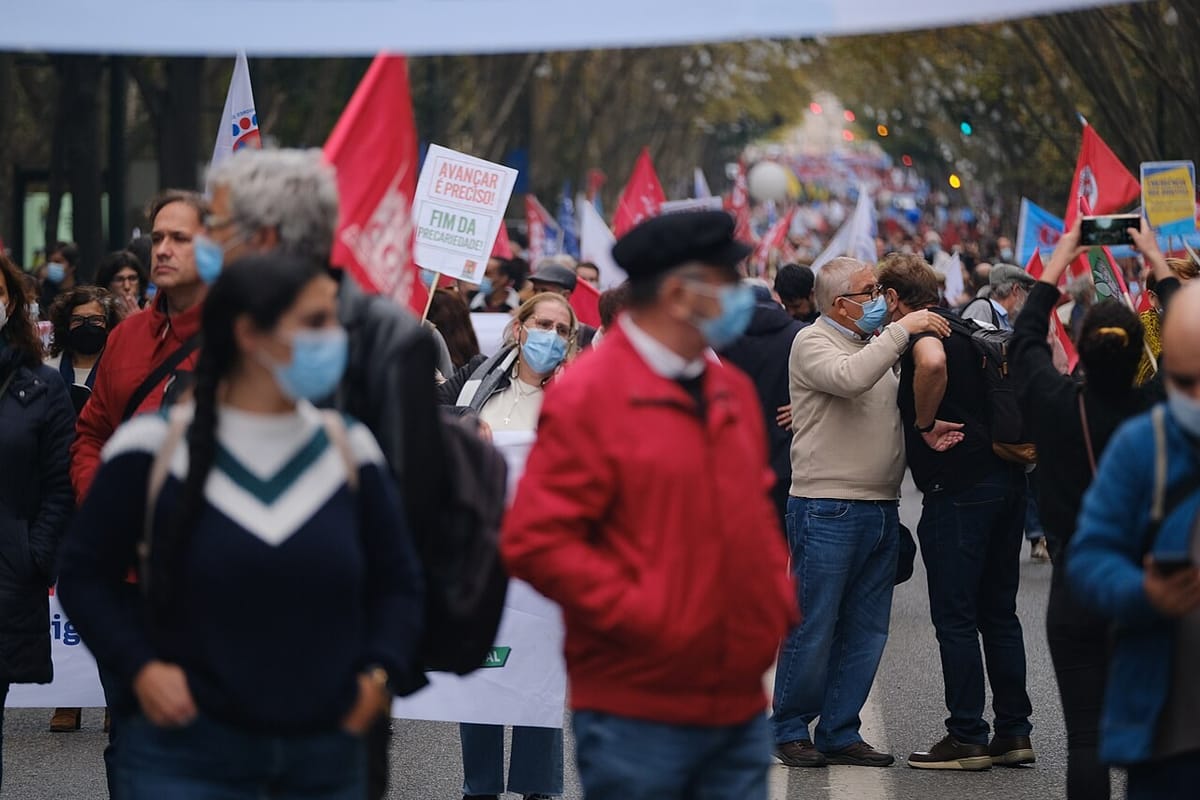
About 350,000 people who keep Portugal's public services running were called out on strike from midnight, for 24 hours on Friday 2 October. The stoppage covers the general careers of central, regional and local government: the operational assistants, technical assistants and senior technicians who staff school corridors and canteens, Social Security counters, registry and notary offices, court offices and council bin rounds.
Three unions affiliated to the CGTP confederation called it jointly: the national federation of public-service unions (FNSTFPS), the local and regional government workers' union (STAL) and the Lisbon city workers' union (STML). They warn that schools, universities, Social Security services, registries, the justice system and rubbish collection could all be disrupted. Whether a given school or office opens depends on how many of its staff stop work, so families should check with their own school before setting out.
What the unions want
The unions say workers in the general careers are "the worst paid in public administration". They are asking for an immediate revaluation of those careers, recognition of the particular demands of each profession, and for pay talks to start now rather than wait until next year. A march is due to leave Lisbon's Praça da Figueira at 11:00 for a rally outside the Finance Ministry, with the CGTP's secretary-general, Tiago Oliveira.
The strike comes days before a round of pay talks. Under the multi-year agreement the government signed with two other union groups earlier this year, civil servants get a rise of 60.52 euros or at least 2.3 percent in 2027, and the lowest public-sector salary goes to 995.51 euros. The CGTP's Frente Comum, which did not sign, wants a public-sector minimum of 1,150 euros, a rise of at least 15 percent for everyone else and a meal allowance of 13 euros a day. Even the signatories now want more: the FESAP federation asks for 1,050 euros and 6.5 percent, and the Frente Sindical led by the STE union for 7.3 percent. The demands go to the government on Tuesday 6 October at the Labour Ministry, in the same week the 2027 budget is due in parliament.
Minimum services on island flights
An arbitration panel at the public administration directorate-general, DGAEP, has ordered minimum services for staff at the weather institute, IPMA, after the institute and the FNSTFPS failed to agree, and has set a minimum level of flights to and within the islands. Emergency, military and state flights must operate, along with one return flight each between Funchal and Lisbon, Ponta Delgada and Lisbon, Ponta Delgada and Funchal, and Funchal and Porto Santo, plus one flight on each of a list of inter-island routes in the Azores. "Insularity does not mean that every flight scheduled during the strike is an unavoidable social need," the panel wrote. SATA said it would let passengers on inter-island flights change their travel date free of charge.
This is the national stoppage behind the dispute we reported from Madeira last month, where a rising regional minimum wage is squeezing the public pay scale.
A push to limit school strikes
On the eve of the strike, the Iniciativa Liberal party tabled a bill to make minimum services compulsory in schools whenever teaching or non-teaching staff strike during term. The law currently requires them only so that final assessments and national exams can go ahead. The party says Portugal has had almost 1,500 strikes in the last decade and that closures hit the most vulnerable pupils hardest.
Travellers face a second dispute this weekend: easyJet's cabin crew strike, which began on Thursday and runs until 6 October, has led the airline to cancel at least 443 flights in Portugal. We set out the background to that strike in September.