A Marinha Grande Factory Now Machines Titanium Flaps for Saab's Gripen Fighters as Portugal Grows a Small Aerospace Niche
Vangest, a precision-engineering group in Marinha Grande, is producing titanium flaps for Saab's JAS 39 Gripen fighter and chasing Airbus qualification. With 70 of its 350 staff on aerospace and 35% sector growth projected to 2035, it is a small sign Portugal is building a supply-chain foothold.
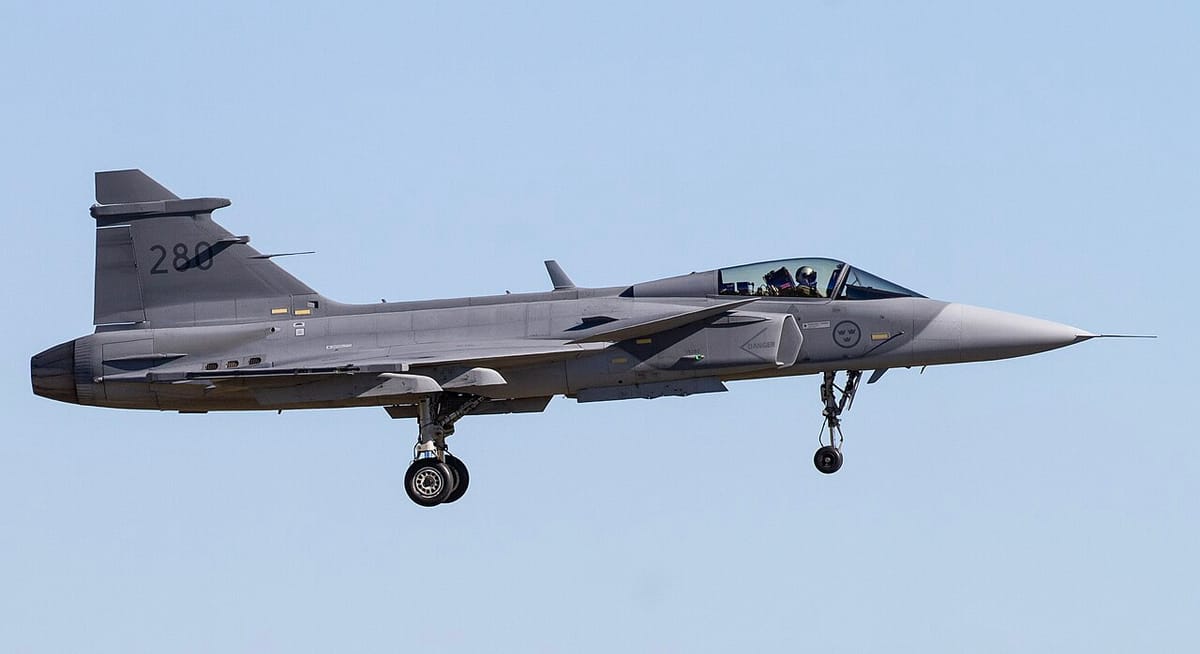
In a cluster of industrial pavilions in Marinha Grande — a town better known for glassmaking and plastic moulds than for military aviation — a Portuguese company is quietly machining parts for one of Europe's front-line fighter jets. Vangest, a metalworking and precision-engineering group, is now producing titanium flaps and other machined components for the Saab JAS 39 Gripen, the Swedish combat aircraft, according to a report by ECO.
The work is exacting. “It serves to direct air. It's a flap,” plant manager Dulce Alves explained of the component, one of the small aerodynamic surfaces that steer airflow over the aircraft. The material is unforgiving titanium — “very hard,” she said, chosen precisely because the parts must survive the extreme speeds and stresses of a fighter in flight. On a project that began in June 2025, the plant has already delivered 100 titanium pieces, with another 100 due by August.
A factory built for tolerances
Vangest occupies a 43,000-square-metre complex of eight pavilions, two of them dedicated entirely to aerospace and holding some 100,000 hours of installed machine capacity. Those machines run almost around the clock — 20 to 22 hours a day across two shifts — because in aerospace the cost of a rejected part is punishing: the company keeps non-conformance to about 0.2% of output and is chasing the sector's benchmark of under 0.1%. Of its 350 employees, around 70 — a fifth of the workforce — now work on aeronautics. Owned by the Portuguese fund ZenoPartners, led by Duarte Moreira, the group reinvests roughly a tenth of its annual revenue in equipment and people and projects aerospace revenue growing about 35% through 2035.
Climbing the supply chain
The Gripen contract is the latest rung on a long climb. Vangest has supplied OGMA (Indústria Aeronáutica de Portugal), the Alverca-based maintenance and manufacturing firm, since 2012, machining around 500 different part references a year for platforms including the Embraer KC-390 military transport. Now it is a direct supplier to Saab, and is pursuing qualification with Airbus, a process it hopes to complete within six to twelve months.
Breaking in is deliberately hard. “Entering aeronautics is very difficult. They don't want many players, because of cybersecurity and technology concerns,” said Hamid Monsef, the group's head of aerospace business development. The contrast with Portugal's neighbour is stark: Seville alone counts more than 400 qualified Airbus suppliers, while Portugal still lacks a comparable base. Vangest's ambition — backed by group chief executive Rune Bakke and Portugal general manager Rui Tavares — is to knit together a small domestic “mini-cluster” of specialised partners that can deal with aircraft-makers as a single, credible Portuguese solution.
Tested by the storm
That resilience was tested this June, when Storm Kristin battered the region and knocked out infrastructure across central Portugal. Vangest kept its deliveries moving with only a week or two of delay, running on borrowed generators, and even leaned on the Portuguese Air Force to help transport equipment — an unusually literal example of the civil-military ties the aerospace push is meant to build.
Why it matters
Portugal does not fly the Gripen, so the significance here is industrial rather than military: a mid-sized Portuguese firm is proving it can hold the tolerances that Europe's aircraft primes demand. That capability is exactly what Lisbon hopes to leverage as defence spending climbs — the Government has been talking up the “economic payback” from big-ticket orders such as its €3.9 billion buy of three Italian-built frigates. Contracts flow to the countries that can already make the parts, and Marinha Grande is a small, concrete sign that Portugal is trying to earn a place on that list.