Unions Suspend the Lisbon Metro's 28 and 30 October Morning Strikes in Protest at a Minimum Service Ruling, While CP's Friday Rail Strike Stands
The partial Metro strikes of Wednesday and Friday mornings are off: the unions say the minimum service the arbitrators ordered put safety at risk. CP's 24-hour rail strike on Friday 30 October still goes ahead.
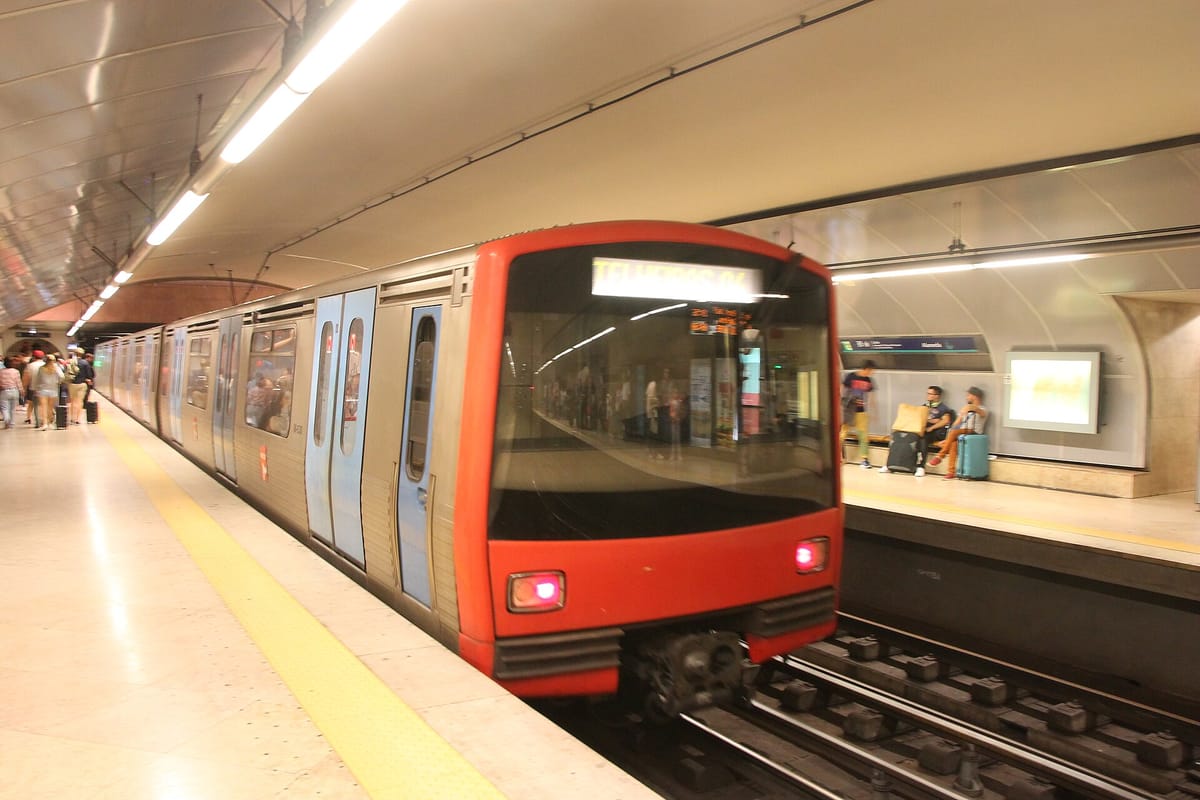
The Lisbon Metro's two morning strikes are off. The unions representing Metropolitano de Lisboa workers have suspended the partial strikes they had called for Wednesday 28 October and Friday 30 October, each due to run from 05:00 to 10:00, the transport federation Fectrans said in a communiqué on Monday evening.
The unions say they are dropping the stoppages in protest at the minimum service an arbitration panel had ordered for both days. They argue that running trains under the terms set would put the safety of passengers and staff in question.
Friday's rail strike is a separate dispute and still stands. Conductors, ticket-office staff and supervisors at Comboios de Portugal (CP, the state railway) strike for 24 hours on 30 October, and CP's passenger notice still warns of disruption that day and possibly on the 29th and 31st. We set out the union's demands and how to get a CP refund last week.
What the arbitrators decided
Minimum services in public companies are set by arbitration panels at the Conselho Económico e Social (CES, the Economic and Social Council). For these two strikes the panel, in ruling ARB/29/2026, ordered a reduced train service. The Metro's own notice, published on Monday afternoon before the unions' decision, said trains would run on all four lines between 07:00 and 10:00, stopping only at a list of stations, with every other station closed and much longer waits than usual.
Fectrans says the service ordered amounts to about 25 percent of normal running and matches what the company asked for. It points out that in 2024, faced with a similar strike and the same presiding arbitrator, the panel set no minimum train service. For the 24-hour strike of 14 October, too, the arbitrators refused one, and the network shut.
The federation's main objection is to the ruling's reasoning. According to Fectrans, ARB/29/2026 accepted the company's argument that train safety is guaranteed by automatic systems that "in no way depend" on staff at the Central Command Post, which controls train movements. "If, as the company maintains, the safety of train movements does not depend on human intervention at the command post, why does the decision itself consider it necessary for workers to be present there?" the communiqué asks.
Sara Gligó, a leader of Fectrans and of the STRUP union, told Lusa, as reported by Observador, that the unions had written to their members and to the CES to call off the strikes. She said the ruling "goes against existing case law" and allows striking workers to be replaced by others "who are not qualified for these duties".
The dispute is not over
The underlying grievances remain. The strikes were called over staffing and working conditions for supervisors at the command post and in the traction section, the same issues behind the 14 October stoppage, as we reported when the two dates were announced. The Metro's board had called the strikes disproportionate and said a recruitment and training plan would be finished in the second half of December.
"Despite the suspension of the strikes, the workers' fight for their rights will go on," Fectrans says, and it questions whether minimum services of this kind are compatible with the Constitution and the strike law. On Monday the Metro said it would keep talking to the unions in the hope of an agreement. It had not updated its notice to reflect the suspension by late Monday evening, so passengers may wish to check the Metro's channels before travelling on Wednesday.