Two Painted Pilasters Stood in a Caramulo Garage for Seventy Years. Specialists Say the Painter Was Columbano.
The family of Abel Lacerda, who founded the Museu do Caramulo, lifted a cover in the garage of his house and found decorative painting underneath. The curator Pedro Lapa places the work beside the panels in the Hotel da Lapa.
Two wooden pilasters, each about three metres tall, spent more than seventy years under a cover in the garage of a house at Caramulo. The family that owns the house has now been told by specialists that the paintings on them are by Columbano Bordalo Pinheiro, the most important Portuguese portraitist of his generation, who died in 1929.
The house was built by Abel Lacerda, the art collector who founded the Museu do Caramulo, in Tondela, in the Viseu district. He lived in it from 1954 until his death in 1957, and the museum he assembled opened two years later, in 1959. His great-niece, Madalena Gouveia Reis, told the Lusa news agency that he had kept in the garage "some columns he must have bought, nobody knows where or from whom".
A conversation, and then a cover lifted
The discovery came out of a family conversation a few weeks ago. "Our uncle, Miguel Lacerda, Abel Lacerda's son, wanted to show us some columns that had been there for more than seventy years, and with paintings, he said, by Columbano," Gouveia Reis recounted. She and her brothers Tiago and Salvador were surprised, she said, because the house is a lived-in family house rather than one with hidden treasures. They lifted the covering that had been protecting the pieces and found "a very interesting painting" underneath.
Photographs went out to friends in museums and to art specialists, and the answer, she said, came back immediately.
What the curator says
One of those consulted was Pedro Lapa, the curator and art historian who has studied Columbano's work, directed the Museu Nacional de Arte Contemporânea at the Chiado and was artistic director of the Museu Coleção Berardo.
Lapa told Lusa that he had examined the pilasters only in photographs, but that digital images now allow details to be seen clearly enough, and that these are without doubt decorative paintings by Columbano. He placed them alongside works of the same kind in the Hotel da Lapa in Lisbon, with dance and courtship as their themes, and thought they must belong to the same period. Without seeing the texture of the paint in person he would date them to the end of the nineteenth century or the beginning of the twentieth.
His assessment of their quality was warmer than a simple attribution. These paintings, he said, are freer and less constrained than much of the artist's output, and that gives them a special creative value.
A question of where they came from
The family's working theory is that the pilasters arrived during the years when Abel Lacerda was buying art both for the museum he was building and for the house, which was serving as a staging post for the collection. Everything else he acquired ended up in the Museu do Caramulo. These two, as Gouveia Reis put it, were left behind, stored so well that they stayed in the garage for seven decades.
The figures painted on the wood are festive, which has led the family to suspect they may once have framed the ballroom of a palace. A deeper investigation into their origin is only now beginning.
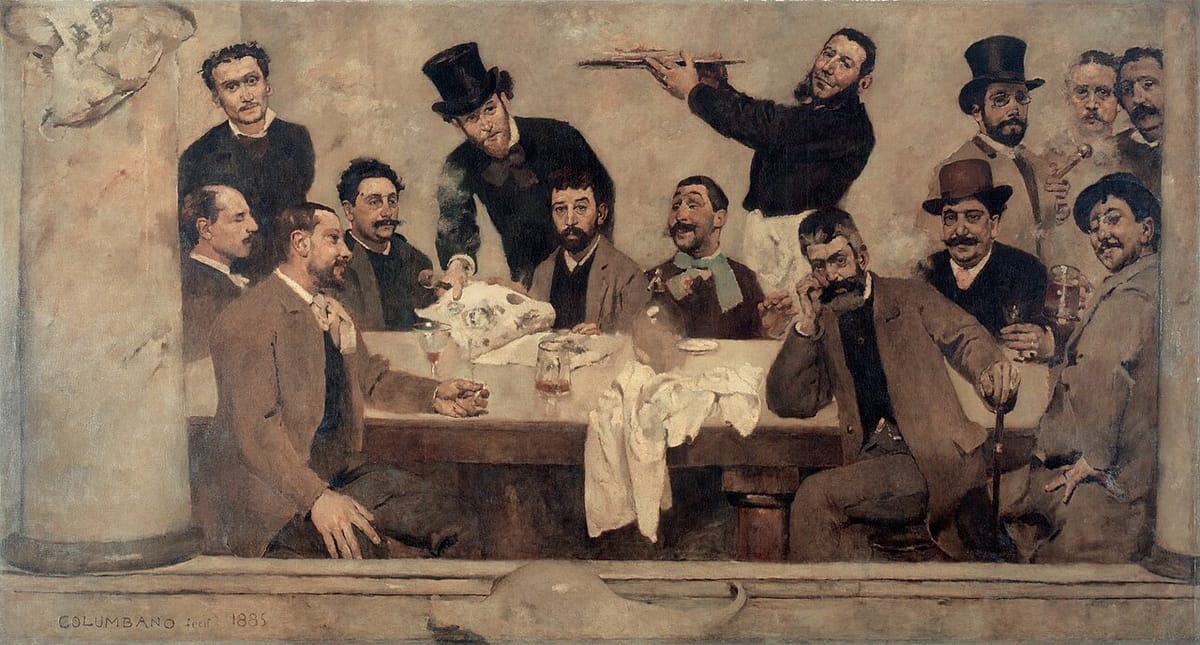
Columbano Bordalo Pinheiro, born in 1857, was the younger brother of the caricaturist and ceramicist Rafael Bordalo Pinheiro. He is best known for his severe, dark portraits of the Portuguese intellectual class and for the group portrait of the Grupo do Leão. Decorative commissions of the sort described here are a less catalogued part of his work, which is precisely why two of them turning up in a garage in the serra is worth a proper look.