Twenty-Seven Cameras in the Bairro Alto Get Another Three Years, in a City That Already Has 126 and Wants 616 More
A government order published on Monday renews Lisbon's oldest street surveillance system, running since 2014. The renewal itself is routine; what sits behind it is a plan to take the police camera network out of the nightlife districts and into residential neighbourhoods.
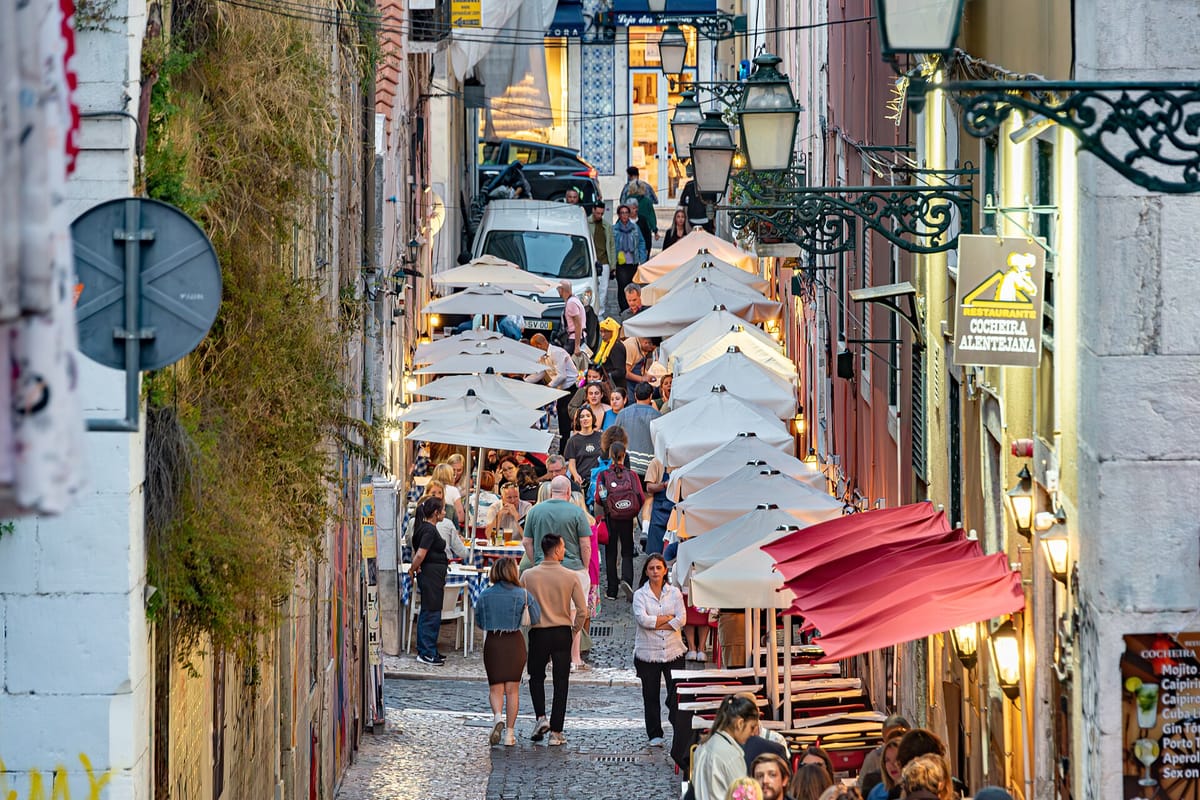
The twenty-seven surveillance cameras watching the Bairro Alto have been authorised for another three years. The order renewing them was published on Monday in the Diário da República (the official gazette), signed by Telmo Correia, Secretary of State for Internal Administration.
The system is older than most of the people it films on a Friday night. It came into operation on 22 May 2014 and has been kept alive ever since by a chain of renewals, first in two-year blocks and later in three-year ones. Monday's order continues that pattern rather than breaking it.
The request came from the national directorate of the Polícia de Segurança Pública (Public Security Police, or PSP). Its case, as summarised in the order, was that the conditions justifying the original authorisation still hold, and that the Bairro Alto is "one of the busiest areas of the city, where crimes of various kinds occur, from petty crime through to violent and serious crime".
A hundred and twenty-six cameras, and counting
The renewal matters less on its own than as one piece of a network that is being built out quickly.
At a meeting of the Assembleia Municipal de Lisboa (Lisbon Municipal Assembly), councillor Joana Baptista, an independent elected on the PSD list, set out what is currently running in the city. There are 126 cameras in operation: the 27 in the Bairro Alto, 32 at Campo das Cebolas, 30 at Cais do Sodré, 17 at Restauradores and 20 at Ribeira das Naus. Every one of those locations sits in the historic centre or along the riverfront.
Two expansions are already on the table. In July the city council said it wanted a second protocol with the PSP to install 500 cameras at Parque das Nações, along Almirante Reis and on Avenida da Liberdade, an investment it put at 12 million euros. Separately, Baptista described a following phase of 116 cameras covering the Baixa Pombalina and Santa Apolónia, costing 3.5 million euros to be written into the municipal budget across 2027 and 2028. That figure also covers works at the PSP's 1st Squadron and at Cometlis, the force's Lisbon Metropolitan Command.
Taken together, the two announced phases would add 616 cameras to the 126 already running. That is close to a sixfold increase, and it moves the network well beyond the nightlife districts it started in. Almirante Reis and Parque das Nações are residential and commuter ground, not places people go out drinking.
What this means for residents of Portugal
- Video surveillance in public space needs central authorisation, and it expires. A council cannot simply switch on street cameras. Each system is authorised by government order for a fixed term, and has to be renewed, which is why the Bairro Alto has generated a paper trail since 2014. That expiry date is the main formal check on the system.
- The 500-camera phase is a proposal, not a done deal. It requires a protocol with the PSP and the same authorisation route. The 116-camera phase depends on money being entered in budgets for 2027 and 2028, which is two municipal budget votes away.
- If you live in the Bairro Alto, nothing changes on the ground. The same 27 cameras carry on. What changed on Monday is the legal permission behind them, which now runs three years further out.
- Lisbon is not unusual in this. Municipalities across the country, including several in the Algarve, have moved down the same path over the past few years. Lisbon is doing it at a larger scale and in denser ground.
The Bairro Alto renewal is routine, and that is rather the point. Twelve years of quiet three-year extensions is how a system stops being a pilot and becomes permanent, and the decision that deserves the argument is not this one but the 500 cameras that would follow it into neighbourhoods where people live rather than drink.