Transtejo's Ten Electric Ferries Ran Together for the First Time on Wednesday, Three Years After the First One Arrived
The state ferry operator marked the moment at Cais do Sodré with a claim it has waited three years to make. The figure that matters to commuters is a different one: cancellations down about 90 percent, and the permanent 30 percent cut at Cacilhas gone.
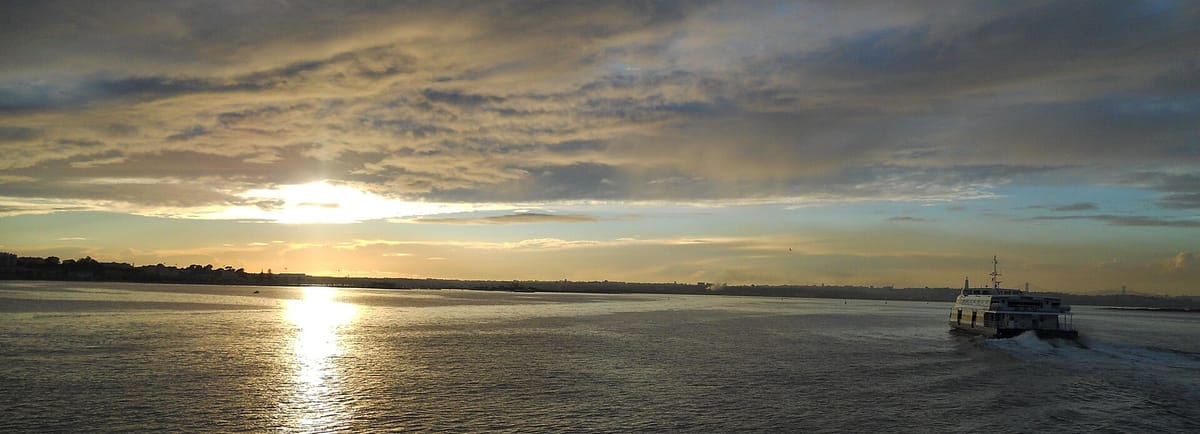
For the first time since the fleet was ordered, all ten of the electric catamarans that cross the Tagus between Lisbon and the south bank were working at the same time on Wednesday. Transtejo Soflusa, the state-owned river operator, marked the moment with a ceremony on the quayside at Cais do Sodré and a claim it has been waiting three years to make: that this is now the largest fully electric river operation anywhere in the world.
The last of the ten vessels reached Portuguese water in October 2025. Getting all ten to run on the same day took another eleven months. "For various reasons, over time, we never managed to have the ten vessels working at the same time," the company's president, Rui Ribeiro Rei, told reporters. "So from today we will have more capacity to guarantee our operations."
The vessel that held the fleet up was the one that arrived first. The Cegonha Branca, delivered in March 2023, developed a fault that took two years to repair. It is back in full service.
The claim, and what sits behind it
Transtejo's case for the world record rests on three things rather than on the count alone. Each of the ten boats carries 540 passengers, which puts 5,400 seats on the water across the electric fleet. The charging towers on the quays deliver power at roughly four times the rate of comparable shore equipment. And the stretch of the Tagus these boats work is an estuary wide enough to behave, in Rui Rei's words, practically like open sea rather than like a river or a lake.
"There is no operation in Europe or in the world with ten electric vessels of 540 seats and this level of charging," he said. That is also, he acknowledged, why the project ran into so much trouble: the charging system needed reconfiguring after repeated faults, with a reinforced broadband link and additional sensors, and crews had to be retrained.
The ten boats cost 97 million euros, financed with Portuguese public money and European funds, in a procurement that began in 2020. Each is named after a bird of the Tagus estuary: Cegonha-Branca, Garça-Vermelha, Flamingo-Rosa, Íbis-Preto, Tarambola-Dourada, Milhafre-Preto, Perna-Verde, Alvéola-Amarela, Trepadeira-Azul and Peneireiro-Cinzento. Batteries are charged only to 90 percent to preserve them. Each boat has two saloons, outside deck space, places for passengers with reduced mobility and room for at least twenty bicycles.
The number that matters to commuters
The interesting figure from Wednesday is not the seat count. It is the cancellations.
Transtejo says it has cut suppressed sailings by about 90 percent since November last year. On the Cacilhas run, which is the busiest crossing on the river, a permanent 30 percent cut in scheduled departures has ended, and the service to Cais do Sodré now runs from 5:00 to 2:30. Electric boats have carried more than five million passengers so far, about three million of them at Cacilhas, which has been running on electric power alone for roughly three months.
Seixal is also fully electric. Montijo is being converted progressively, and some Barreiro departures are already worked by electric boats, on a route where that was never part of the original plan. Diesel use is down 1.74 million litres, which the company puts at the equivalent of 87,000 car journeys between Lisbon and Porto.
That reliability record is the basis for an unusual public pitch. Rui Rei used the ceremony to invite back the commuters who gave up on the ferries during the worst of the disruption and moved to Fertagus, the private rail operator on the south bank line. "All those thousands of passengers who meanwhile chose to go by Fertagus can start coming by Transtejo, because they will come 540 at a time, normally seated, in comfort, with wifi, and soon watching television," he said.
The Minister for Infrastructure and Housing, Miguel Pinto Luz, who attended, called the day historic and said the government would keep backing river mobility as part of the transport strategy for the Lisbon metropolitan area. "We will be here to take on this great challenge of making the Tagus more and more a motorway that is friendly to the environment and to people," he said. He also noted that extra Fertagus carriages are going through licensing and adaptation, a process that takes time.
Readers who have been following this story will recognise how far the tone has moved. In August the transport regulator put Lisbon's river ferries on a monthly report card for delays and cancellations, an intervention that only happens when a service has stopped being dependable.
Half the fleet still burns diesel
Ten electric boats is half the story. Transtejo still operates about ten diesel vessels, more than two thirds of them on the Barreiro route, and it is not letting them go.
"We have been putting off some further replacement and we have been investing heavily in maintaining the diesel fleet, because we still need a good part of it for other operations, including the new ones at Algés and possibly at Parque das Nações," Rui Rei said. "We cannot do without part of the diesel fleet without guaranteeing that in time we have a plan to replace it completely." The diesel boats also cover for electric vessels that are out of service.
That plan is being written. The company has committed to putting a full fleet renewal proposal to the Ministry between the end of this year and the first quarter of 2027, informed by an external study of supply and demand on both banks. One conclusion is already settled: the next generation will be different. "We will not need to buy vessels as large in future," Rui Rei said. "What we will need are slightly smaller and more agile vessels and, possibly, slightly higher top speed."
Parque das Nações in 2027
The other announcement concerns the eastern end of Lisbon. Transtejo is finishing a protocol with Lisbon city council and expects approval in time to carry out works at the Parque das Nações quay and start running there during 2027. That would give the operator a service stretching from the western edge of the city's river frontage to the eastern one.
The date is worth holding lightly. When we looked at the Parque das Nações plan at the end of June, the council and the operator were already some way apart on timing, and no start date was given on Wednesday either. The Algés service, opened as a trial in July, is a firmer commitment: Rui Rei said it moves to a full all-day timetable this month.
For anyone weighing the river against the road or the train, the fare side has not changed: the ferries sit inside the Navegante pass, and our guide to subscribing to the Passe Navegante covers how the metropolitan tariff applies to a Tagus crossing.