The Portuguese Army Buys a €1.3 Million Laser Combat Simulator to Sharpen Field Training
The Portuguese Army has bought a laser-based force-on-force combat simulator from Sweden's Saab for about €1.3 million, part of a roughly €5 million plan to modernise training. Based at Santa Margarida, it instruments soldiers and weapons to score live exercises objectively.
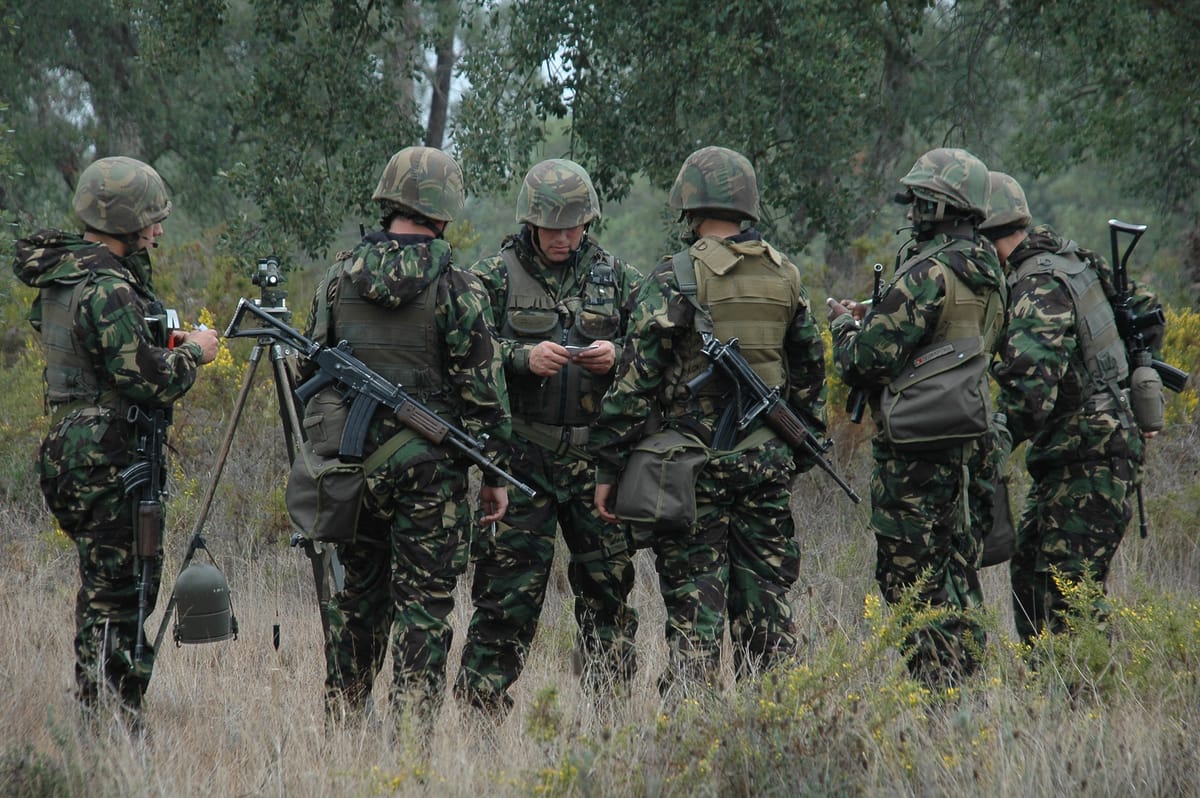
The Portuguese Army is putting a little more technology into the business of training soldiers to shoot. It has bought a laser-based combat simulator from the Swedish defence group Saab for €1,250,260 before tax — around €1.3 million all in — a system designed to turn live field exercises into something closer to a refereed match, where every shot and every hit is recorded and measured rather than left to argument.
The equipment is a "real tactical engagement simulation" system, and the principle is straightforward. Soldiers and their weapons — from individual rifles and machine guns to anti-tank launchers and vehicles — are fitted with laser emitters and sensors. When a soldier fires, the system works out whether the shot would have connected and what its effect would have been, registering casualties and near-misses in real time. The result is objective data on how a unit actually performed under pressure, replacing the guesswork of traditional blank-fire manoeuvres with a hard record that instructors can replay and dissect.
The simulator will be based at the Centro de Capacidades Táticas, Simulação e Certificação at the Campo Militar de Santa Margarida, the Army's main manoeuvre base north-east of Lisbon, and it is rated to handle exercises up to company level — a few hundred troops. It replaces an older system, SITPUL, and is due to be delivered by the end of 2026.
This is not a one-off purchase but the second piece of a phased plan worth roughly €5 million. Late in 2025 the Army acquired a Virtual Battle Space 4 system — a computer-based environment for rehearsing operations on screen — and two further tools are planned: a constructive simulation system for modelling larger engagements, and a virtual range for individual weapons practice. A separate tender worth around €75,000 is upgrading the centre's infrastructure to house the new kit.
The spending is small in the scheme of a national defence budget, but it is telling. Simulation has become a standard way for modern armies to squeeze more value from limited ammunition, fuel and range time, letting troops repeat scenarios far more often, and far more safely, than live firing allows. For a mid-sized force like Portugal's, which has committed to lifting military spending toward NATO's benchmarks, investments that stretch each training day tend to offer more capability per euro than big-ticket hardware.
For the general reader, the purchase is a quiet illustration of where defence modernisation actually happens — less in dramatic weapons deals than in the unglamorous machinery of training. As Portugal rebuilds parts of its armed forces after years of tight budgets, the ability to certify that a unit can fight, on evidence rather than assumption, is exactly the sort of foundation the country will need before any of the flashier capabilities make sense.