The Pisão Dam Is Given Until 2030 and Keeps Its 222 Million Euros, With the Works Halted by the Courts Since May
A Council of Ministers resolution pushes the Crato dam's spending calendar from 2027 to 2030 without raising the ceiling. The project left the Recovery Plan in 2025, and four environmental groups have it tied up in the administrative courts.
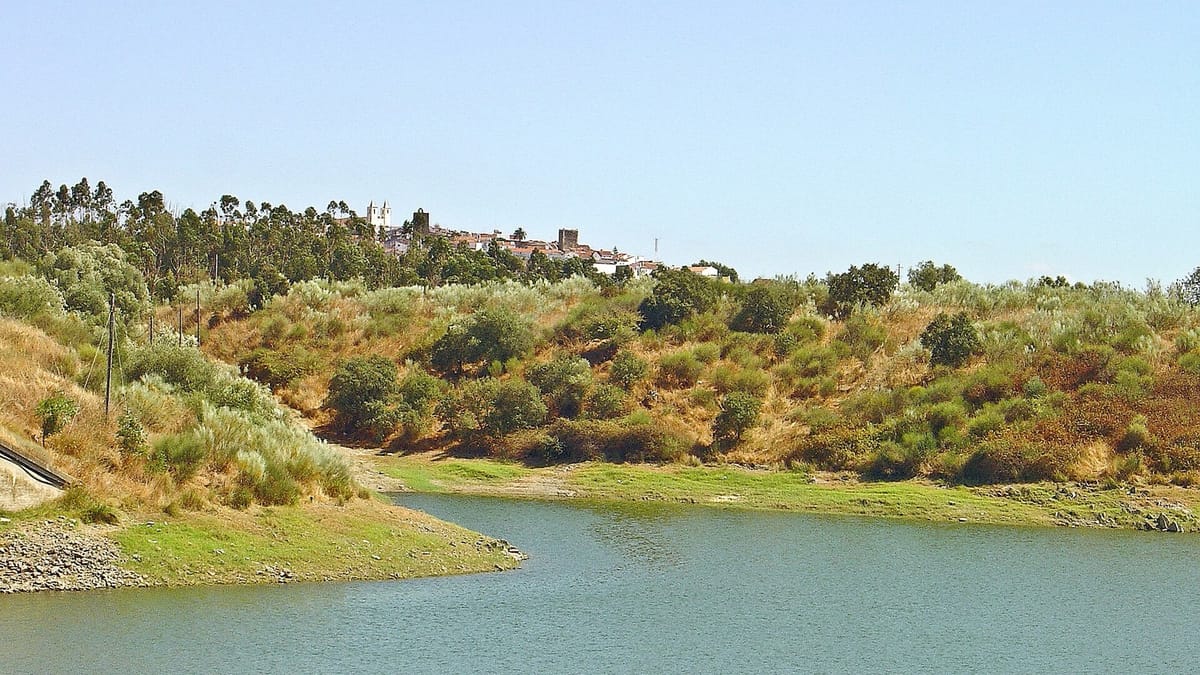
The Government has given the Pisão dam at Crato, in the Alto Alentejo, three more years to be built. A resolution approved by the Council of Ministers in Guarda on Thursday stretches the project's spending calendar to 2030 and keeps the ceiling already authorised, 222.2 million euros. The Government said court rulings that halted the works had made the old timetable impossible.
The project's formal name is the Empreendimento de Aproveitamento Hidráulico de Fins Múltiplos do Crato (Crato Multi-Purpose Hydraulic Scheme). It covers the dam, a small hydroelectric plant and an irrigation network. It is managed by the Comunidade Intermunicipal do Alto Alentejo (CIMAA, the Alto Alentejo Intermunicipal Community), and the reservoir will flood the village of Pisão.
What changes
The scheme's financing was last set in March 2025 by Resolução do Conselho de Ministros n.º 46/2025 (Council of Ministers Resolution 46/2025). That text capped total spending at 222,227,189.07 euros plus VAT and ordered the works to be finished by 2027. It also spread the money by year: 66.1 million euros in 2025, 81.6 million in 2026 and 72.5 million in 2027, after just under 2 million allowed across 2022 to 2024.
The new resolution leaves the total untouched and pushes the end date to 2030. The Council of Ministers communiqué of 1 October gives no new year-by-year figures, and the resolution has not yet appeared in the Diário da República (the official gazette).
How the dam left the Recovery Plan
Pisão began as one of the flagship water projects of the Recovery and Resilience Plan (PRR), Portugal's EU-funded post-pandemic investment programme. According to the 2025 resolution, it went in with 120 million euros and a 2025 deadline. The 2023 reprogramming of the plan raised that to 141.3 million euros, to absorb inflation, and moved completion to 30 June 2026.
By March 2025 the Government accepted that the dam would not be working by then, so PRR money could no longer pay for it. The resolution switched the funding to the State Budget or other sources, "preferably" European funds or a European Investment Bank loan. Regional reports on Thursday's decision say the works will now be paid for through the Sustentável 2030 programme and the EU's Cohesion Fund, once the European Commission approves the transfer.
The court fight
Four environmental associations, GEOTA, Quercus, LPN and Zero, have challenged the dam's Declaração de Impacte Ambiental (Environmental Impact Statement) in the courts. CIMAA has said the statement was suspended from September 2025, and that a January 2026 ruling by the Tribunal Administrativo e Fiscal de Castelo Branco (Castelo Branco Administrative and Tax Court) let the works restart.
On 8 May the Tribunal Central Administrativo Sul (Southern Central Administrative Court) overturned that ruling on a procedural point and sent the case back to Castelo Branco. On 18 May CIMAA announced that the works were suspended again. In September its president, Joaquim Diogo, who is also mayor of Crato, said every case against the dam had been sent back to Castelo Branco, where the judge is preparing to hear residents, experts and other witnesses. The primary works have not restarted since.
Diogo said that the new deadline was no surprise, because CIMAA had asked the Government to extend the plan "to 2029/2030".
The Government's national water strategy, Água Que Une (Water That Unites), approved in June, lists the Crato scheme at 220 million euros. It appears there among the resilience projects for the Tagus and West river basins, with construction pencilled in for 2025 to 2028. For this year's reservoir picture, see our report on where Portugal's water is short, and on how the Government is closing the Recovery Plan.