The Douro's 12 Million Euro Non-Harvest Payment Lands at 1,125 Euros a Hectare, With One Fifteen-Day Window and Drones to Check the Grapes Are Still There
The order implementing the government's September announcement pays a per-hectare rate scaled by how far this year's crop sits above a grower's own five-year average. The grapes have to stay on the vine until the IVDP has been to look at them.
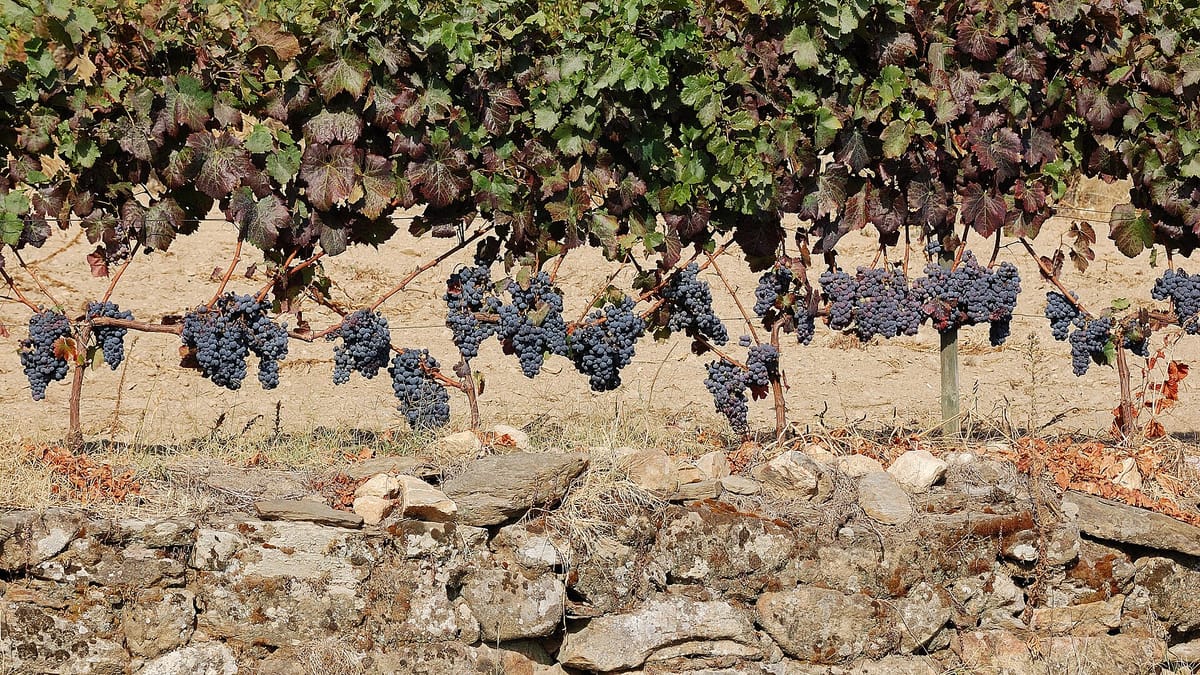
Ten days ago the government announced 12 million euros for Douro growers who cannot sell this year's grapes, and described it as 50 cents a kilo to leave the fruit hanging. The rules landed on Tuesday, and they are not written as a price per kilo at all.
Portaria n.º 431/2026/1 (Ministerial Order 431/2026/1), published in the Diário da República and signed by the Minister of Agriculture and Sea, José Manuel Fernandes, on 11 September, sets the payment at 1,125 euros per hectare of vineyard under cultivation, multiplied by what the order calls a coeficiente de não colheita (non-harvest coefficient). It implements Resolução do Conselho de Ministros n.º 177/2026 of 9 September, which authorised the Instituto dos Vinhos do Douro e do Porto (Douro and Port Wine Institute, or IVDP) to spend up to 12 million euros on the measure.
The formula, and who it leaves out
The coefficient is where the money is actually decided. It is the grower's unharvested production divided by the maximum yield per hectare that the IVDP sets for the Região Demarcada do Douro (Douro Demarcated Region).
And "unharvested production" has a narrow definition. It is the difference between what the grower declares for the 2026-2027 campaign on their declaração de colheita e produção (harvest and production declaration), in kilograms per hectare, and their own reference average productivity, which the order defines as the average they declared across the previous five campaigns.
Read that carefully and the design becomes clear. The measure pays for the crop above a grower's own five-year normal. A grower whose vines produced roughly what they always produce has nothing to claim, however little of it they can sell. The support is aimed squarely at the surplus that a good growing year has dumped on a region that was already carrying historic stocks of unsold wine.
Two groups get a different benchmark. Growers who started in 2026, and growers who exceeded the region's maximum yield in any of the five previous campaigns, have their personal average replaced by the regional five-campaign average.
If the total of approved claims exceeds the 12 million euro envelope, every individual amount is cut proportionally. The de minimis ceiling applies as well: no single undertaking may take more than 50,000 euros in agricultural de minimis aid over three years, under EU Regulation 1408/2013.
One window, and it will not be extended
The IVDP has fifteen days from the order's entry into force to publish an aviso opening applications, and the application period itself is fifteen days. The order states in terms that the window is "single and non-extendable" for every grower in the region, regardless of when their own harvest falls. Applications go through an electronic form in each grower's reserved area on ivdp.pt, and the grower has to name the parcels they intend not to pick.
Eligibility runs to the usual list: registered with the IVDP, holding a Douro vineyard also registered with the institute, beneficial-ownership declaration filed where applicable, and tax and social security up to date at the point of payment. Members of cooperative wineries qualify in their own right.
The IVDP then has eight days from the close of the window to decide. The order waives the normal right of interested parties to be heard first, citing the urgency of the decision under the Código do Procedimento Administrativo (Administrative Procedure Code).
The grapes have to stay there, and they will be checked
From the moment a grower applies until the money is paid, the grapes named in the application cannot be picked, processed, sold or otherwise disposed of. They have to remain on the vines until an on-site inspection.
The IVDP will verify that inspection against the parcel cadastre, the region's grower register, the production authorisation, the harvest declarations and the delivery records, and the order expressly authorises it to use remote sensing and geo-referenced photography to do it. Payment follows the inspection, in a single bank transfer through the institute's Conta Produtor vintage payments account.
Breaking the rules costs more than the grant. Failure to keep the obligations means repaying the whole amount, with legal interest and, if necessary, through tax enforcement. Picking or selling the grapes anyway carries an additional penalty: exclusion from all IVDP support for the following two campaigns, on top of any regulatory offence.
One clause is worth noting for the long run. Article 14 provides that the unharvested quantity counts as 2026-2027 production when the grower's reference average is calculated in future campaigns. Taking the money this year does not depress the baseline used against you next time.
What this means for residents of Portugal
- If you own vines in the Douro, the clock is the risk. A single fifteen-day window, opened by an IVDP notice with fifteen days' notice at most, and no extension. Operational detail will follow in an IVDP circular on its website.
- Per hectare, not per kilo. The order pays a per-hectare rate scaled by a coefficient, and it does not publish the regional maximum yield that sits in the denominator. Until the IVDP notice appears, no grower can convert the 50 cents a kilo quoted in September into what they will actually receive.
- Port and Douro wine supply is not affected. The measure applies to fruit that already has no buyer, not to the graded crop that becomes bottled wine. The quota system underneath is the one our explainer on the 76,000-pipa benefício sets out.
- The structural fix is still missing. The government has promised a permanent fund to manage these swings. This is the second emergency measure in two years, and it is still a measure rather than a mechanism.
The Douro's difficulty is that a good year makes things worse. The state's answer, for a second September running, is to buy the surplus off the vine. What Tuesday's order adds is the arithmetic, and the arithmetic is narrower than the announcement sounded.