The Cascais Line Goes First as a Finance Ministry Team Starts Preparing a Private Operator for CP's Trains, With Sintra Only 'Subject to Confirmation'
A dispatch in the official gazette creates the team that will design the Cascais line subconcession. Sintra/Azambuja may follow; the Sado line and Porto's suburban trains, once in the plan, are no longer in it.
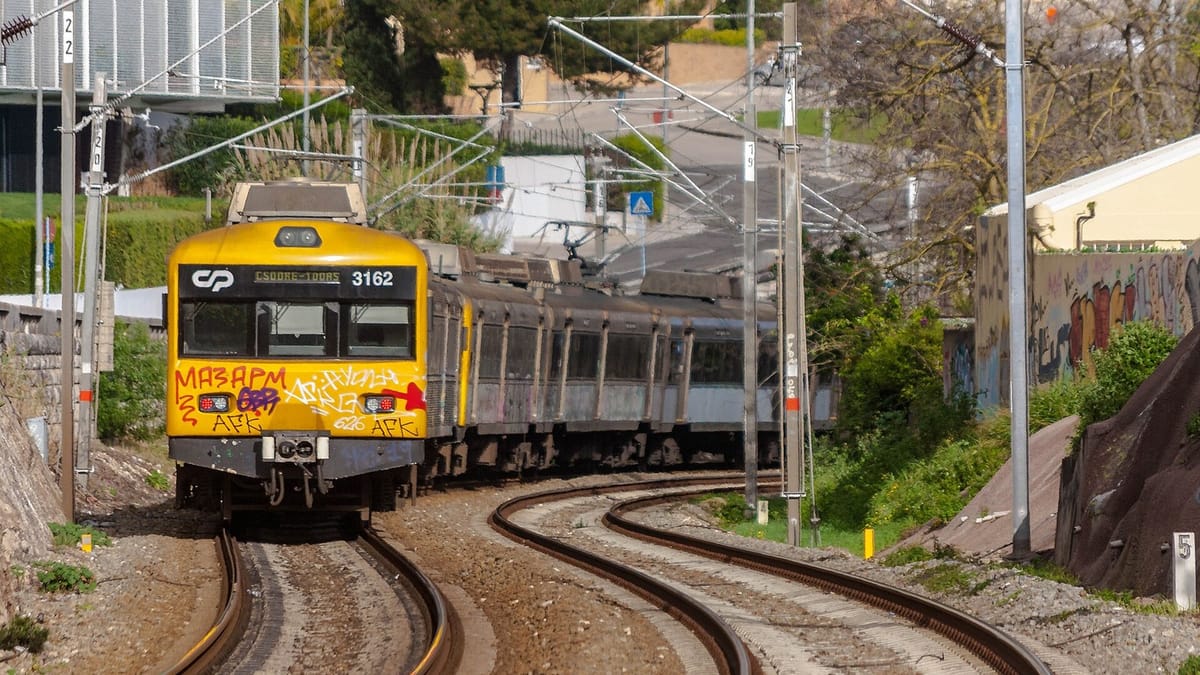
The plan to let a private company run trains on Lisbon's commuter lines has taken its first formal step, and it is narrower than the one set out in the summer. A dispatch published on Monday in the Diário da República (the official gazette) sets up the team that will prepare the subconcession of CP (Comboios de Portugal) services as a public-private partnership. Only the Cascais line is confirmed. The Sintra/Azambuja line comes second and is "subject to confirmation".
What the dispatch says
Despacho n.º 11811/2026 was signed on 11 September by Rita Cunha Leal, director of UTAP (Unidade Técnica de Acompanhamento de Projetos, the Finance Ministry's unit that oversees public-private partnerships). It sets out how the decision was reached:
- on 10 August, CP sent the Secretary of State for Mobility a reasoned proposal to study a subconcession of suburban passenger services on the Cascais and Sintra/Azambuja lines, under the public-private partnership law, Decreto-Lei n.º 111/2012;
- the same day, the Secretary of State agreed and named her members of the team;
- on 27 August, the Secretary of State for the Treasury and Finance told UTAP to form the team, with a mandate covering Cascais first and Sintra/Azambuja in a second phase "subject to confirmation".
CP's own proposal describes the same sequence. The first subconcession covers only the Cascais line; Sintra/Azambuja will be studied later, "in light of the experience acquired in the first phase".
The team has seven members, chaired by Hong Cheng Leong of UTAP, with three more from UTAP and three named by the Secretary of State for Mobility, plus four alternates. None is paid for the work. CP will give technical and logistical support, and the team works from UTAP's offices on Rua Braamcamp in Lisbon.
From four lines to one
When the plan was presented in July, four suburban networks were in the frame: Cascais, Sintra/Azambuja, the Sado line and the Porto suburban trains. According to ECO, CP studied the Sado line and the Porto network but both have been left out. The dispatch mentions only Cascais and Sintra/Azambuja.
ECO reports that the Government aims to launch the Cascais partnership in the first quarter of 2028, for six years. The Cascais line carried 38 million passengers in 2024, with 31 million euros in fare revenue and EBITDA of 8 million euros. Sintra is much larger: 99 million passengers, 76 million euros in fare revenue and EBITDA of about 20 million euros.
Miguel Pinto Luz, the Minister of Infrastructure and Housing, explained in June why Cascais goes first. It is "the subconcession that is furthest ahead, because of its critical mass, because it is an independent line, it is easier to move forward", he said, as reported by ECO. He has argued that the model will let CP redirect its resources "to where the market does not work".
What changes for passengers
For now, nothing does. CP runs every train on the Cascais line and will keep doing so while the team prepares the project, and a tender has not yet been designed, let alone launched. Fares and tickets stay as they are, including the 20-euro green rail pass now written into law for Lisbon's commuter trains.
The questions that matter to riders, such as who owns the trains, what service levels a private operator must meet and how fares would be set, belong to the next stage. Under the partnership law, that is the work this team has now been given.