The A1 Turned Thirty-Five on Sunday, and Now Carries 2.6 Times the Daily Traffic of the Day It Was Finished
One of the Brisa engineers on the final Torres Novas to Condeixa stretch told Lusa what changed: the country stopped being 800 kilometres long and became 300 or 400.
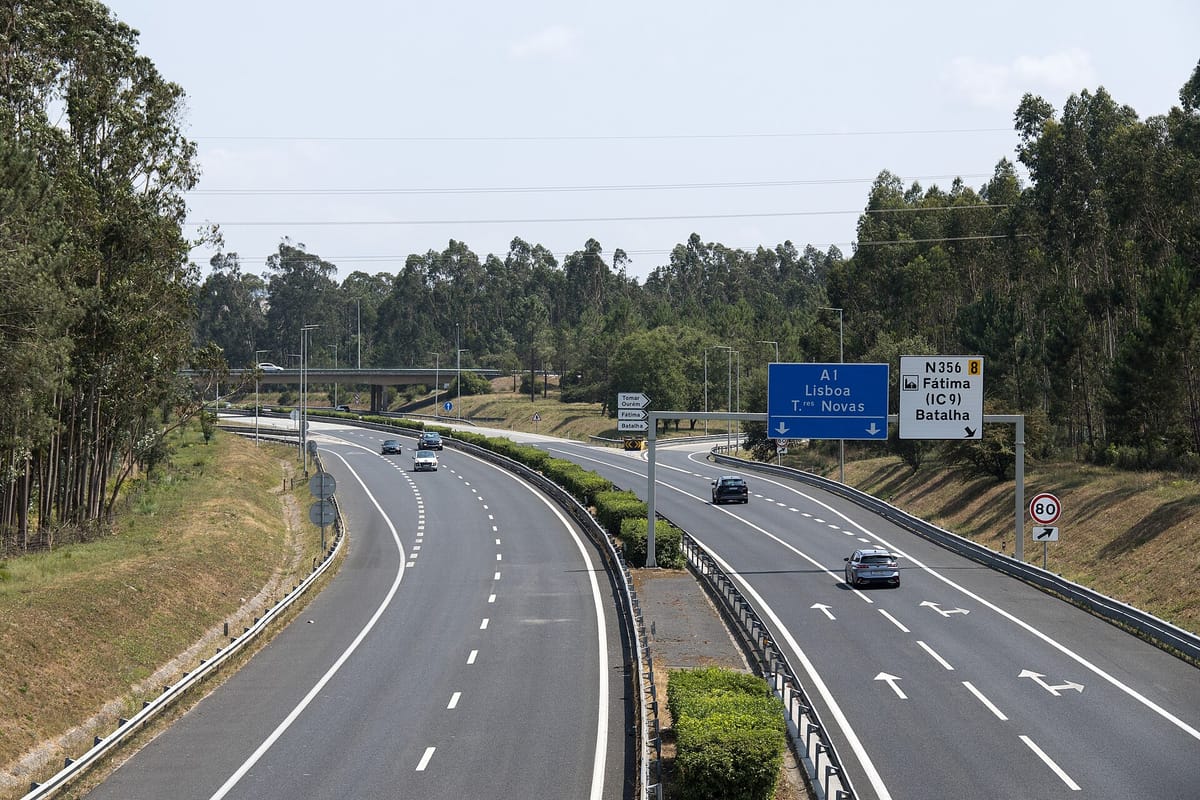
The A1 was finished 35 years ago on Sunday, and the engineer who helped build the last piece of it remembers the change in one sentence: the country got shorter.
The motorway was completed on 13 September 1991, when the stretch between Torres Novas and Condeixa-a-Nova opened and gave Portugal an unbroken road link from Lisbon to Porto. The first section, from the capital to Vila Franca de Xira, had opened 30 years earlier.
"Before the motorways it took practically a day to get up there," Joaquim Mendes, one of the Brisa engineers responsible for the works at the time, told the Lusa news agency. "You left in the morning to arrive at the end of the day, or you went the day before. Then the country got shorter. It stopped being 800 kilometres long and became 300 or 400." Now 83 and retired for about two decades, he made the point that the line did more than join the two big cities: it pulled Santarem, Leiria, Coimbra and Aveiro into the same day's travel and changed how goods as well as people moved.
Clay, caves and a woman in front of the machines
The final stretch took careful preparation, he said, because of what it ran through. "There were mountain areas with rock, more stable soils, and areas with clays that could not be used in construction because they are sensitive to water." The site threw up surprises too: mines and caves turned up near Fatima, in the Ourem district, and the route through the Serra de Aire e Candeeiros needed wildlife crossings built into it. None of it, in his telling, was fundamental. "There are always some unforeseen things, some situations that escape us when we do the survey campaigns, but there were no surprises of substance."
The social side was larger than the engineering. "There are thousands of workers who have to have lunch, dinner and somewhere to sleep, so there is a connection between those people and civil society." Relations were mostly good, he said, with one exception he still laughs about: a woman who lay down in front of the machinery to stop the work advancing. "It was a very easy thing to solve. It was a matter of telling the lady: bear with us, but we have to go ahead."
The day the road was finished was marked with a ceremony he describes as "above all political" and a lunch with the company's workers. He kept few objects from the job. A fire at a depot where he worked destroyed the documents and photographs he had held on to.
Two hundred kilometres to a thousand
For Brisa, the completion was a hinge. "It was the turning of a page, from a phase of crisis to a phase of great national projection," Mendes said, recalling that the company went from roughly 200 kilometres of motorway to a network approaching a thousand within a few years.
The traffic figures have moved the same way. In a note marking the anniversary, Brisa says the A1 remains one of the country's principal road axes, running about 300 kilometres between Lisbon and Porto, and that its average daily traffic reached 42,885 vehicles in 2025. That is more than double the 1991 level, and 2.6 times what the road carried in the year the last section opened.