The 20-Euro Green Rail Pass Doubled Regional Train Journeys in 2025 and Left Them 77 Percent Full, While Only 37 Percent of Long-Distance Trains Arrived on Time
The transport regulator's 2025 rail statistics show regional passengers up 108 percent and occupancy up from 35 to 77 percent in the pass's first full year, while ticket revenue fell, the State's compensation rose and punctuality hit its lowest since at least 2015.
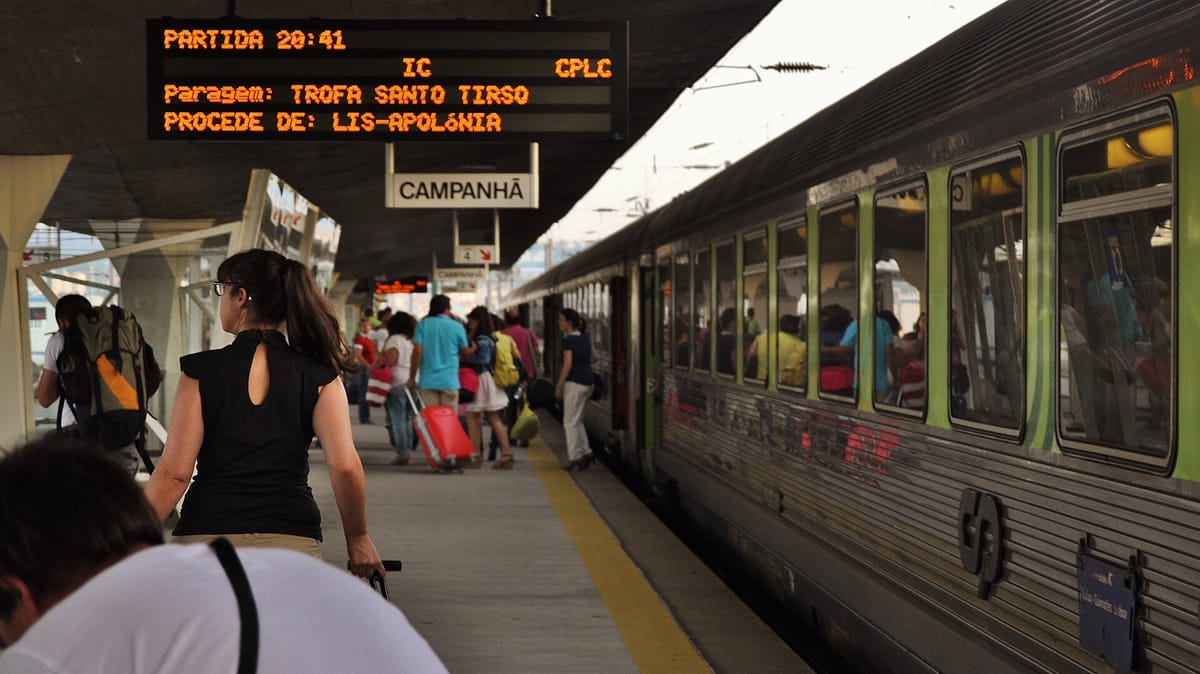
Passenger numbers on CP's regional and inter-regional trains more than doubled in 2025, the first full year of the 20-euro monthly Passe Ferroviário Verde (Green Rail Pass). At the same time, trains ran late more often than at any point in at least a decade. Both findings come from the annual rail statistics published on 1 October by the Autoridade da Mobilidade e dos Transportes (AMT, the transport regulator).
The 42-page analysis draws on data from Infraestruturas de Portugal (IP, the state rail network manager), the two passenger operators, CP and Fertagus, and the freight operators Medway and Captrain. It is the most complete picture so far of what the cheap pass has done, and it arrives just as the pass is being extended. A decree-law that took effect on 26 September opens it to CP's urban trains and the Fertagus line across the Tagus, as we reported, with CP still to set the start date.
Record demand, fuller trains
The pass was created by Decree-Law 73/2024 and has been sold since late October 2024. It replaced the earlier 49-euro national rail pass. For 20 euros a month it gives unlimited travel on CP's regional and inter-regional trains, on Intercidades services in second class, and on the parts of the Lisbon, Porto and Coimbra urban networks that the metropolitan passes do not cover. Alfa Pendular trains are not included.
The AMT's figures for 2025:
- Trains in Portugal carried about 240.7 million passengers, 10 percent more than in 2024 and 42 percent more than in 2019. Passenger-kilometres, which also count how far people travel, rose 26 percent in the year.
- Regional and inter-regional services carried 108 percent more passengers than in 2024. Compared with 2022, that is close to three times as many.
- Long-distance passengers rose 31 percent, almost all of it on Intercidades. Alfa Pendular demand stayed flat, up just 0.3 percent.
- Porto's urban and suburban trains, where the pass covers about 112 km of the network, carried 16 percent more passengers.
The number of trains grew far more slowly, by about 1 percent to some 468,000. So the trains filled up. Average occupancy on regional and inter-regional services rose from 35 percent in 2024 to 77 percent in 2025, and Intercidades and other long-distance services reached 62 percent. Those are averages over the whole day. The regulator notes that weekday rush-hour occupancy runs at roughly double the rate for the rest of the day, and it warns that 77 percent, while a sign of strong demand, "can create capacity and comfort constraints" for passengers.
Lisbon was the exception. On CP's Lisbon suburban lines, passenger numbers were about 2 percent lower in 2025 than in 2023. Fertagus, which added services from December 2024, grew 18 percent over the same period.
Passengers pay less, the State pays more
The pass has changed who pays for the railway. Even with demand rising sharply, ticket sales fell 12 percent on regional services, 5 percent on Porto's suburban trains and 4 percent on Intercidades, a combined loss of 6.8 million euros. What passengers actually paid per kilometre fell 60 percent on regional trains and 24 percent across the network.
The State made up the difference. It paid CP 18.9 million euros in 2025 to compensate for the Green Rail Pass, against 4.7 million in 2024. Other fare compensation, mainly from the Incentiva+TP public transport fund and free passes for young people, rose from 61.4 million to 81.3 million euros. The regulator calls this "a significant change in the funding model" for a large part of Portugal's passenger rail services.
The worst punctuality in at least a decade
Service quality moved the other way. Both CP and Fertagus recorded their lowest punctuality since at least 2015. Only 37 percent of long-distance trains arrived on time, which means about 63 percent were late, down from 53 percent on time in 2022. On CP's Lisbon suburban lines, punctuality fell from 86 percent in 2022 to 59 percent. Regional services were the only ones to improve, from 65 to 68 percent, though they remain below 2022 and 2023. Fertagus was again the best performer, at 81 percent.
CP cancelled 28 percent more trains than in 2024. It blamed works to modernise the network, strikes, a shortage of rolling stock, too few staff in critical jobs, wildfires and level-crossing collisions. The regulator singles out the works on the Beira Alta line as still disrupting services in 2025. The Iberian blackout of 28 April 2025 and the general strike of 11 December also led to large numbers of cancellations.
Complaints from passengers reached 6,522, up 9 percent on 2024 and 50 percent on 2022, the highest in the period the report covers. Missed timetables were the single largest reason, at 19 percent of all complaints. Complaints against Fertagus rose 42 percent in the year. The regulator says the rise is greater than growing passenger numbers alone would explain, which points to a worse perception of service. Its 2025 survey of rail users found a generally unfavourable view of how services had changed, worst on urban and suburban lines, especially for punctuality, frequency and how delays and disruption are handled.
What it means for passengers
For anyone living in Portugal who commutes by train or travels between cities, the report confirms what many have already seen on the platform. The 20-euro pass is very good value on regional and Intercidades routes, but those trains are now far fuller, and delays are more common than they were a few years ago. As the pass reaches Lisbon and Porto commuter lines, the same pressure on capacity may follow unless more trains are added. Infraestruturas de Portugal has already said it does not expect punctuality to improve in the second half of 2026, as its half-year accounts showed.