Residents Clocked 220 km/h on the Marginal's 50 km/h Limit, and Their Petition for Radars Has Passed 1,700 Names
A Cascais residents' association wants speed cameras, coordinated policing and fines of €1,000 to €2,000 on the coastal road from Lisbon. Hours before they described the campaign, a car left the EN6 at Praia da Parede and a man of about 50 was found dead on the rocks.
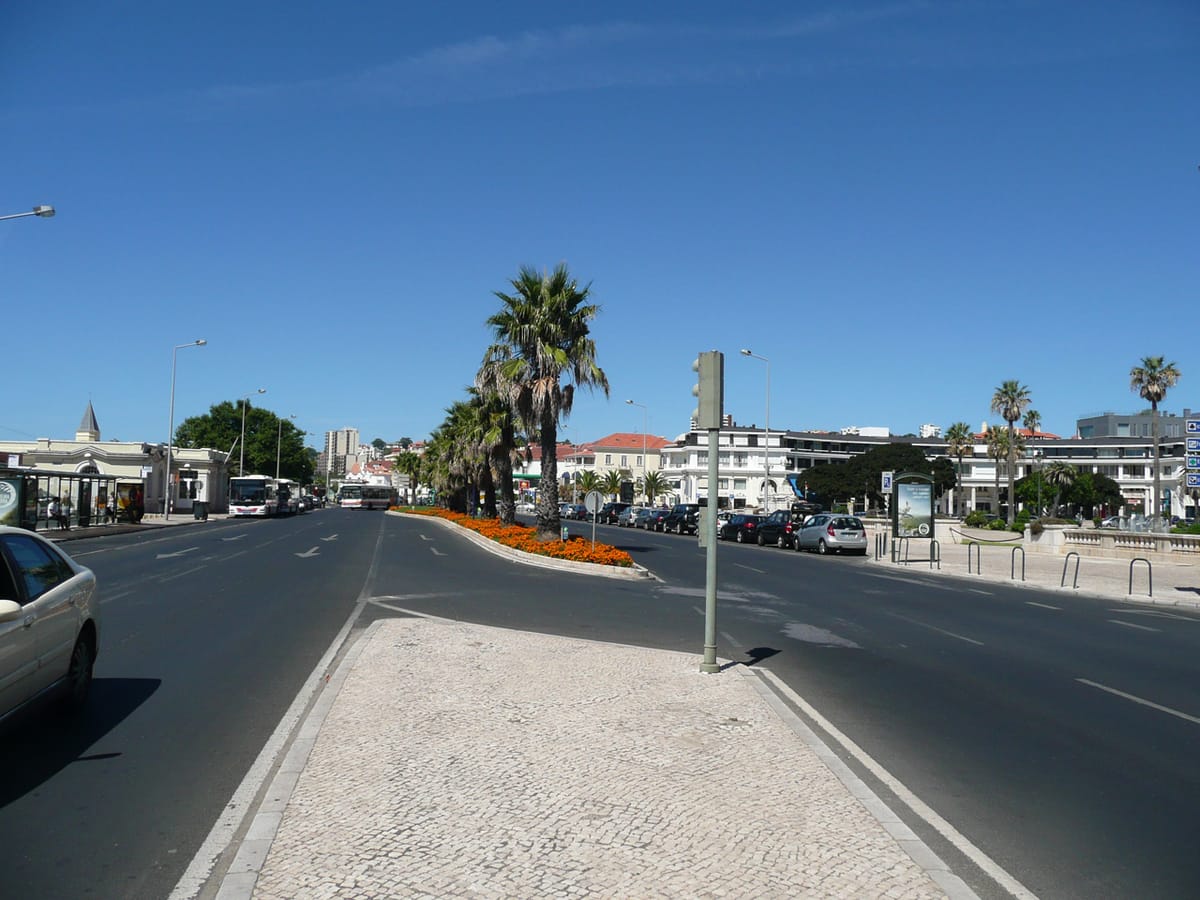
Residents living beside the Avenida Marginal, the coastal road that runs about 25 kilometres from Lisbon to Cascais, have collected more than 1,700 signatures on a petition demanding speed cameras, heavier fines and coordinated policing on a road where the limit is 50 kilometres an hour and where they say they have logged cars travelling at 220.
The petition was launched two weeks ago by the Associação de Moradores do Bairro Almirante Nunes da Mata (AMBA, the residents' association of the Almirante Nunes da Mata neighbourhood, also known as Bairro das Avencas) in Cascais. "We started this petition locally, it was only for residents, and we are about 200 houses, but it quickly went viral," said Ricardo Parro, who speaks for the association. The signatures now come from Cascais and from the neighbouring municipalities of Oeiras, Sintra and Lisbon.
Hours before Parro described the campaign, the road produced another death. At 07:04 on Monday morning a light vehicle left the EN6 in the Cascais-to-Lisbon direction near Praia da Parede, struck the sea wall and came to rest beside the recycling bins in the beach car park, according to Pedro Araújo, commander of the Parede fire brigade. The body of a man of about 50 was found on the rocks below. An INEM (National Institute of Medical Emergency) doctor declared the death and the body was taken to the Instituto Nacional de Medicina Legal (National Institute of Legal Medicine). The Polícia de Segurança Pública (PSP, Public Security Police) said the car was damaged at the front and along the right side, with the passenger door open, and that its traffic-accident investigation brigade would establish whether the man had been thrown from the vehicle. Firefighters from Parede and Estoril, INEM, the PSP and the Polícia Marítima (Maritime Police) attended.
What the petition asks for
The residents want three bodies to act together: the Câmara Municipal de Cascais (Cascais city council), the PSP and Infraestruturas de Portugal, the state road manager. Their specific demands are more police enforcement, the installation of speed-control radars, and fines large enough to change behaviour.
On that last point Parro was blunt about the current scale of penalties. "This should not be fines of 200 euros or 300, this has to be 1,000, 2,000 euros, which is what will end this problem," he said.
Asked whether the 50 kilometre-an-hour limit should be lowered, he said the limit is not the issue. "The problem is that nobody respects it." Residents have been recording the speeds actually driven on the Marginal, and he said those readings reach 220 kilometres an hour.
The complaints are not only about speed. Residents describe illegal street racing at night, daytime speeding, motorcyclists pulling wheelies in traffic, and a noise level Parro compared to sitting in a racing circuit's grandstand. "This is not a motorway, this is a local road," he said, calling the situation "total lawlessness on one of the most beautiful roads in our country". He also raised the safety of pedestrians using the pavements alongside the avenue, and argued that the taxes Cascais residents pay, in a municipality where the IMI (municipal property tax) is among the higher ones, should be buying a solution. "One of these days there is going to be a big tragedy here," he said.
A pattern, not an incident
Monday's crash is the visible edge of a longer run. Parro dates the deterioration to the past four or five years, with "many accidents, several fatal accidents". On 19 August a collision involving two cars and a motorcycle closed lanes on the Lisbon-to-Cascais carriageway. In June a crash between a bus and a car in Cascais killed one person and injured at least two more.
The road itself is the problem the engineering has never solved. The Marginal is a wide, straight, largely flat dual carriageway with sea views, sitting inside a dense residential corridor and running past beaches, railway stations and pedestrian crossings. It reads like an open road and is regulated like a local one. That gap is exactly the failure mode that Portugal's Visão Zero 2030 road safety strategy, adopted in June after a six-year delay, is supposed to close, and it is the reasoning behind the government's separate proposal to make driving above 180 kilometres an hour a crime rather than an administrative offence.
Where 1,700 signatures actually gets you
The association is considering sending the petition to the Assembleia da República (Assembly of the Republic), and here the arithmetic matters more than the enthusiasm.
Portugal's right-of-petition law, Lei 43/90 as most recently amended by Lei 63/2020, sets thresholds that decide how far a petition travels. Above 1,000 signatures it is published in the Diário da Assembleia da República and the petitioners must be heard by the responsible parliamentary committee. Between 2,500 and 7,500 it is debated in committee. Above 7,500 it goes to the floor of the house.
At just over 1,700 names, a formally filed petition would clear the first threshold and no more: publication and a committee hearing, but not a debate. For comparison, the campaign against building inside the Sintra-Cascais Natural Park a few kilometres inland passed 7,500 signatures last week and so obliges Parliament to debate it in plenary. The Marginal petition would need to grow roughly fourfold to reach the same standing.
That is not the same as saying it will fail. The three bodies the residents are addressing are municipal, police and state-road authorities, and none of them needs a parliamentary debate to install a radar or run enforcement operations. Parliament is the amplifier, not the decision-maker.
What This Means for Expats
- If you drive the Marginal, assume enforcement is coming. A campaign with this much cross-municipal support and a fatal crash on the day it went public is the sort of thing that produces radars. The current limit of 50 kilometres an hour is the one you will be measured against.
- Fines are set nationally, not locally. The residents want penalties of €1,000 to €2,000, but a municipality cannot invent them. Changing the fine bands means changing the Código da Estrada (Highway Code), which is why the campaign is looking at Parliament at all. In the meantime, speeding penalties also cost licence points under the carta por pontos system, which bites harder than the cash.
- Signing an abaixo-assinado is not filing a petition. A signature collected on an association's own website has no procedural status. It only acquires one when the text is formally submitted to the Assembleia da República, at which point the thresholds above apply and the identifying details of signatories matter.
- Foreign residents can sign and can petition. The right of petition is not restricted to Portuguese citizens, so residents of Cascais, Oeiras and Sintra who hold other passports can add their names and be counted.
- Factor the road into where you live. Newcomers looking at the Cascais line often treat proximity to the Marginal as a straightforward amenity. Residents on the Parede and Avencas stretch are describing night-time racing noise and pedestrian risk as a daily condition, which is worth checking in person, after dark, before signing a lease.
Nothing about the Marginal's design will change quickly. Radars can be installed in months, enforcement operations in weeks, and a coordinated plan between a city council, a police force and a state road manager somewhere in between. What the residents have established is that the problem is no longer theirs alone: the signatures arriving from three neighbouring municipalities suggest that a road most people experience as a scenic drive is, for the people who live beside it, something closer to an unpoliced racetrack.