Rail Deaths in Portugal Drop to 14, but Nine Died at Level Crossings, the Most in Five Years
The rail safety authority's 2025 report counts 25 significant accidents, the fewest in five years, but level crossing accidents more than doubled to 11. Broken rails and track deformations also rose.
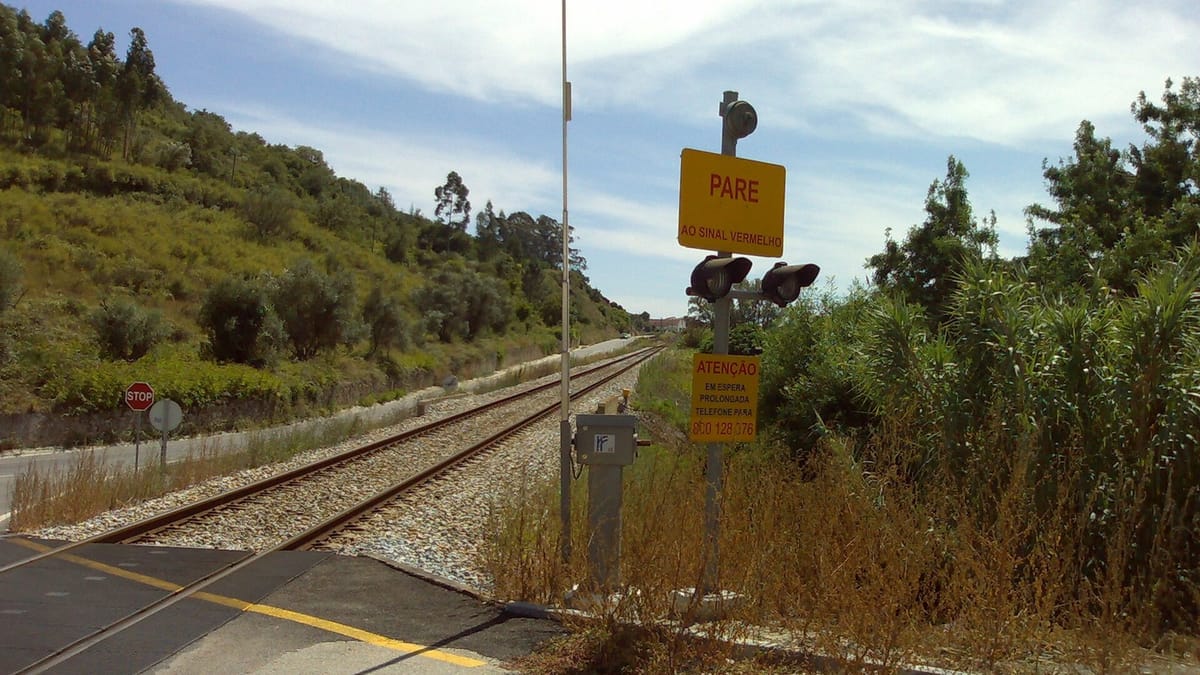
Fourteen people died in rail accidents in Portugal in 2025, down from 20 the year before, but nine of them died at level crossings. That is the highest toll at crossings in five years, and crossings are now the leading cause of rail accident deaths. The figures are in the 2025 Annual Rail Safety Report, published on Tuesday by the ANSF (Autoridade Nacional de Segurança Ferroviária, the National Rail Safety Authority), which is part of the IMT (Instituto da Mobilidade e dos Transportes, the Institute for Mobility and Transport).
Fewer accidents overall
The report counts 25 significant accidents on the national network in 2025, 16.7 percent fewer than in 2024 and the lowest figure in five years. Serious injuries fell from eight to six. Accidents in which people were struck by moving trains fell from 20 to nine. Deaths among people on the tracks without authorisation fell from 13 to four.
"The results of 2025 show that investment in rail safety is producing concrete and positive results," said João Jesus Caetano, the IMT's president. "However, the situation at level crossings demands redoubled attention and a coordinated response from all stakeholders."
Level crossings
Accidents at level crossings more than doubled, from five in 2024 to 11. Deaths among level crossing users went from four to nine, and two people were seriously injured. Every rail accident death in 2025 happened either at a crossing (64.3 percent) or when someone was struck by a train (35.7 percent). There were no deaths from collisions or derailments.
The network had 763 level crossings at the end of 2025, down from 785 a year earlier, or roughly one for every 4.2 kilometres of track. The drop came entirely from passive crossings, which have no barriers or lights; their number fell from 314 to 290. Active crossings rose slightly, from 471 to 473.
The ANSF says removing a crossing is the most effective fix but is "not always possible due to the technical complexity and the high investment required". Its approach combines closing and automating crossings, upgrading protection systems, better signs and visibility, and awareness campaigns aimed at drivers and pedestrians.
According to RTP, Infraestruturas de Portugal (IP), which manages the network, plans to close 135 of the highest-risk crossings and reclassify another 237 by 2030, at a cost of 316 million euros. By the end of 2026 it aims to close 16 and automate 31. A new decree-law, published in September, bans new level crossings and sets thresholds for closing existing ones from March 2027.
Track faults on the rise
The report also tracks "precursors", events that could lead to an accident. There were 120 in 2025, up 18 percent. Most were track faults: 52 cases of track deformation (up 44 percent) and 40 broken rails (up 29 percent). The ANSF carried out 45 supervisory actions during the year, which led to 69 corrective measures.
The network is 2,525 kilometres long. According to the report, 71 percent of it is electrified and 74 percent has automatic train protection.
The report separately records 38 suicides on the rail network, the highest number since at least 2021. Suicides are excluded from the accident figures. Including them, 52 people died on the network in 2025, two fewer than in 2024. Anyone in Portugal who is struggling can call the SNS suicide prevention line on 1411, which opened in September 2025.
The ANSF's home is about to change. Decree-Law 179/2026, which takes effect on Thursday, moves rail safety oversight from the IMT to the AMT (Autoridade da Mobilidade e dos Transportes, the transport regulator).