Portugal's Speaker Calls for a Limit of Two Inquiries at a Time, but the Law Contains No Such Cap
Four parliamentary inquiries have been constituted, and Aguiar-Branco wants only two running so small parties can take part. The Parliamentary Inquiries Act sets no cap, and an inquiry requested by MPs cannot be refused. Parliament will also open on Saturdays from 31 October.
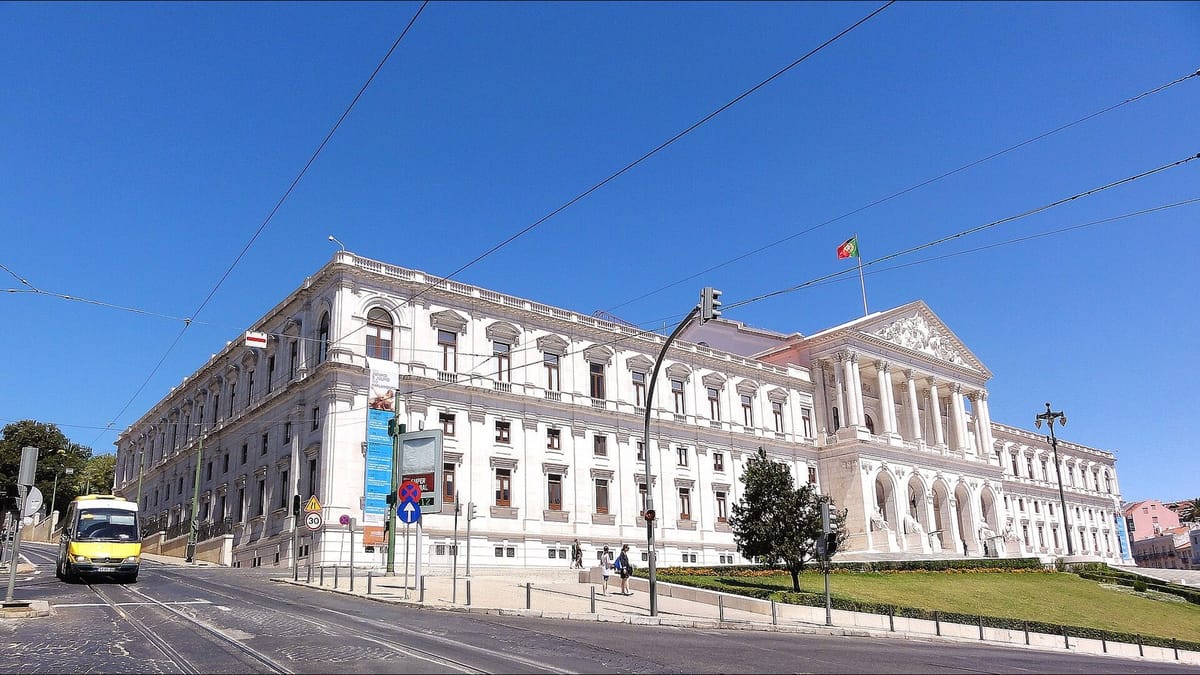
The Speaker of Portugal's Parliament, José Pedro Aguiar-Branco, wants no more than two parliamentary inquiries working at the same time, and he will put the idea to the leaders of the parliamentary groups on Wednesday. The difficulty is that four have already been set up, and the law that governs them contains no limit on how many can run at once.
Aguiar-Branco made the case on Monday, after he symbolically opened the main door of the Assembleia da República (Assembly of the Republic) to mark the 116th anniversary of the Republic. He accepted that, strictly under the rules, four committees of inquiry can sit at the same time. "But there has been a practice of not having more than two, so that all MPs can take part," he said, according to Público. "Let us not forget that there are parliamentary groups that do not have many MPs."
Four inquiries already constituted
The four, as Público listed them, are the inquiry into INEM (Instituto Nacional de Emergência Médica, the National Institute of Medical Emergency), one into the wildfires, the Bloco de Esquerda (Left Bloc) inquiry into the digital marking of the national exams, and Chega's inquiry into Luís Neves's years at the head of the Polícia Judiciária (Judicial Police), now Minister of Internal Administration. Público described the first two as nearing their end.
The INEM committee is not in fact working at the moment. A resolution published in September stopped the clock on it until 30 November, because documents it had asked for had not arrived.
The concern about small parties is real. On the 25-member Neves committee, approved on 30 September, the Left Bloc and PAN, with one MP each, have no seat at all.
What the law allows
The Regime Jurídico dos Inquéritos Parlamentares (Parliamentary Inquiries Act, Lei n.º 5/93) gives two routes to an inquiry. One is a vote of the plenary. The other is a request signed by one fifth of the MPs in office, limited to one request per MP in each legislative session. Article 4 says committees requested this second way "are compulsorily constituted", and that the request cannot be assessed or refused except on formal grounds, or where its object breaches the Constitution.
Chega's Neves inquiry was created this second way. The act sets no cap on committees running in parallel, and gives the conference of leaders no power to shelve one once it exists.
What the Speaker does control is the calendar. Under article 6, after consulting the conference of leaders, he sets the number of members and the time allowed for an inquiry requested by MPs, and for a voted one when the resolution has not fixed it. An inquiry lasts at most 180 days. Under article 11, the plenary may add 90 more at the committee's reasoned request, and for an inquiry requested by MPs that extension must be granted if the requesting MPs' groups ask for it.
Aguiar-Branco was careful on that point. Asked which two committees should go ahead first, he said he had "no preference". "My role, and I think it became very clear in recent times, is to make sure that committees of inquiry respect the Constitution and respect the law that governs them," he said. "Since they have all been constituted, managing the agenda is now a matter for the MPs." The conference of leaders, he added, "is sovereign".
The timing is tight. The 2027 State Budget is due in Parliament by 10 October, and the Speaker had already warned that the Neves committee's work may be suspended during the budget debate.
Parliament opens on Saturdays
The Speaker also announced that the Parliament building will open to the public every Saturday from 31 October. "It is an experiment that is going to continue," he said, according to RTP. Monday's Republic Day open house came on the day President Seguro called for cross-party compromise; Aguiar-Branco would not comment on the speech.