Portugal's Rules for Building Lifts and Escalators Are Up for Review After 24 Years, With a Draft Due Within 90 Days
An order published on Monday tells the energy directorate DGEG to draft new rules for the maintenance, inspection, sealing and accident reporting of lifts, escalators and goods lifts, replacing a regime dating from 2002.
The government has ordered a rewrite of the rules that apply to lifts in Portuguese buildings once they are in use: who maintains them, how often they are inspected, when they are sealed off and what happens after an accident. Despacho (order) n.º 11834/2026, signed on 22 September by the Deputy Secretary of State for Energy, Jean Barroca, and published in the Diário da República (official gazette) on Monday, gives the Direção-Geral de Energia e Geologia (Directorate-General for Energy and Geology, DGEG) 90 days to present a draft.
The review covers passenger lifts, goods lifts, escalators and moving walkways. The order takes effect the day after publication, so DGEG's deadline falls at the end of December. The 90 days are for a proposal; no date is set for a new law.
What the current law requires
The rules date from Decreto-Lei n.º 320/2002 (Decree-Law 320/2002). Law 65/2013 later replaced the parts on how maintenance companies and inspection bodies are licensed. Under the 2002 decree:
- every lift in service must have a maintenance contract with a registered maintenance company, either "simple" (upkeep only) or "complete" (including replacement parts), and the company's name, contacts and type of contract must be displayed in the cabin;
- the maintenance company answers for accidents caused by poor maintenance, and the owner is jointly liable;
- periodic inspections are the job of the câmara municipal (municipal council), which may hire accredited inspection bodies. Lifts in shops and offices open to the public are inspected every two years; those in mixed buildings, or in residential buildings with more than 32 flats or more than eight floors, every four; those in other residential buildings every six. After two periodic inspections, every lift moves to a two-year cycle;
- escalators and moving walkways are inspected every two years, and goods lifts every six;
- accidents must be reported to the council within three days, and immediately if someone dies, and a lift involved in a death, serious injury or major damage is sealed until it has been inspected.
Users can also report a lift that works badly or looks unsafe to the council, which may order an extraordinary inspection.
What the review must cover
DGEG's proposal must deal with maintenance and inspection; repairs, modifications and modernisation; sealing and accidents; civil liability and fines; and a register of installations and their records. The order asks for simpler and proportionate procedures, more use of electronic means, the safety of users, clearer duties for central government, councils, inspection bodies, maintenance firms and owners, and modernisation of older lifts' safety features.
DGEG must consult ASAE (the Food and Economic Safety Authority), the Directorate-General for Consumers, the Instituto Português de Acreditação (Portuguese Accreditation Institute), councils, maintenance firms, inspection bodies and building owners, preferably through their associations.
The order does not say what prompted it, beyond noting that the need for a review "has been flagged to the government", and it cites no accident. It is also separate from the new regime for Lisbon's funiculars and historic street lifts, which moved under a single safety regulator in August.
For flat owners, lift maintenance and inspections are usually paid through the building's shared budget; our guide to how a condominium works in Portugal explains how those costs are shared and voted.
Sources: Despacho n.º 11834/2026, Diário da República, 2nd series, n.º 188, 28 September 2026; Decreto-Lei n.º 320/2002 of 28 December 2002, Articles 3, 4, 5, 7, 8, 9 and 11; Lei n.º 65/2013 of 27 August 2013, Article 1 (all in the Diário da República, Portuguese only).
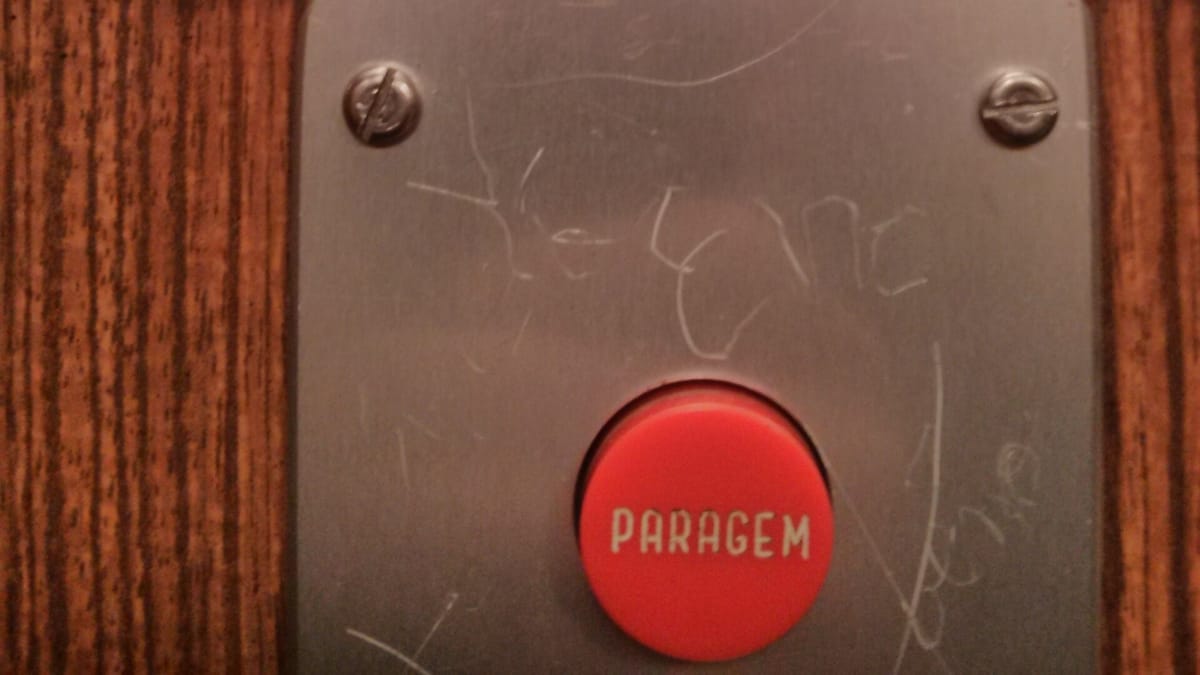
Feature image: the emergency stop button of a lift in Portugal. Photo by Daniil Vasiliev (CC BY-SA 2.0), via Wikimedia Commons.