Portugal's Petrol Stations May Now Stock Three Times as Much Bottled Gas Without a Licence
A decree-law in force from Saturday lifts the licence-free limit for gas bottle stores at filling stations to 1.560 cubic metres, saying the old cap left households short where stations are the main supplier.
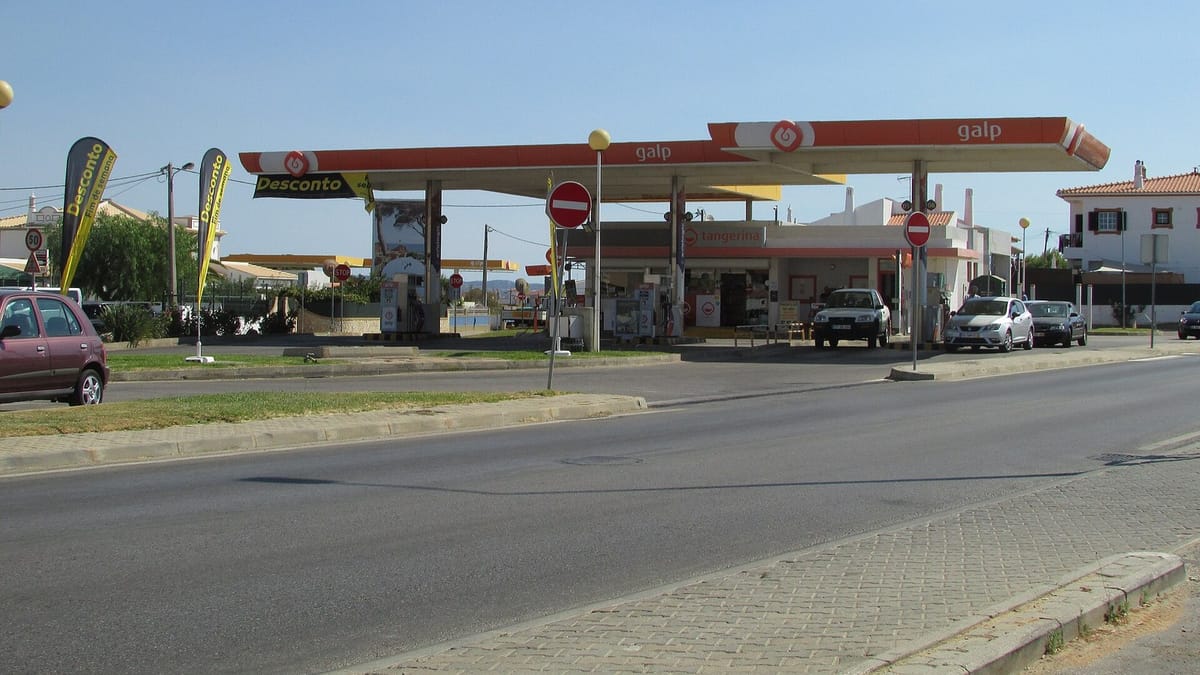
Petrol stations in Portugal can now keep up to three times as much bottled gas on site without a licence. The change comes in Decreto-Lei n.º 198/2026 (Decree-Law 198/2026), published in the Diário da República (Official Gazette) on Friday 2 October and in force from today, Saturday.
The decree rewrites the 2002 law that governs how fuel depots and filling stations are licensed and inspected (Decreto-Lei n.º 267/2002). It is the sixth amendment to that law and the first in more than a decade. The Council of Ministers approved it on 6 August, and President António José Seguro promulgated it on 29 September.
The bottled gas limit
Until now, a store of gas bottles (butane or propane, sold as gás de petróleo liquefeito, or LPG) was exempt from licensing only if its capacity was below 0.520 cubic metres, wherever it stood. Anything larger needed a simplified licence.
The new text keeps that general limit but adds a separate one for petrol stations. A bottle store at a filling station is now exempt up to 1.560 cubic metres, provided it meets the safety rules for gas bottle stores in Portaria n.º 451/2001 (Ministerial Order 451/2001). That is exactly three times the old ceiling.
The Government gives a practical reason in the decree's preamble. It says the old limit "does not adequately meet consumers' supply needs", particularly "in areas where filling stations play an essential role in distributing LPG bottles for household use". Where homes are not connected to piped gas, the local petrol station is often where people swap an empty bottle for a full one.
A station that already has a licensing application pending for a bottle store that the new rule now exempts does not have to wait for a decision. Those procedures end automatically. The licensing authority must tell the applicant within 30 days and refund any fees paid for steps it never carried out.
What else changes
- Less paperwork when risk falls. The preamble says changes that add no risk, such as storing less fuel, should face a simpler procedure. Under the amended text, an operator that cuts its storage capacity by taking a tank out of use asks for the change to be noted on its licence within 30 days.
- Renewable gases are out. Storage of gases of renewable origin and low-carbon gases, as defined in Decreto-Lei n.º 62/2020, is excluded from this law.
- Biofuels are in. Storage of biological or synthetic substitutes for petroleum products, such as biodiesel and bioethanol, is expressly covered.
- Who decides. References to the regional economy directorates, abolished in 2014, are replaced by the Direção-Geral de Energia e Geologia (Directorate-General for Energy and Geology, DGEG), which handles licensing for larger depots and for public filling stations on national and regional roads.
The amended text also spells out what happens when a licensing authority is slow. If it misses its deadline to decide on an operating licence, its silence counts as approval. If it fails to call the final inspection or issue the bill for the inspection fee on time, approval follows ten days after that deadline. Either way, the operator must first have liability insurance and a named technician responsible for the site, and the authority can still inspect later.
What it means for households
For people who rely on bottled gas, the change should make it easier for a nearby station to keep enough full bottles in stock. It does not change the price of a bottle. Low-income households can still claim the 25 euro discount on bottled gas, which now runs to the end of December. For this week's pump prices, see our report on fuel sales in August and Monday's expected price cut.