Coimbra's Electric Metrobus Will Cost Up to 66.3 Million Euros as Its Depot Overruns by 3.8 Million
A Council of Ministers resolution raises Metro Mondego's spending ceiling by 4.8 million euros, saying last year's sums would not finish the Sobral de Ceira depot or pay for 40 electric buses and their chargers.
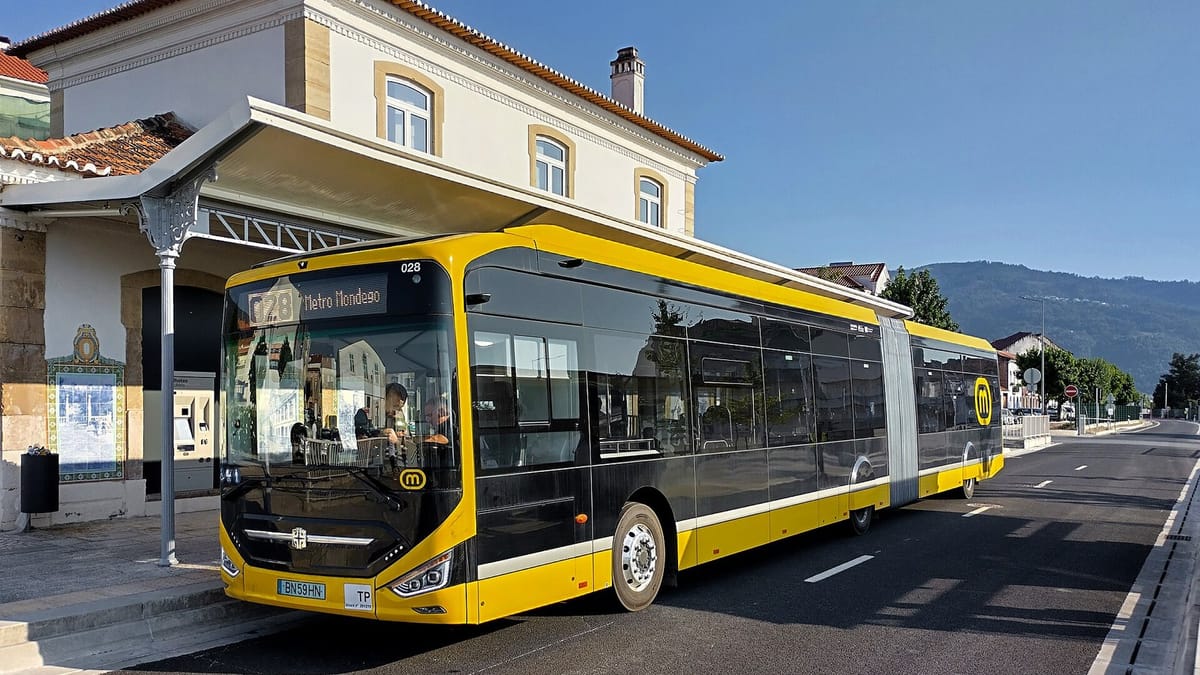
The Government has raised the spending ceiling for Coimbra's electric Metrobus to 66.3 million euros before VAT, after concluding that the money approved last year would not finish the system's depot or pay for its fleet. The decision is set out in Resolução do Conselho de Ministros n.º 192/2026 (Council of Ministers Resolution 192/2026), approved on 24 September and published in the Diário da República (Official Gazette) on 1 October.
The Sistema de Mobilidade do Mondego (Mondego Mobility System) runs battery-electric articulated buses on dedicated lanes, much of them along the old Lousã railway line. It already links Coimbra with Miranda do Corvo and Lousã. Metro Mondego, the state company behind it, says the network will cover 42 kilometres and carry about 13 million passengers a year, according to Lusa.
Where the extra money goes
The previous authorisation, Resolution 57/2025 of March 2025, capped the project's main contracts at 61.51 million euros. The new ceiling is 66.307 million, an increase of about 4.8 million euros, or 7.8 percent. The resolution says plainly that the amounts approved in 2025 "are insufficient" to complete two parts of the work.
- The depot. The Parque de Material e Oficinas (rolling stock depot and workshops) at Sobral de Ceira, a parish of Coimbra, can now cost up to 16.85 million euros, including studies, project management and site supervision. Last year's cap was 13.08 million, so this line rises by about 3.77 million euros, close to 29 percent.
- The buses. The purchase of 40 vehicles and their battery-charging system, including technical advice on the tender and the connection to the power grid, may now cost up to 35.91 million euros, against 34.89 million before.
- Maintenance. The long-term maintenance contract keeps its total of about 13.54 million euros, spread from 2025 to 2040.
All figures are before VAT. For the depot, the resolution allows 3.97 million euros of spending this year and a final 245,625 euros in 2027. For the fleet, it allows 449,208 euros this year and 3.55 million in 2027, which suggests the final payments for vehicles and charging fall due next year.
Who pays
The depot and fleet are financed by the EU's Sustentável 2030 (Climate Action and Sustainability) programme, at up to 85 percent of eligible spending, with a maximum national contribution of 18.6 million euros. The national share and the maintenance costs must come out of Metro Mondego's own budget. The resolution rules out any top-up from the Finance Ministry's central reserves.
The ceiling has moved before. The original 2021 authorisation was 68.08 million euros; a 2023 resolution cut it to 61.51 million and secured European funding, and the 2025 resolution reshuffled money between years without changing the total. The new figure is still below the 2021 amount.
What it means for passengers
Nothing changes on the street today. The extra money pays for work already under way, rather than new routes or more frequent services. A depot with its own workshops lets the operator service and charge its fleet in one place, and the cost of keeping the buses running is fixed under the maintenance contract until 2040.
Separately, since Thursday 1 October, Metro Mondego has sold only the MOVE-C intermodal fare, which lets passengers travel with several operators in the Coimbra region on a single ticket, Lusa reported.
For comparison with Portugal's other big public transport investment this autumn, see our report on the 421 million euros approved for Porto's metro lines to Gondomar and Trofa.