Portugal Tells Brussels That Regauging Its Railways Would Cost Up to 6.9 Billion Euros and Take Thirty Years
The Infraestruturas de Portugal study sent to Brussels concludes that migrating the national network to European gauge will hardly be justifiable. Spain reached the same conclusion in July, and Spain is the country whose decision settles Portugal's.
Portugal has told the European Commission that converting its railways to the gauge used by most of the rest of Europe would cost up to 6.9 billion euros, tie the network up in works for somewhere between 17 and 30 years, and deliver benefits so far into the future that the exercise "will hardly be justifiable". The assessment, drawn up by Infraestruturas de Portugal (Infrastructure of Portugal, the state company that owns and runs the network) and released by the government this week, is Portugal's formal answer to a question Brussels has been pressing on both Iberian countries for two years.
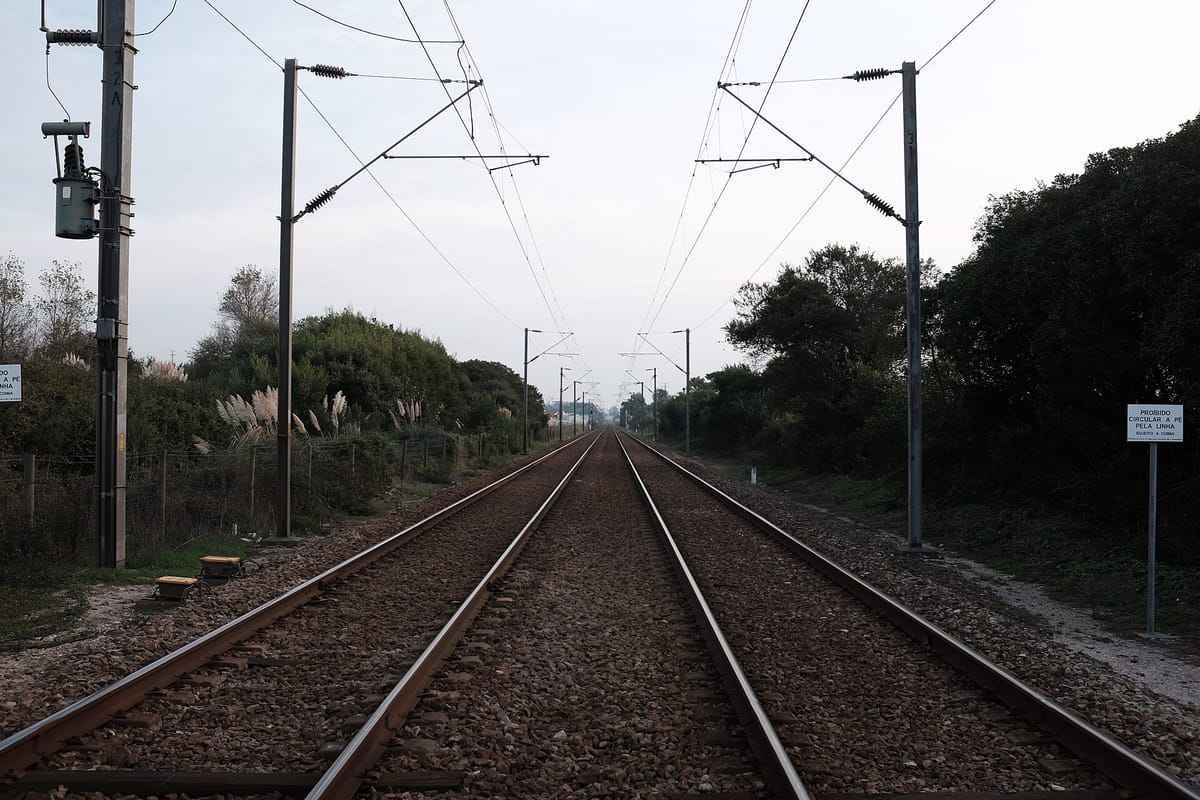
The question is about bitola: the distance between the rails. Portugal and Spain run an Iberian gauge of 1,668 millimetres, inherited from the nineteenth century. Almost everywhere else in the European Union the standard is 1,435 millimetres. A train built for one cannot run on the other, which is why freight and passengers still have to change vehicles, or change bogies, at the border. Infraestruturas de Portugal's own network statement records a single exception on the Portuguese side: the Linha do Vouga, which is metre gauge.
What the study costed
Infraestruturas de Portugal looked at three scenarios, against a baseline in which nothing changes in either country.
In the first, Spain converts and Portugal does not. That leaves Portugal building transfer terminals wherever the two networks meet: Valença on the Linha do Minho, Vilar Formoso on the Linha da Beira Alta, and Elvas and Caia, where the future high-speed line to Madrid will cross.
The second converts only the infrastructure that forms part of the Atlantic Corridor, which is more than half the national network, and leaves the rest on Iberian gauge. The study calls the result a "railway island" inside the national network, and prices the consequences: eight freight transfer terminals, seventeen gauge-changing installations, and rolling stock capable of running on both gauges. This is identified as the worst of the options, on the grounds that the gains would not cover the complexity and cost of operating two separate systems at once.
The third converts the whole network. That is the only version that removes every discontinuity between the existing lines and anything built to 1,435 millimetres in future, and the economic analysis clearly favours it over the half measure, because it maximises the interoperability gain and simplifies operations instead of complicating them. The problem is when the benefits arrive. They are long-term; the disruption is immediate.
The bill for the Atlantic Corridor option runs between 6 billion and 6.5 billion euros. Full conversion runs between 6.4 billion and 6.9 billion. Both figures include infrastructure and trains, and the rolling-stock share is higher in the split-network scenario, because a fleet that has to work two gauges is the more expensive fleet to buy. Portugal's national rail network is 2,643 kilometres long.
The part that is not about money
The cost is not the argument the study leans on hardest. The works themselves are.
Conversion would take roughly 17 to 30 years depending on the scenario, and across that whole period the study expects "recurrent operational constraints and frequent interruptions to rail circulation". During the transition, services would have to be pushed onto alternative routes on a systematic basis, freight and passengers would be temporarily moved to the roads, and some passenger services would be handed to other modes altogether. The damage, as the document frames it, would land on rail's competitiveness, on logistics efficiency and on decarbonisation, which are the three things the conversion is supposed to improve.
The heaviest impact would fall on the suburban networks of Lisbon and Porto, where the railway carries millions of daily journeys and where there is no spare capacity to absorb years of diversions.
There is also a timing problem with the trains. CP, the state passenger operator, has nearly 200 new trains on order, all of them built for the existing Iberian gauge. Converting the network would mean renewing rolling stock that has only just been bought.
And the study revives a finding from an earlier assessment of the Atlantic Corridor itself, the European freight axis that runs from Portugal to Germany: gauge is not the biggest thing holding Iberian rail freight back. The restrictions on crossing the Pyrenees, and the maximum length of trains, rank higher.
Why Spain effectively decides this
Portugal's conclusion is that any final decision "should be taken in full coordination with Spain", backed by demand, financing and phasing analysis, and supported by strong European funding. That is, in practice, a decision passed back to Brussels.
Madrid got there first. Spain's own report became public in July and reached the same place. When the two filings first surfaced in August, we reported that Portugal and Spain had both ruled out regauging, with the only published total a Spanish one: about 30 billion euros for roughly 13,000 kilometres of conventional line and some five cents of economic benefit for every euro spent. This week's release is the Portuguese half of that answer, and the first time the national figures have been public. The Spanish government decided not to proceed , despite having high-speed lines already built to European gauge and a physical connection to the French network. For Portugal the Spanish position is close to decisive: Spain is the main destination for Portuguese freight, and the cross-border links that matter are Iberian gauge on both sides of the frontier. That includes the Atlantic Corridor route, which runs from Sines, Setúbal and Lisbon up to Aveiro and Leixões.
What the EU rules actually require
The obligation comes from Regulation (EU) 2024/1679, the current guidelines for the trans-European transport network. Its Article 17 requires member states to build any new railway line on the core and extended core networks to 1,435 millimetres, with the requirement counted as met when trains of that gauge can run on the infrastructure by 31 December 2030 for the core network and 31 December 2040 for the extended core. A "new" line, for this purpose, is one where construction had not started by 18 July 2024.
Article 17(3) is the provision Portugal has just answered. It obliged member states whose existing network runs on a different gauge to complete an assessment by 19 July 2026, identifying the existing lines on the European Transport Corridors that could be migrated, coordinated with the neighbouring state on cross-border sections, and including a socio-economic cost-benefit analysis of whether migration is viable at all. Where migration is warranted, the state then has to draw up a plan, at the latest one year after finishing the assessment, naming the lines and indicating a timeline.
The regulation's own recitals explain why the escape hatch exists. It treats a network on a different gauge as an "isolated network" and accepts that applying some of its standards to one would not be justified in cost-benefit terms. Article 17 does not apply at all to Ireland, to islands or to the outermost regions.
The government said in July that it had put a preliminary assessment to DG MOVE, the Commission's transport directorate, and remained open to continuing the conversation. According to Observador, which reported the study's contents on Thursday, the Lisbon to Madrid line, whose Portuguese section was built to Iberian gauge, is to be reassessed in the light of a Commission decision requiring both countries to present an integrated migration plan by the end of 2027.
The lines being built right now
The study covers only the existing network. For the high-speed lines currently in planning, Portugal has asked for a derogation until 2040 for the Lisbon to Porto line, which is being built to Iberian gauge precisely so it can connect to the network that already exists. Infraestruturas de Portugal says the new line will tie into the conventional network at Canelas, Oiã, Adémia and Taveiro, so that high-speed services can reach the existing stations at Aveiro and Coimbra. The 2040 date matches the extended-core deadline in Article 17(1) rather than the 2030 one.
The timing is pointed. Ground is due to break on the first high-speed section at the end of September, and the country is committing to an alignment and a gauge for decades while telling Brussels the rest of the network cannot follow. The same week brought a second piece of railway rulemaking, with the government rewriting the level crossing rulebook after 27 years.
For passengers, nothing changes in the near term, and that is rather the point of the document. The Iberian Peninsula will keep its own gauge, the border will keep its transfer arrangements, and the cost of ending that will keep being quoted in tens of billions across the two countries and in decades of works. What the study does settle is that Portugal will not move first, and probably will not move at all unless Spain does and Europe pays.