Portugal Carves Out Dedicated Centres for Driving, Hunting and Firearms Medicals to Take the Paperwork Off Family Doctors
Portaria n.o 377/2026/1, published on Tuesday, lets each of the 39 local health units open a Centro de Avaliacao Medica e Psicologica. It covers group 1 and group 2 driving licences, hunting permits, gun licences and nautical activities. No centre exists yet, and the text sets no price.
If you have ever booked a consultation with a family doctor purely to get a signature on a form for a driving licence renewal, Portugal has just written the rule that is meant to stop you doing it. Portaria n.º 377/2026/1, published in the Diário da República (Official Gazette) on Tuesday and in force from Wednesday, creates Centros de Avaliação Médica e Psicológica (Medical and Psychological Assessment Centres), or CAMP, inside the country's local health units.
The reasoning is stated plainly in the preamble. Issuing medical and psychological certificates, the government writes, has been absorbing a considerable part of the activity of Cuidados de Saúde Primários (Primary Health Care) and limiting its capacity to actually treat people.
What a CAMP will handle
The new centres carry out the medical, psychotechnical and technical acts needed to issue an atestado de robustez física e psíquica, the certificate of physical and mental fitness. The portaria lists what it is for:
- obtaining and renewing a group 1 or group 2 driving licence;
- a hunting licence;
- a licence to use and carry a firearm;
- nautical activities;
- any other legally provided purpose requiring proof of physical and mental fitness.
Each centre must staff doctors, psychologists and senior diagnostic and therapeutic technicians, and carry out an individual clinical examination rather than a paper review. Forms do not change, and no other public body loses a competence: the CAMP does the assessment and passes the result to the applicant and to whoever asked for the certificate.
The framework exists; the centres do not yet
This is the part worth reading closely. The portaria does not open a single centre.
Creating a CAMP is at the initiative of each Unidade Local de Saúde (Local Health Unit), of which there are 39 across the country. Before it can open, the unit has to produce a viability study naming the staff, listing the equipment, describing the physical space and its accessibility, and setting out a cost-benefit analysis that demonstrates financial sustainability. That study goes to the executive director of the Serviço Nacional de Saúde (National Health Service), whose favourable opinion is a precondition for the centre to exist at all.
Where geography or thin resources justify it, one CAMP may serve several neighbouring local health units on a transitional basis.
The measure was written into the Plano de Emergência e Transformação na Saúde (Health Emergency and Transformation Plan) approved in May 2024, and the underlying obligation comes from the driving licence rules transposing EU law. Health minister Ana Paula Martins signed the portaria on 18 June. It reached the gazette on 25 August.
What this means if you live here
- Nothing changes for your next renewal yet. Until your local health unit gets a favourable opinion and opens a centre, the existing routes stand: your family doctor, or a private clinic if you do not have one assigned.
- The portaria sets no price. It is silent on what a CAMP assessment will cost the user. That is the single most consequential detail still missing.
- Group 2 matters more than group 1. Group 2 covers heavy vehicles and passenger transport and carries stricter and more frequent medical requirements, so professional drivers are the group most exposed to how well these centres are resourced.
- It is aimed at freeing up appointments. If it works, the benefit lands on everyone waiting for a primary care slot, not only on people needing certificates. Portugal's health service is already missing legal waiting-time limits on half of first specialty appointments.
Whether this becomes real depends on 39 separate business cases, each of which has to prove it pays for itself. Our guide to exchanging a foreign driving licence in Portugal covers the medical certificate step as it works today, and that is the process to plan around until the first centre actually opens its doors.
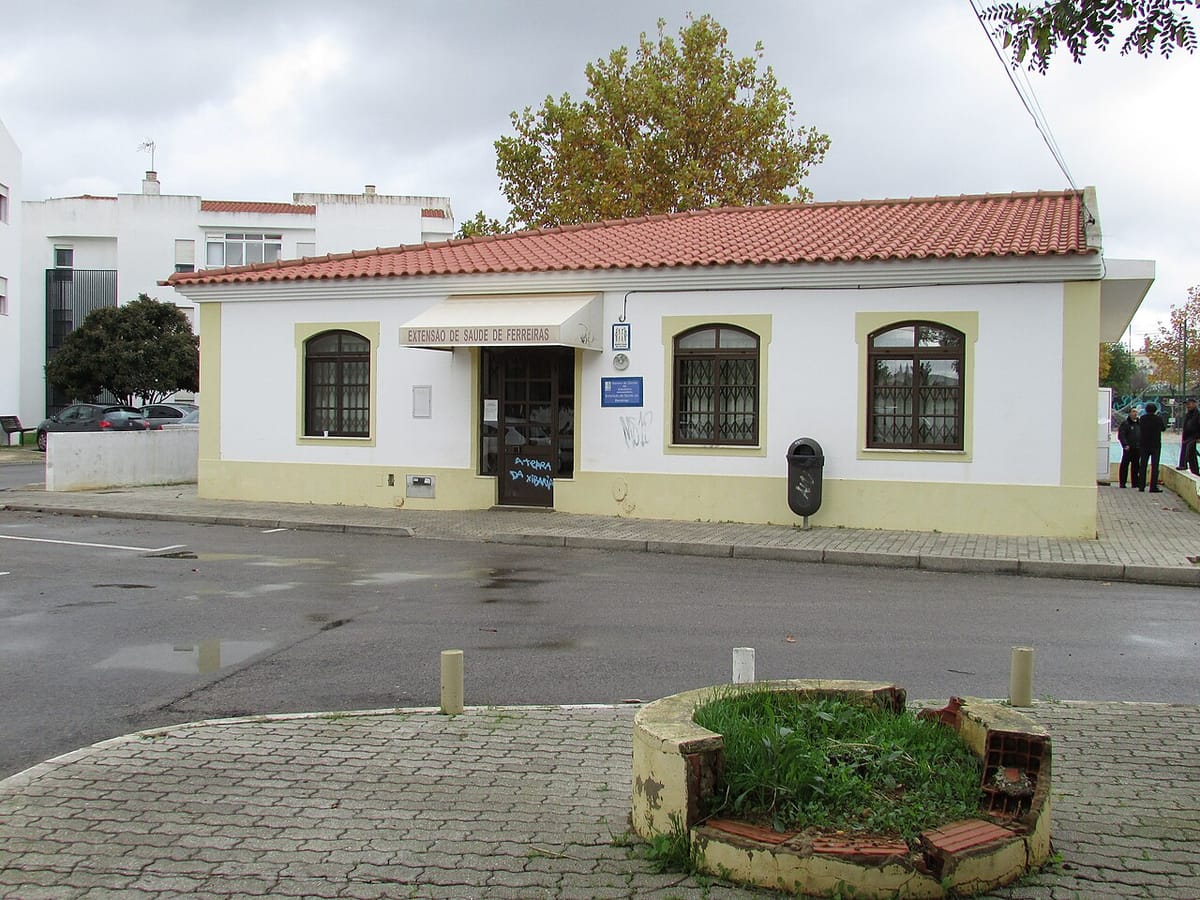
Feature image: the Extensão de Saúde de Ferreiras, a small public primary care post in the Algarve of the kind the new centres are meant to relieve.