Portugal Budgeted 1.01 Million Euros for Three Months of Volunteer Fire Brigade Fuel, and Two District Federations Say None of It Has Landed
A March decree-law promised 10 cents a litre, converted into 360 euros a heavy appliance. The IMT rules took until 17 July and applications closed on 28 August. On Saturday Setúbal and Vila Real said the money still has not arrived, and diesel goes up again on Monday.
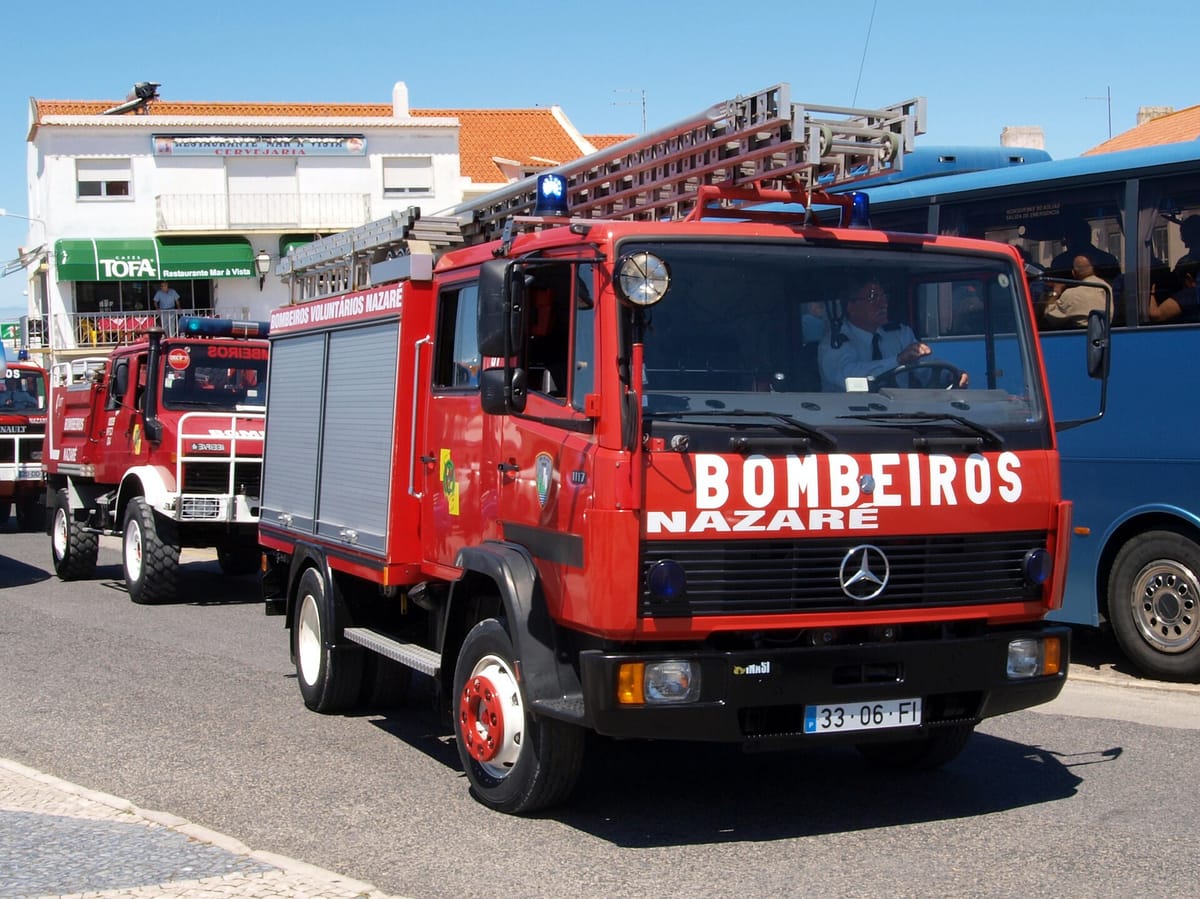
Portugal set aside 1,013,832 euros to cover three months of fuel for every volunteer fire brigade in the country. That is the arithmetic of a decree-law published in March and a regulation published in July, and on Saturday two district federations of firefighters said, independently and within hours of each other, that none of it has reached them.
The Federação dos Bombeiros do Distrito de Setúbal (Setúbal District Firefighters Federation) put out a statement saying the extraordinary support for fuel costs published in the Diário da República at the end of March had, months later, still not arrived. The Federação de Bombeiros do Distrito de Vila Real used its own channels to describe the effect on what it called the "weak treasuries" of its corporations, and warned that if the measures keep being late, some services may have to be suspended for want of liquidity.
Where the figure comes from
Decreto-Lei n.º 80-A/2026 of 31 March, corrected by Declaração de Retificação n.º 14/2026/1 of 21 April, created a set of exceptional and temporary supports against the fuel price rise that followed the conflict in the Middle East. Hauliers, coach operators, farmers, fishermen, the social sector, taxi firms and humanitarian firefighters' associations were all covered, on different terms.
For the fire brigades, article 13 sets the support at 10 cents a litre of road diesel and petrol burned between 1 April and 30 June 2026 by rescue and firefighting vehicles. It does not ask anybody to produce receipts. It assumes a consumption of 1,200 litres a month for a heavy appliance and 400 litres a month for everything else, and converts that into two fixed amounts: 360 euros for a "class S (Super)" vehicle and 120 euros for the rest. Article 14 makes the Instituto da Mobilidade e dos Transportes (IMT, the Institute for Mobility and Transport) responsible for paying it, once, out of the Fundo Ambiental (Environmental Fund).
The envelope is 3.6 million euros, fixed by Despacho n.º 6769-A/2026, which approved the Environmental Fund's 2026 budget. The IMT's operational regulation splits it three ways by weight: 24.987 percent to taxis, 46.851 percent to the social sector and 28.162 percent to the humanitarian firefighters' associations. That last share is the 1,013,832 euros.
Worth reading the other way round: at 360 euros a heavy appliance, that share buys 2,816 vehicle payments for the whole country, and at 120 euros it buys 8,448. That is the ceiling on what the state undertook to hand back to the volunteer fire service for three months of fuel, in a spring and early summer when its appliances were fighting fires.
Three and a half months to write the rules
The delay has a documented shape. On 2 June, two months after the decree-law, the economics daily ECO asked the IMT why nothing was being paid. The answer was that "the operationalisation procedure will be defined by a regulation to be published in due course", and that the institute was coordinating with other public bodies on releasing the money and identifying eligible entities in sectors it does not supervise.
That last clause is the bottleneck, and it is written into the scheme's design. The IMT issues taxi licences itself, so it already knows how many taxis exist. It does not register fire engines. Under article 3 of the regulation, the Autoridade Nacional de Emergência e Proteção Civil (ANEPC, the National Authority for Emergency and Civil Protection) has to identify the eligible associations and their vehicles, and the Instituto da Segurança Social has to do the same for the social sector, before the IMT can validate a single claim.
The regulation was eventually published on 17 July. Under article 8, the window for submitting, confirming or updating the necessary information opened the next day and closed on 28 August. Claims are assessed in order of submission, up to the limit of the budget, which means a brigade that applied late can in principle be told the money ran out. Eligibility requires the vehicles to be assigned to rescue, firefighting or patient transport missions, registered as operational with the ANEPC, and in compliance with their inspection obligations, and the association to be square with the tax authority and social security.
Applications closed a fortnight ago. The Setúbal federation's statement on Saturday is what has happened since.
What the federations are actually asking for
Both statements make a point of saying that the fuel support is not the real argument. "The extraordinary supports, although necessary at moments of greater pressure, do not constitute a structural solution," the Setúbal federation said. "The associations need financing that is adequate and updated to the real costs of the services they provide."
Its list of demands is specific and mostly has nothing to do with fuel:
- immediate payment of the extraordinary supports already approved and not yet transferred;
- an urgent update of the taxa de saída, the call-out fee, and of the per-kilometre rate paid for patient transport;
- an update of the values in the protocols with the Instituto Nacional de Emergência Médica (INEM, the National Institute of Medical Emergency);
- a contrato-programa between the state and the humanitarian associations, with a mechanism for updating the values periodically as costs move.
"It is not just a matter of asking for more support," the statement says, but of guaranteeing "fair, adequate and updated financing for a mission essential to the protection and safety of populations". The underlying complaint is that the associations are covering, out of their own funds, the gap between what a call-out costs them and what they are paid for it.
The Vila Real federation named the same three causes: chronic underfunding of the humanitarian associations, the absence of structural measures for the sector, and successive delays in payments by public institutions. It said rescue cover in the district is not currently at risk, thanks to the effort of officers and firefighters, but that there are worrying signs about the ability to pay suppliers and staff.
The argument is older than this year
None of this is new. In April the Liga dos Bombeiros Portugueses was on the point of terminating its emergency agreement with INEM over unpaid debt. In May the government raised the monthly subsidy for the brigades' emergency posts to 10,800 euros from 1 July. In June, INEM's own accounts showed transfers to the brigades and the Red Cross up 37.4 percent while its own loss widened. And in March, before the decree-law existed, the volunteer brigades were already warning that fuel prices were threatening rescue operations. The support announced at the end of that month was the answer to that warning.
The timing of Saturday's statements is not accidental. Diesel goes up about four cents a litre on Monday on current estimates, even after the government widened the ISP discount for diesel in an order published on Friday night. As the Setúbal federation put it, fire crews cannot throttle back according to the pump price. "Ambulances, emergency vehicles, firefighting and other operational means have to keep responding to the needs of populations."
The sector's governance has had a rough fortnight of its own, with the head of the national firefighters school resigning in a seventeen-page letter. The money question is the quieter one, and it is the one that decides whether an appliance leaves the station.