Porto Shows King Pedro IV's Heart in Public for Only the Third Time Since 1835, and Sunday Is the Last Day
The heart Pedro IV left to Porto in 1834 is on view in the Lapa brotherhood's Great Hall until 16:00 on Sunday, free of charge. It was never shown in public until 2022, when it travelled to Brazil for the bicentenary.
The heart of King Pedro IV, who was also Pedro I, the first Emperor of Brazil, is on public view in Porto this weekend, and Sunday is the last chance to see it. It is shown in the Salão Nobre (Great Hall) of the Irmandade da Lapa (Brotherhood of Our Lady of Lapa), entered through the Galeria dos Retratos (Portrait Gallery), from 10:00 to 16:00 on Sunday 27 September, after two afternoons from 14:00 to 18:00 on Friday and Saturday. Entry is free, subject to the capacity of the rooms, according to the brotherhood's programme.
Until 2022, the heart had never been put on public display.
A bequest to "the heroic city"
According to the brotherhood's own account, Pedro dictated his last wishes in the early hours of 23 September 1834, the day before he died. Among them was that his heart should go "to the heroic city of Porto, theatre of my true glory", in gratitude for its support for the liberal cause. He had lived in the city through the Cerco do Porto (Siege of Porto) of 1832 and 1833, the decisive episode of the Portuguese civil war.
The heart left Lisbon on 4 February 1835 aboard the ship Jorge IV, in the care of Pedro's former aide-de-camp, Baltasar de Almeida Pimentel, and reached the Ribeira quay on 7 February. It went to the mayor and then to the brotherhood. It was Maria II who chose the Lapa church, where her father had attended the military masses during the siege. For two years it stood under a canopy with a permanent sentry; in 1837 it moved into the mausoleum on the Gospel side of the chancel, built by Costa Lima, where it still lies in a silver urn inside a glass vessel, the brotherhood says. The mausoleum is locked with five keys, and those keys are kept in the mayor's office.
Three showings in four years
The first public showing came only in August 2022, before the heart was flown to Brazil for the bicentenary of its independence. Porto City Council said at the time that it was being shown to the public "for the first time". It came back on 9 September 2022 and was shown a second time that weekend before going back into the mausoleum. When the transfer was planned, an assessment by the Instituto Nacional de Medicina Legal e Ciências Forenses (National Institute of Legal Medicine and Forensic Sciences) concluded that it could travel only in a pressurised environment, Lusa reported through Observador.
This weekend is the third showing. While the rooms were being prepared, the Portrait Gallery ceiling was found to need repair, and on 3 September the council said it would vote 2,550 euros towards repairs and waterproofing, according to Lusa. The display walks visitors through the decisive moments of Pedro's life. The weekend opened on Thursday night, the 192nd anniversary of his death, with solemn exequies in the church: the Army band's Porto detachment and the Lapa polyphonic choir, readings from the funeral eulogy of 1856 and, at the close, the Hymno da Carta, the constitutional anthem Pedro composed himself. Porto's mayor, Pedro Duarte, said it was important to celebrate values such as liberty, RTP reported.
Why Brazilians come too
Pedro's body is in São Paulo; the heart stayed behind. For Portugal's largest immigrant community, it is the heart of the emperor who declared their country independent in 1822. AIMA counted 493,622 Brazilian residents at the end of 2025, 31.1 percent of all foreign residents.
No further showing has been announced. Our Porto Brief carries each week's events in the city.
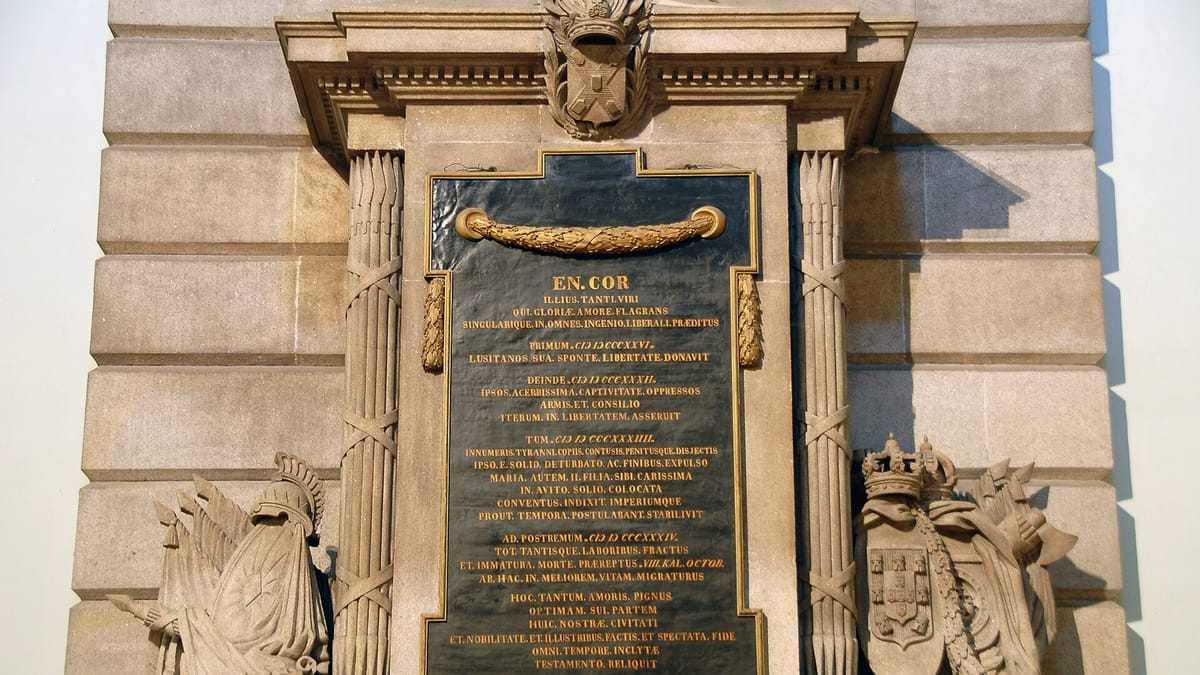
Feature image: the mausoleum of Pedro IV's heart in the chancel of the Igreja da Lapa, Porto, with its Latin inscription beginning "En cor". Photo by António Amen (public domain), via Wikimedia Commons.