Porto Moves Its Tuk-Tuk Stops Out of the Ribeira and Clérigos, and Tests an App to Ration Access to the Old Town
Since 1 October tuk-tuks can no longer pick up passengers at the Ribeira or Clérigos, and coach stops have moved too. Porto is also testing a platform that approves access to the centre automatically.
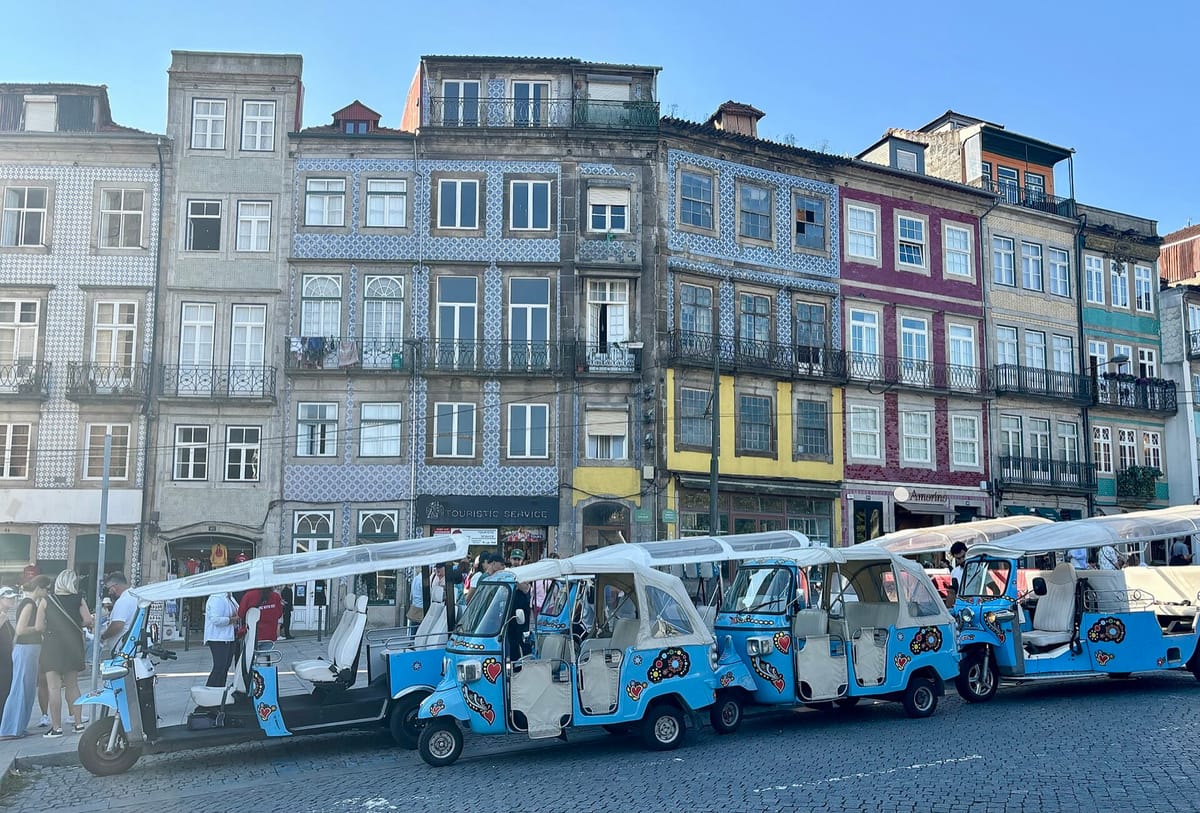
Tuk-tuks can no longer pick up or drop off passengers at the Ribeira or by the Clérigos tower in Porto. The Câmara Municipal do Porto (Porto City Council) moved the stops used by tourist vehicles on Thursday, 1 October, with most of the changes in the Baixa (downtown) and the historic centre, and it is now testing an online system that will decide automatically which tour operators may enter the old town, when and where.
The changes cover both tuk-tuks (which the council defines as tourist vehicles with nine seats or fewer) and coaches on occasional services, such as tour and excursion coaches.
Where tuk-tuks can stop now
According to the council's note of 30 September:
- Closed: the stop at the Ribeira is deactivated and the one at Clérigos removed.
- New: pick-up and drop-off points on Rua de Ferreira da Silva, Largo Actor Dias, Rua de Alexandre Herculano, in Lapa, by the Castelo do Queijo and at the Estádio do Dragão.
- Unchanged: the existing stops at Passeio Alegre and São Lázaro.
And where coaches can stop
- Closed: the coach stop on Rua do Dr. Ferreira da Silva is deactivated, and the current one on Campo dos Mártires da Pátria removed.
- New, inside the restricted zone: Rua de Gonçalo Cristóvão, Rua Tareija Vaz de Altaro, and a new spot on Campo dos Mártires da Pátria next to the courthouse.
- New, outside it: Avenida da Boavista near the Castelo do Queijo, Rua de D. João de Castro, Rua de Júlio Dinis, Via Futebol Clube do Porto and Largo da Lapa.
All other existing stops stay. The council's interactive map (mapas.cm-porto.pt) and its Portal do Munícipe (residents' portal) carry the updated list.
An app to book the old town
In a second note on Friday, the council said it is testing a digital platform for access to the Zona de Restrição (restricted zone), the area of the centre closed to tour coaches without permission. Operators will register their vehicles and licences, then ask for a day, time slot and stop. A traffic-light calendar will show how busy each stop is in real time. Where a request meets the rules and there is space, it will be approved automatically; stops that are full will be blocked.
The Polícia Municipal (Municipal Police) will be able to check on the spot whether a vehicle has a valid authorisation. "We are replacing bureaucracy with technology," said Hugo Beirão Rodrigues, the councillor for mobility and tourism. The council did not say when the system will leave its test phase.
The rules underneath
The stops are the latest layer on rules Porto has tightened in stages. The city's regulatory code, the Código Regulamentar do Município do Porto, was amended last autumn (approved by the council on 29 September 2025 and the municipal assembly on 6 October 2025) to create the restricted zone, inside which coaches on occasional services are banned unless authorised. Coaches cannot enter it at all from 18:00 to 20:00 on weekdays, according to the residents' portal; between 08:00 and 18:00 they need an authorisation.
Tuk-tuks are exempt from the coach ban only if they run on a tourist circuit licensed by the council. Under the code:
- Licences are awarded by public tender, last five years for small vehicles and cannot be renewed.
- Each operator may run at most eight small vehicles.
- Tricycles, quadricycles and similar vehicles must be electric or use equally non-polluting technology, and passengers must be seated.
- Circuits may run only between 10:00 and 22:00.
- Vehicles must share their GPS position, and a stop on the street to let passengers on or off may never last more than three minutes.
- The licence costs 505 euros to issue, plus 125 euros per vehicle per year, paid between 1 February and 31 March.
- Breaches are treated as offences under the Highway Code, and a licence can be revoked after more than five infractions in a month or 20 in a year.
When it first planned the zone in July 2024, the council said it did not know how many tuk-tuks were operating in the city, and proposed licences for five companies with eight vehicles each, 40 in all. It has not published a current count.
Porto is not alone. Lisbon announced in February 2025 that its ban on tuk-tuks circulating, stopping and parking would be extended to about 300 streets from that April, citing a marked rise in complaints from residents and shopkeepers, and Sintra cracked down on tuk-tuks and tourist vehicles in April, before its coach limits ended up in court.
Sources: Câmara Municipal do Porto, notes of 30 September and 2 October 2026 (porto.pt); Regulamento n.º 1222/2025, Diário da República, 2nd series, 7 November 2025; Código Regulamentar do Município do Porto, consolidated version of 27 November 2025, Title D-7 and the table of fees; Portal do Munícipe, access to the restricted zone; Câmara Municipal do Porto, note of 22 July 2024; Câmara Municipal de Lisboa, note of 11 February 2025.