Markets, Business & Tech Briefing: Energy Lifts PSI 0.48%, 800 Solar Fast-Track Zones, Spain's AI Consortium Cleared
📋 In This Edition
- Market Wrap: Energy Carries Lisbon Back Above 9,280
- From the Council of Ministers: 800 Fast-Track Zones for Solar, and a 'Once Only' Rule for Paperwork
- The €581.8 Billion Bill Hanging Over the Civil Service Pension Fund
- Brussels Clears Spain's AI Gigafactory Consortium While Portugal's Bid Waits on Sines
- Bonds and the Euro: A 35-Point Spread and a Currency Catching Its Breath
- The Day Ahead
Market Wrap: Energy Carries Lisbon Back Above 9,280
Lisbon took back Wednesday's slip. The PSI (Portuguese Stock Index) closed Thursday, 20 August, at 9,282.81 points, up 0.48%, a gain of 43.91 points that more than reversed the previous session's drop to 9,238.90. Nine of the index's sixteen members rose and seven fell, and the leadership was unusually concentrated: almost every name that mattered on the upside was an energy company.
Galp Energia was the day's best performer, adding 1.44% to €21.77. Much of that is the unwinding of a technical move rather than fresh news. Galp traded ex-dividend for the first time on Wednesday, which mechanically strips the value of an upcoming payout out of the share price; with that adjustment behind it, the stock spent Thursday clawing the ground back. The rest of the sector followed. The utility EDP rose 1.20% to €4.648 and its renewables arm, EDP Renováveis (EDP Renewables), added 1.04% to €13.55, while the grid operator REN, or Redes Energéticas Nacionais (National Energy Networks), climbed 1.00% to €3.545. Outside energy, the paper maker Navigator gained 0.87% to €3.238 and BCP, or Banco Comercial Português, put on 0.83% to €1.089.
Consumer and construction names sat on the other side of the ledger. The restaurant group Ibersol was the worst performer, down 1.59% to €9.88. The grocer Jerónimo Martins fell for a second consecutive session, losing 1.11% to €16.99; the builder Teixeira Duarte dropped 1.04% to €0.476; and Sonae shed 1.00% to €1.98. European bourses were split between gains and losses, so Lisbon's advance owed more to its own sector mix than to any regional tide.
From the Council of Ministers: 800 Fast-Track Zones for Solar, and a 'Once Only' Rule for Paperwork
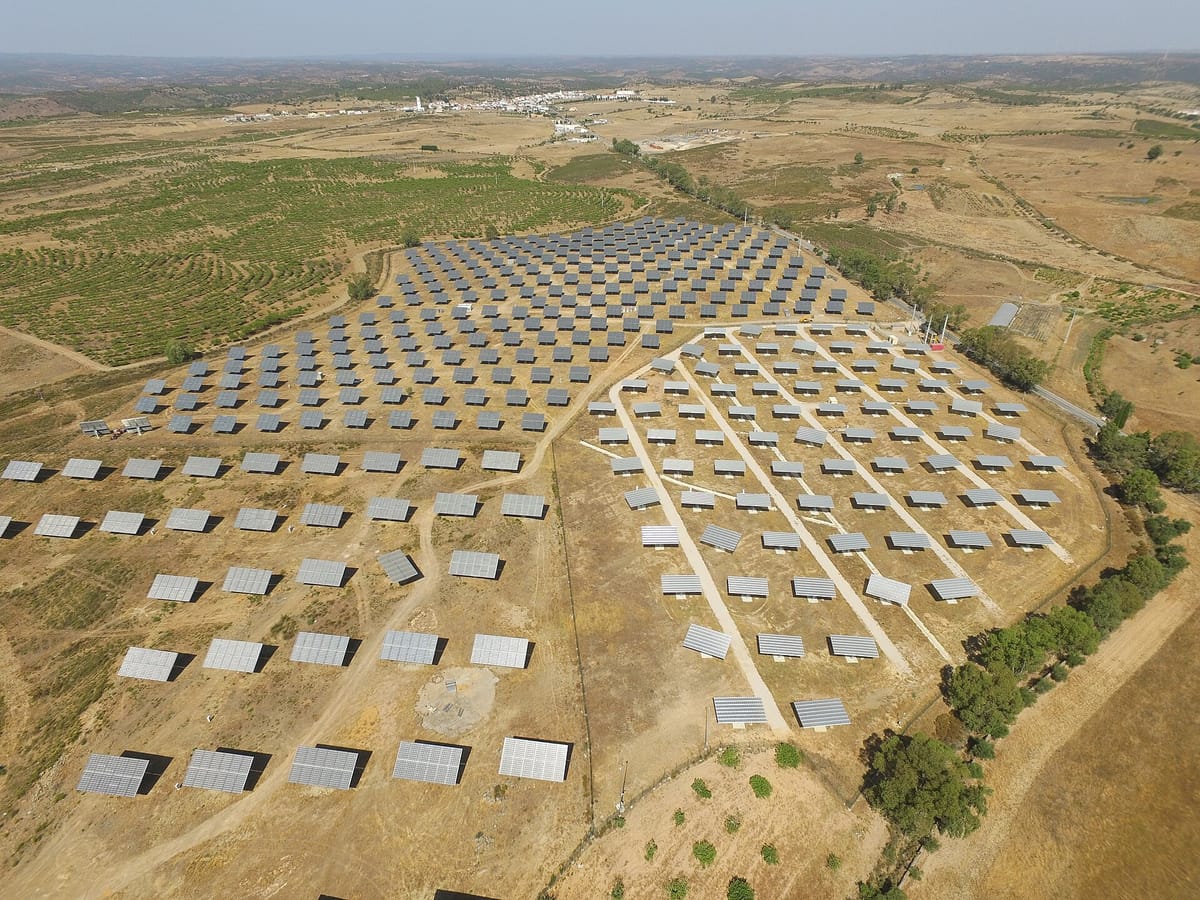
The government spent Thursday's cabinet meeting on two measures that will land on company balance sheets long before they reach the headlines. The first is a sectoral programme for the accelerated deployment of renewable energy, which maps out more than 800 areas across roughly 170 mainland municipalities as acceleration zones for solar and photovoltaic projects. The sites were selected after public consultation, territorial studies and a strategic environmental assessment. Inside those zones, developers get shortened licensing procedures and, where the strategic assessment already covers the ground in question, an exemption from filing an individual environmental impact assessment. The stated aim is to lift domestic renewable output and cut the country's dependence on imported energy.
That is a direct tailwind for the very companies that led Thursday's index. Permitting delays, not capital or panels, have been the binding constraint on the Portuguese solar pipeline for years, and a pre-cleared map of where projects may go removes the single most expensive unknown from a developer's timetable. The detail to watch is which municipalities made the list, because that determines whose land suddenly became a great deal more valuable.
The second measure is administrative, and its cost falls on every company in the country. The Council of Ministers approved a bill on interoperability in public administration that writes the "once only" principle into law: citizens and businesses hand a given piece of information to the state once, and agencies then share it internally, within data protection rules, rather than asking for it again. António Leitão Amaro, the minister presenting the bill, framed it as a question rather than a policy: why should citizens have to deliver to the state, over and over, data the state already holds? The existing interoperability platform works only partially, hemmed in by successive consent requirements and by the bilateral protocols agencies have to negotiate with one another. For small firms in particular, where compliance time is paid for out of the owner's evenings, this is the kind of reform whose benefit never shows up in a headline number.
The €581.8 Billion Bill Hanging Over the Civil Service Pension Fund
A working group studying Social Security reform, coordinated by the economist Jorge Bravo, has put a figure on one of the longest liabilities in Portuguese public finance. The Caixa Geral de Aposentações (General Retirement Fund), the closed pension scheme for civil servants who joined before 31 December 2005, will require about €581.8 billion from the state between 2026 and 2111, measured at 2025 prices with no discounting applied. That is equivalent to 189.7% of last year's nominal output, or an average of roughly €6.8 billion a year across 85 years.
The number is arresting, but it is a schedule rather than a surprise. The State Budget already transfers around €7 billion a year into the fund, and the 2026 budget plans €7.5 billion. Spending peaks in 2044 at €20.058 billion, with state transfers topping out at €17.426 billion the following year, and then declines: about €10.643 billion in 2060, roughly €1 billion by 2080, with the last subscribers expected to have died out by 2056.
The shape of that curve is a direct consequence of the scheme's closure. Since 1 January 2006 new public-sector hires have paid into the general Social Security regime instead, so the fund receives no new contributors while its historic obligations run on for another 85 years. In 2025 contributions from subscribers and employers covered just 34.2% of its pension bill, with the budget funding about 59%, leaving a self-financing ratio of 39.4%; the group estimates that figure would sit near 66% had the scheme stayed open to new members. The two halves of the system are joined at the hip. The general regime ran a surplus of €5.468 billion last year, yet consolidating that with the fund's deficit still left Portuguese pensions €1.494 billion in the red overall.
Brussels Clears Spain's AI Gigafactory Consortium While Portugal's Bid Waits on Sines
The European Commission approved on Thursday the creation of a joint venture between the construction group ACS, the telecoms operator Telefónica, Banco Santander and SETT, the Sociedad Española para la Transformación Tecnológica (Spanish Society for Technological Transformation), the state vehicle also referred to as SEPI Digital. The transaction was notified to Brussels on 17 July and cleared under the simplified merger procedure, the Commission having concluded that the parties' limited position in the resulting market raised no competition concerns. The three private partners hold 47% of the capital between them, 15.67% each, with the state entity taking the remainder, and Madrid has authorised €719 million through its digital transformation ministry. The two sites proposed are Móra la Nova, in Tarragona, and San Fernando de Henares, outside Madrid.
The vehicle exists for one purpose: to bid for one of the artificial-intelligence gigafactories the European Union intends to build. Brussels wants up to seven of them, supported by as much as €10 billion of public money from European funds and member states alongside at least €20 billion of private capital, each site housing the kind of processor count that no single European company can currently assemble on its own.
Portugal is chasing the same programme, and the slots are few. In June the government approved a resolution enabling ARTE, the Agência para a Reforma Tecnológica do Estado (Agency for the Technological Reform of the State), to subscribe to a candidacy anchored on Sines, committing €200 million of public investment over seven years, with Brussels matching that amount should the bid succeed. Sines has the two things these projects need and Iberian cities largely do not: transatlantic subsea cable landings and a deepwater industrial site with power. With the awards expected to be settled in early 2027, Thursday's clearance is a useful marker of where the competition stands: the Spanish consortium is now legally constituted and funded, and Portugal's own bid will be judged against it.
Bonds and the Euro: A 35-Point Spread and a Currency Catching Its Breath
Portugal's borrowing costs barely moved. The 10-year Obrigações do Tesouro (Treasury bonds) yielded about 3.61% late on Thursday, easing by under a basis point, while Germany's 10-year Bund edged up to around 3.26%, within a whisker of its highest level in a year. That leaves the spread Portugal pays over the eurozone benchmark at roughly 35 basis points, essentially unchanged from Wednesday. The distinction matters: the upward pressure on Portuguese yields this month is coming from the global level of interest rates, not from any doubt about Lisbon, whose risk premium remains close to the slimmest it has ever been.
The euro held Wednesday's advance rather than extending it. The single currency traded around $1.167, down a marginal 0.03% on the day from a close of $1.1677, and remains at its strongest against the dollar since June. For Portuguese importers of energy and raw materials that firmness is worth real money; for the hotels still filling with American visitors in late August, rather less.
The Day Ahead
Friday brings a thin domestic calendar. Galp's interim dividend of €0.35 gross per share reaches shareholder accounts, a cash transfer that has already been priced in and should not move the stock, though it does mark the end of the technical distortion that has shaped the last two sessions. The question for Lisbon is whether the energy names can hold Thursday's gains once that rebound has run its course, with no home-grown catalyst behind them. Watch the euro's ability to stay above $1.16, and keep an eye on the fine print of the renewables acceleration programme as it is published: the map of those 800 zones is the most consequential thing to come out of Thursday for anyone building in Portugal.