Lisbon's New Artificial Intelligence Building Comes In at €8 Million, €1.1 Million Above What the Government Announced
A resolution published in the gazette on Friday raises the ceiling for the AIDE research building at the Instituto Superior Tecnico from €6,878,710 to €8 million after the tender came in high. The 2025 tranche was never spent, and the school now covers €1.5 million from its own revenue.
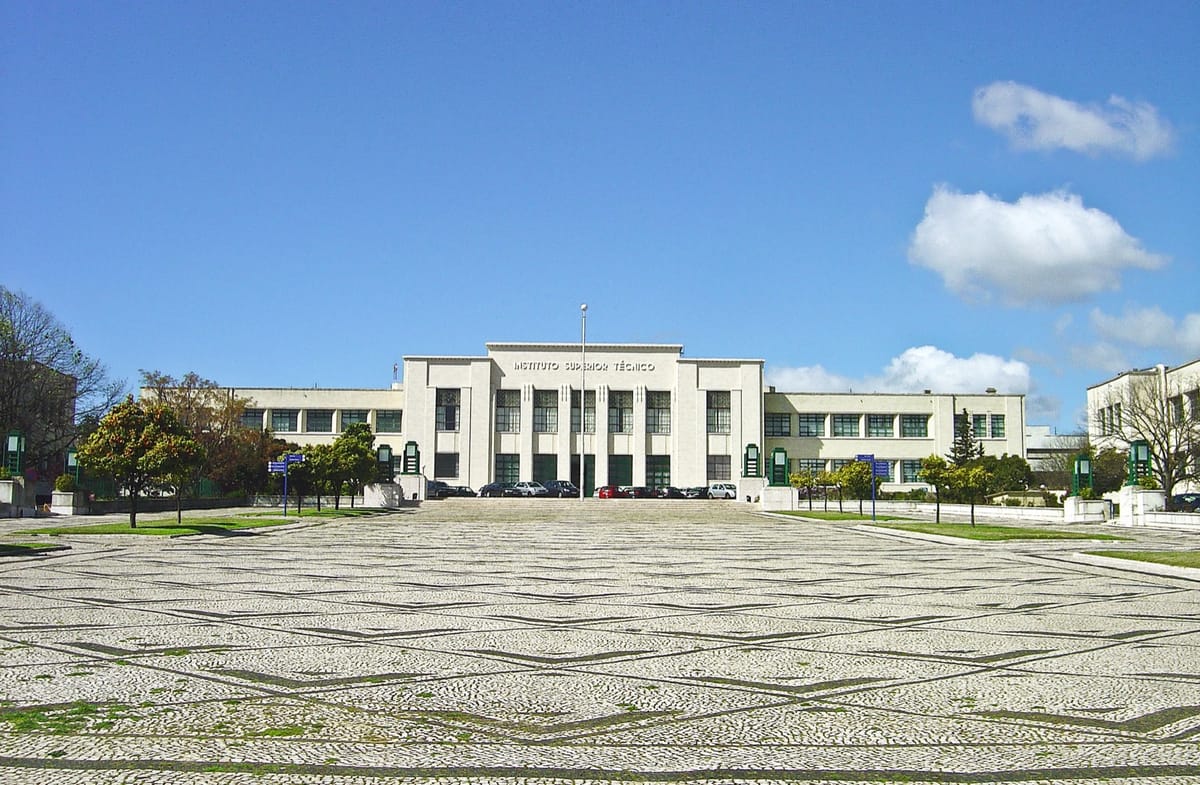
The building that is meant to house Lisbon's flagship artificial-intelligence research centre has come in over budget. A Council of Ministers resolution published in the Diário da República (the Official Gazette) on Friday, 21 August 2026, raises the spending ceiling for the works from €6,878,710 to €8,000,000, an increase of €1,121,290, or 16.3%.
The reason given in the text is short and unglamorous: after the tender ran its course, "the financial charges associated with executing the works proved higher than initially foreseen".
What is being built
The project is the rehabilitation and construction of a building in the south garden of the Alameda campus of the Instituto Superior Técnico (Higher Technical Institute), the University of Lisbon's engineering school. It is to become the Centro para a Inteligência Artificial e Economia Digital, or AIDE: the Artificial Intelligence for the Digital Economy research, development and innovation centre.
The original authorisation, Resolução do Conselho de Ministros n.º 92/2025 of 2 May 2025, described an ambitious piece of architecture. The building was to consume 20% less energy than the Net Zero Energy Building standard. Part of the campus perimeter wall was to come down, opening the grounds to the surrounding streets as an urban garden. Lisbon, the government wrote at the time, would gain "a digital-transition infrastructure unique in the region", housing research and corporate innovation under one roof.
None of that has changed. What has changed is the price, the calendar and who pays.
The numbers, before and after
Under the 2025 resolution, the money was to be spent across three years: about €1.38 million in 2025, €4.13 million in 2026 and €1.38 million again in 2027, split 40% from the European Regional Development Fund (FEDER) and 60% from national financing.
The version published on Friday reads very differently:
- 2025: €0. The entire first-year tranche was never spent. The tender was not concluded in time, so the schedule now begins in 2026.
- 2026: €3,316,574.79, made up of €1,326,629.92 from FEDER and €1,989,944.87 from balances of European funds.
- 2027: €4,683,425.21, made up of €1,873,370.08 from FEDER, €1,298,726.03 from European fund balances and €1,511,329.10 from the Instituto Superior Técnico's own revenue.
All of those figures exclude VAT. The financial-execution annex attached to the resolution, which is expressed with VAT included, puts the full bill at €8,480,000: the €8 million ceiling plus tax at the 6% reduced rate that applies to this kind of public works contract.
The single most consequential line is the last one. In the 2025 version, no part of the cost fell on the school's own budget; the money was all FEDER plus national financing. In the 2026 version, €1,511,329.10, close to a fifth of the total, comes out of the Instituto Superior Técnico's own receipts in 2027.
The Treasury has closed the door
The resolution is explicit that no extra public money is coming. The charges "are borne by appropriate funds entered, in 2026, and to be entered, in 2027" in the school's own budget, with "no budgetary reinforcement by recourse to the provisional allocation or other centralised allocations of the Ministry of Finance, nor by recourse to chapter 60, managed by the Treasury and Finance Entity, during budget execution".
A further clause, newly added, says that taking on these multi-year commitments "does not constitute grounds for the attribution of an additional ceiling in respect of 2027". In plain terms: the school absorbs the overrun, and it cannot use the overrun as an argument for a bigger spending envelope next year.
The data-centre line has quietly changed
There is one more difference worth noting between the two annexes. The 2025 works schedule listed, for 2026, a line called "fixed equipment (data centre)" worth €2,455,748.89, by some distance the largest single item in that year.
The schedule published on Friday has no data-centre line at all. Its fixed-equipment entry reads "fixed equipment (AVAC and GTC)", meaning heating, ventilation and air conditioning plus centralised technical management, and it is worth €719,933 in 2026 and the same again in 2027.
The rest of the 2026 schedule runs: site setup €135,601, demolition and site preparation €96,407, excavation €22,535, structure €930,259, masonry €72,899, infrastructure networks €540,652, ceilings and light fittings €267,615, window frames and doors €288,791, exterior cladding €323,484, lifts €92,574 and exterior landscaping €24,821. Heavier finishing work carries into 2027, when the exterior landscaping alone jumps to €416,437.
The resolution does not explain the change of heading, and it would be wrong to read a cancelled data centre into a renamed budget line. But a project sold in 2025 partly on the strength of its computing infrastructure now describes its big equipment spend in terms of climate control.
The government announced the old figure
The resolution published on Friday is dated 30 July 2026 and signed by Prime Minister Luís Montenegro. It was approved at the Council of Ministers meeting of that date.
The communiqué the government issued after that meeting says something different. Item 7 records the approval of a resolution authorising the Instituto Superior Técnico to spend on the AIDE works "up to a maximum global amount of 6,878,710.00 euros". That is the 2025 figure, not the €8 million the resolution itself sets.
The communiqué went out on 30 July. The corrected number reached the public on 21 August, three weeks later, in the gazette. Anyone who read the press release and not the statute would have the wrong figure.
Why a 16% overrun matters more than it looks
Portugal is in the closing stretch of the 2021 to 2027 European funding cycle, and a great deal of its research infrastructure is being built against FEDER deadlines rather than domestic ones. The 2025 resolution said as much: approval was "urgent and unpostponable" because, without it, the school could not launch the tender in the second half of 2025 and "would run the risk of losing the financing", since the money depended on meeting timetables agreed with the European Union.
That tender then produced a price 16.3% above the estimate, and a year of the schedule was lost. Both are familiar symptoms in Portuguese construction right now: building costs have run well ahead of the estimates baked into pre-2024 project budgets, and public-works tendering has slowed sharply as the Recovery and Resilience Plan winds down.
The resolution's answer is not to find more public money but to shift €1.5 million of the burden onto the institution and to draw on unspent balances from earlier European programmes. That is a workable solution once. It is not a template.
What This Means for Expats
- If you work in tech or research in Lisbon: AIDE is still going ahead, and the timetable now runs through 2027 rather than finishing that year as the 2025 plan implied. If you were counting on the building opening early in 2027, add time.
- If you have a child at the Instituto Superior Técnico: the €1.5 million now coming from the school's own revenue is money that was previously going to come from elsewhere. Institutional budgets are finite, and this is the sort of decision that eventually shows up in other line items.
- If you follow government announcements: this is a clean example of why the Diário da República beats the press release. The communiqué and the statute give different numbers for the same decision, and only one of them is legally operative.
- If you are budgeting a build of your own: a 16.3% gap between estimate and tender price on a public contract signed in 2026 is a reasonable benchmark for what the Portuguese construction market is doing to older cost estimates.
- If you are watching Portugal's AI push: the country has been marketing itself hard as a European hub for artificial intelligence and data infrastructure. The flagship university building for that pitch has just needed an extra €1.1 million and a year of slippage to get out of the ground.
Construction can now begin against a 2026 to 2027 schedule, with the resolution taking effect from the date of its approval. Whether the €8 million ceiling holds is the next question, and the answer will show up the same way this one did: in the gazette, some weeks after the fact.