Lisbon's Mayor Asks the Government to Scrap the Volta Deposit Scheme Outright, While 37,000 Signatures Wait on Parliament's Environment Committee
Carlos Moedas told the municipal assembly on Tuesday that the 10 cent container deposit is a tax and an unprecedented social drama, and asked for immediate cancellation. The Environment Minister says the scheme stays, with adjustments.
Carlos Moedas used his account of the summer at Lisbon's Assembleia Municipal (Municipal Assembly) on Tuesday to ask the government to kill the Volta container deposit scheme outright. "Once again, I ask the Government to do exactly what was done in France, to cancel this system immediately," the mayor said. "It is a good intention. It is a bad result. We do not want it."
His verdict on the five months since the scheme started was blunt: Volta has been "a tax for those who pay, and an unprecedented social drama in the city". Environmental policy, he told the chamber, "should be neither a tax nor a social drama".
The government is not moving. On Wednesday RTP reported the Environment and Energy Minister, Maria da Graça Carvalho, accepting that adjustments are needed while guaranteeing that the Volta system stays. Her position has not changed since the start of the month, when she conceded the implementation problems and described the country as being in a transition, with enforcement to be reinforced and municipalities brought into decisions such as where the machines go.
A petition with 37,000 names is sitting in committee
The mayor is not the only pressure point. A citizens' petition titled "Pelo Fim do Sistema Volta e pela Criação de um Modelo Justo de Gestão de Embalagens" (For the End of the Volta System and the Creation of a Fair Packaging Management Model) reached parliament on 15 August carrying 34,211 signatures. Four days later it was sent down to the Comissão de Ambiente e Energia (Environment and Energy Committee), where it now waits on a ruling about its admissibility. The count on the Petição Pública site has since passed 37,000.
The threshold that matters is 7,500 signatures, the point at which a petition can be debated in plenary. This one carries roughly five times that.
Its demands go further than suspension. The signatories want the scheme stopped in its current form and an independent audit of the financial, operational and environmental model of SDR Portugal, the non-profit association of more than twenty drinks industry and retail companies that runs the system. Their complaint is that Volta "transfers costs from companies to consumers", that the consumer is "held responsible for failures he does not control", that there is a "lack of transparency about who profits from the system", and that it does not deliver the environmental objective announced for it. The first signatory, João Pontes, states that the petition is not tied to any organisation or political party.
What the scheme is, and where the friction comes from
Volta has been running since 10 April. A deposit of 10 cents is added at the till to single-use plastic and metal drink containers under three litres carrying the Volta symbol, and the consumer gets it back by returning the empty container at a collection point in mainland Portugal, the Azores or Madeira. The refund comes as a voucher convertible into cash or discounts, digitally, or as a donation to a charity. The government put the investment at around 150 million euros, financed entirely under extended producer responsibility rules and carried by producers and packers, with no public money. The target behind it is a European one: 90 percent separate collection by 2029. The scheme became mandatory in August, at the end of a transition period.
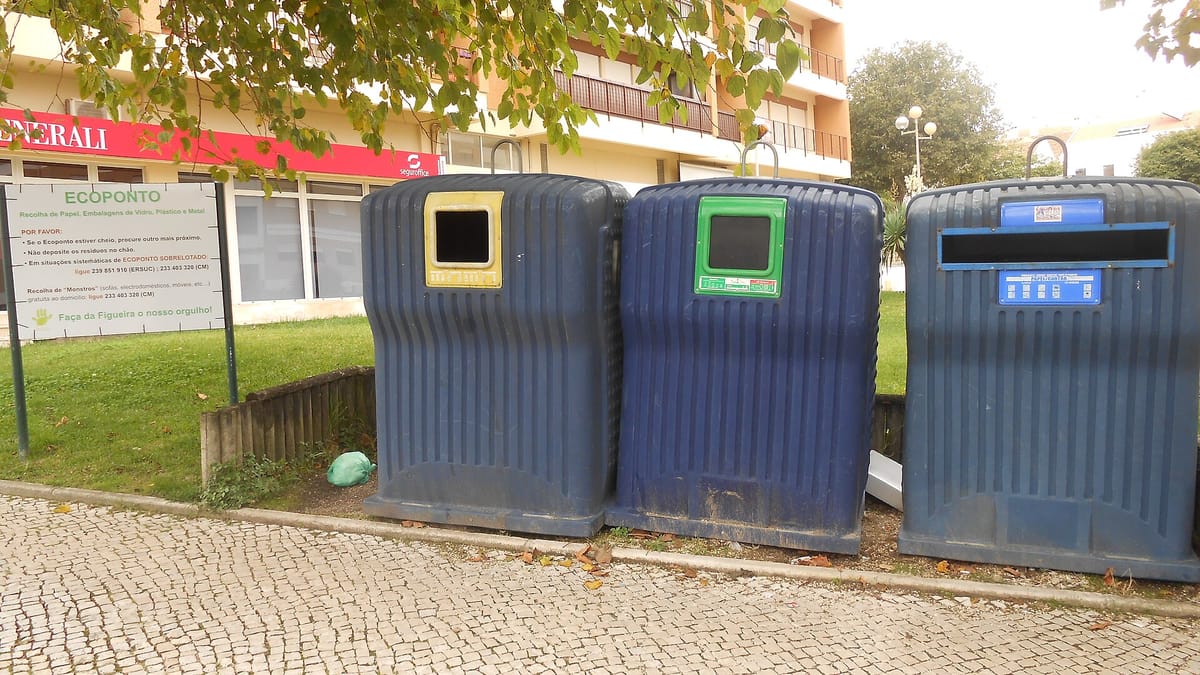
The friction is on the pavement. Ten cents a container is enough of an incentive that bins and street containers are being turned out onto the ground by people collecting empties to redeem, in Lisbon and in other municipalities. That is the "social drama" the mayor was describing, and it is the problem the minister said on 1 September still needed a solution.
At the same assembly meeting, the PCP member Sofia Lisboa welcomed Moedas's position but said it did not settle her concerns, criticising what she called the government's "subordination to private interests" and asking who actually pays for the system. She said recent data put Lisbon as the municipality with the highest number of complaints about urban waste, listing overflowing containers, accumulated rubbish, poor cleaning, bad smells and the spread of rats and cockroaches. The councillor responsible for urban hygiene, Joana Baptista, replied that there is "a big difference between contracting externally and privatisation", and said rubbish complaints have fallen this year rather than risen.
What happens next
Two tracks are now open at once. The committee has to decide whether the petition is admissible, and if it is, a plenary debate follows on a scheme the government has no intention of withdrawing. Meanwhile the operating problems are being handled case by case, which is what the minister has said twice in a fortnight.
For residents, nothing changes today. The deposit is still charged, the refund is still available, and the app route to reclaiming it remains limited. What is being fought over is whether the scheme survives in this shape, and who pays for the mess it has made on the street.