Walking the Portuguese Camino to Santiago
Researched and written with AI tools from official sources. How we make our guides
Choose a route from Lisbon, Porto, or the border, get your pilgrim passport, find a bed, and earn the Compostela in Santiago.
Last verified: October 2026.
Who this is for
- You want to walk or cycle the Portuguese Camino from Lisbon, Porto, or the Minho border.
- You need to know which route to pick, how the pilgrim passport works, and where to sleep.
- You want the Compostela certificate at the end.
Not for you if: you want day hikes or other long trails in Portugal. Read Hiking in Portugal instead.
The Portuguese Camino (Caminho Português) is the pilgrim route from Portugal to the cathedral of Santiago de Compostela in Galicia, Spain. You need no permit. You need a pilgrim passport (credencial), stamped along the way. From Porto, the Central Way is about 245 km, so most people take 10 to 14 days. To earn the Compostela, you walk at least the last 100 km, or cycle the last 200 km, with two stamps a day on that final stretch. The Compostela itself is free.
Which route to choose
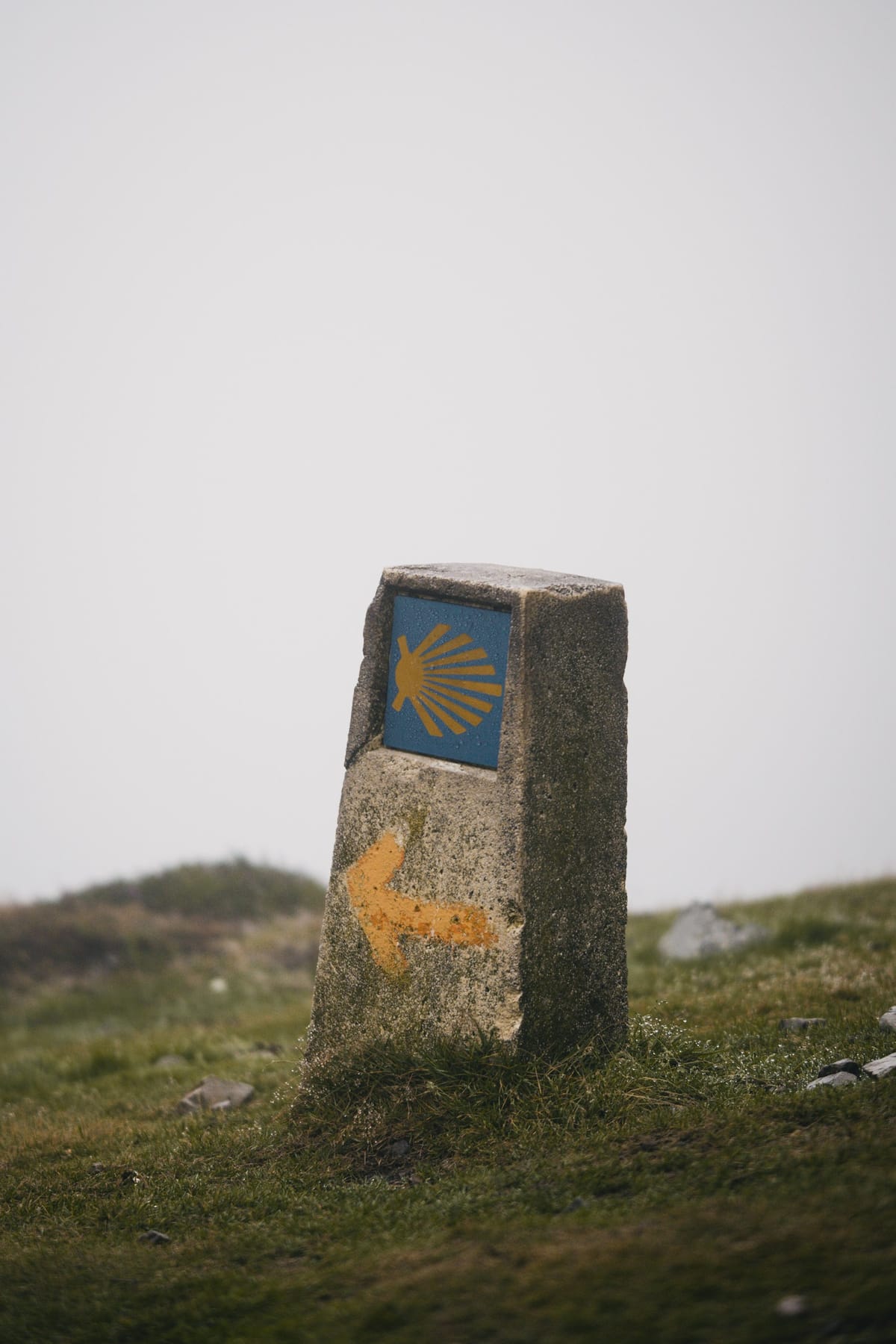
All routes end at the cathedral in Santiago and are marked with yellow arrows. You will also see the official symbol, a yellow scallop shell on a blue background. Distances below come from the regional tourism bodies and vary with detours.
- Central Way from Lisbon. The most used Portuguese route. It runs through Santarém, Tomar, Coimbra, and Porto to Valença, then about 120 km on to Santiago. Turismo de Portugal splits the Portuguese part into 19 stages, about 518 km in total. Many people walk it in two trips: Lisbon to Porto, then Porto to Santiago.
- Central Way from Porto. About 127 km to Valença, through Barcelos and Ponte de Lima, then 119 km in Galicia via Tui, Redondela, Pontevedra, and Padrón. It is the busiest and best served route.
- Coastal Way from Porto. Follows the coast through Matosinhos, Vila do Conde, Póvoa de Varzim, Esposende, Viana do Castelo, and Caminha. You cross the Minho river to A Guarda, or inland at Vila Nova de Cerveira or Valença. The Galician part alone is about 163 km, via Baiona and Vigo, and joins the Central Way at Redondela.
- Coastal path close to the sea (Senda Litoral). A variant that stays as close to the sea as possible north of Porto, often on boardwalks. Carry an offline map.
- Boat variant from Pontevedra (Variante Espiritual). Leaves the main route after Pontevedra and heads to the coast. It finishes with a boat trip along the Arousa estuary and up the Ulla river to Pontecesures, near Padrón. Boats depend on the season and the weather, so check before you commit.
- Interior Way. A quieter inland route of about 205 km in Portugal, from Viseu through Lamego, Peso da Régua, Vila Real, and Chaves, then into Galicia.
- Shortest qualifying start. If you only have a week, start at Valença or Tui, just over 100 km from Santiago.
When to go
- May to June and September to early October bring mild weather, and most hostels are open.
- July and August are hot inland and crowded, and beds go early.
- November to March is quiet, but some hostels close and Atlantic storms hit the coast.
These are seasonal patterns, not rules. Check the forecast and hostel opening before each stage.
Getting your pilgrim passport (credencial)
The pilgrim passport is a card you get stamped along the way. It proves your route and gets you into pilgrim hostels.
- Get it before you start. The Pilgrim's Office in Santiago accepts only passports issued by the cathedral or by an organisation it authorises. Buy an authorised one.
- Where to get one in Portugal. In Porto, the Pilgrim Office next to the cathedral (Rua da Pena Ventosa, 38) opened on 11 April 2026 and issues credentials. In Lisbon, the cathedral issues them from Monday to Saturday, 10:00 to 18:00.
- Collect stamps every day. Churches, hostels, hotels, town halls, and tourist offices all have them.
- On the last 100 km on foot, or 200 km by bike, collect at least two stamps a day. If you walk only the minimum distance in separate trips, get a stamp at the start and end of each stage, with the date.
- Keep it dry. Rain can ruin stamps, so carry it in a zip bag.
Where to sleep
Pilgrim hostels (albergues) are the cheapest option. The rules differ between Portugal and Spain.
Public hostels in Galicia. The Galician regional government (Xunta de Galicia) runs a network of public hostels. Its official rules are:
- €10 per person per night
- no advance bookings: first come, first served
- doors open at 13:00 and close at 22:00, lights out at 22:30
- you leave by 08:00 the next morning
- one night only, except for illness or force majeure
- priority goes to pilgrims with a disability, then walkers, then riders, then cyclists, then those with a support vehicle
Hostels in Portugal. Municipal, parish, and association hostels exist along the routes, but there are fewer than in Galicia. Prices and rules vary, so check each one.
Private hostels, guesthouses, and hotels. They cost more and usually take bookings. Book ahead in May and September on the popular stages.
What to pack
- Broken-in trail shoes or light boots
- A light backpack, packed as light as you can
- A light waterproof jacket
- A sleeping bag liner or light sleeping bag
- Blister plasters and tape
- A head torch, a quick-dry towel, and a water bottle
- An offline map or guidebook, especially for the coastal variants
- Your European Health Insurance Card, if you are covered by Portuguese social security
The card gives you the same right to medically necessary state healthcare in Spain as people insured there. It does not cover private care or getting you home after an accident, so consider travel insurance too.
In an emergency in Portugal or Spain, call 112.
Getting your Compostela in Santiago
The Compostela is the certificate the cathedral gives to pilgrims who finish the walk for religious or spiritual reasons.
- Go to the Pilgrim's Reception Office at Rúa Carretas, 33, near the cathedral.
- Take a ticket with a QR code. It shows your place in the queue in real time, so you can wait elsewhere. On very busy days, the office cannot promise you will get your Compostela the same day.
- Show your stamped credencial.
- Receive your Compostela.
What it costs:
- The Compostela: free.
- The certificate of distance, which records your route and the kilometres you walked: €3.
The office is open every day except 25 December and 1 January. Hours are longer from Easter Monday to 31 October than in winter, and the office changes them on busy days. Check its website before you arrive.
Children who walk with their parents can get a Compostela if they understand the religious or spiritual meaning of the walk. Younger children get a special certificate with their name.
If you walk regularly in Portugal
The Camino is a good first long walk, but Portugal has many other marked trails, with different markings and rules. See Hiking in Portugal for the Fishermen's Trail, Madeira's levadas, and mountain routes.
This guide is general information, not legal or medical advice. Check route conditions and hostel rules before each stage.
Sources
This guide is written from official sources and, where relevant, organisations' own websites.
- Pilgrim's Reception Office, Cathedral of Santiago, FAQs: https://oficinadelperegrino.com/en/faqs/ (100 km on foot and 200 km by bike, two stamps a day, authorised credentials only, address, QR ticket, seasonal hours, closed 25 December and 1 January), checked 1 October 2026
- Pilgrim's Reception Office, the Compostela: https://oficinadelperegrino.com/en/pilgrimage/the-compostela/ (religious or spiritual motive, stamps at start and end of each stage, children), checked 1 October 2026
- Pilgrim's Reception Office, certificate of distance: https://oficinadelperegrino.com/en/pilgrimage/certificate-of-distance/ (€3; Compostela and reception free), checked 1 October 2026
- Xunta de Galicia, official Way of Saint James site, network of public hostels: https://www.caminodesantiago.gal/en/discover/the-way-at-the-present/1.4.2.-the-network-of-public-hostels (€10 a night, no bookings, 13:00 to 22:00, leave by 08:00, one night, priority order), checked 1 October 2026
- Xunta de Galicia, official Way of Saint James site, the Portuguese Way: https://www.caminodesantiago.gal/en/make-plans/the-ways/portuguese-way (118.8 km in Galicia; Tui, Redondela, Pontevedra, Padrón), checked 1 October 2026
- Xunta de Galicia, official Way of Saint James site, the Portuguese Coastal Way: https://www.caminodesantiago.gal/en/make-plans/the-ways/portuguese-coastal-way (163.1 km in Galicia from A Guarda; Baiona, Vigo; joins at Redondela), checked 1 October 2026
- Turismo de Galicia, the Portuguese Way and the Way of Saint James by boat: https://www.turismo.gal/que-facer/camino-de-santiago/camino-portugues-e-ruta-xacobea-en-barco?langId=en_US (sea and river route along the Arousa estuary and the Ulla to Pontecesures), checked 1 October 2026
- Turismo de Portugal (visitportugal.com), Portuguese Way, Central Route: https://www.visitportugal.com/en/content/portuguese-way-of-st-james-central-route (19 stages and stage distances from Lisbon to Valença, Santiago 120 km from Valença, yellow arrows and shell symbol), checked 1 October 2026
- Turismo do Porto e Norte de Portugal, Portuguese Way by the Coast: http://www.portoenorte.pt/en/what-to-do/caminho-portugues-da-costa-portuguese-way-by-the-coast/ (towns from Porto to Caminha, river crossings at Caminha, Vila Nova de Cerveira, and Valença), checked 1 October 2026
- Turismo Centro de Portugal, Portuguese Inland Way of Santiago: https://www.centerofportugal.com/article/portuguese-inland-way-of-santiago (205 km in Portugal; Viseu to Chaves via Lamego, Peso da Régua, and Vila Real), checked 1 October 2026
- Diocese do Porto, Porto Pilgrim Office opens next to the cathedral: https://www.diocese-porto.pt/pt/noticias/not%C3%ADcias/oficina-do-peregrino-de-santiago-%C3%A9-inaugurada-junto-%C3%A0-s%C3%A9/ (address, opened 11 April 2026, issues credentials), checked 1 October 2026
- Sé de Lisboa, the Way of Saint James: https://www.sedelisboa.pt/the-way-of-saint-james/?lang=en (credential at Lisbon Cathedral, Monday to Saturday 10:00 to 18:00), checked 1 October 2026
- European Commission, Your Europe, health cover for temporary stays: https://europa.eu/youreurope/citizens/health/unplanned-healthcare/temporary-stays/index_en.htm (EHIC: same rights as people insured locally; no private care or repatriation), checked 1 October 2026
Last verified October 2026. Rules and fees change; check the official source before acting.