Types of Portuguese Cheese
Researched and written with AI tools from official sources. How we make our guides
Portugal's protected cheeses region by region, what milk each uses, how long it ages, and how to read a DOP label so you buy the real thing.

Last verified: October 2026.
Who this is for
- You live in Portugal, or visit often, and want to know which cheeses to try.
- You want to know what the DOP label means and how to spot the real thing.
- You like to buy from markets and small producers.
Not for you if: you want to know where and how to shop in general. Read Shopping in Portugal, from Traditional Markets to Online Delivery instead.
Portugal makes cheese from sheep's, goat's, and cow's milk, and many of the best are made from raw milk. Eleven Portuguese cheese names are protected across the EU as DOP (Protected Designation of Origin), and one more as IGP (Protected Geographical Indication). One DOP, Queijos da Beira Baixa, covers three cheeses. Many sheep's cheeses are set with thistle flower instead of animal rennet, which gives them a soft, buttery centre. The best known is Serra da Estrela. Look for the DOP or IGP name and seal on the label.
What DOP and IGP mean
These are EU quality labels. They protect a product's name, so only producers in the defined area, following the agreed method, may use it.
- DOP (Denominação de Origem Protegida, or PDO in English). Every stage of production, processing, and preparation happens in the named region.
- IGP (Indicação Geográfica Protegida, or PGI in English). At least one stage happens in the region.
A cheese sold as "Queijo Serra da Estrela" in an EU shop must meet the rules for that name. A similar cheese made elsewhere cannot use it. Portugal's Directorate-General for Agriculture and Rural Development (DGADR) lists every protected Portuguese product. The EU's eAmbrosia register lists them too.
Words you will see on labels
- Queijo: cheese.
- Leite cru: raw milk. Most protected Portuguese cheeses use it.
- Ovelha, cabra, vaca: sheep, goat, cow.
- Cardo: thistle, the plant used to set many sheep's cheeses.
- Amanteigado: buttery, a soft cheese you can spoon.
- Curado: cured or aged.
- Velho: old, a longer-aged version.
- Requeijão: a fresh whey cheese, similar to ricotta.
The Centre: Serra da Estrela and Beira Baixa
Queijo Serra da Estrela DOP. This is Portugal's most famous cheese. It is made from raw sheep's milk from two local breeds, Bordaleira da Serra da Estrela and Churra Mondegueira. Thistle sets the curd. The standard cheese ages for at least 45 days and has a semi-soft, buttery paste. The aged version (Velho) ages for at least 120 days and turns semi-hard to extra hard. The area covers 18 municipalities across the Viseu, Coimbra, Guarda, and Castelo Branco districts, including Seia and Celorico da Beira.
Queijos da Beira Baixa DOP. One protected name covers three cheeses from the Castelo Branco district and part of the Santarém district:
| Cheese | Milk | Minimum ageing | Texture |
|---|---|---|---|
| Queijo de Castelo Branco | Raw sheep's milk | 45 days | Semi-hard or semi-soft |
| Queijo Amarelo da Beira Baixa | Raw sheep's milk, or sheep's and goat's | 45 days | Semi-hard or semi-soft, yellowish |
| Queijo Picante da Beira Baixa | Raw sheep's and goat's milk | 120 days | Semi-hard to hard, strong |
Queijo Rabaçal DOP. A mixed sheep's and goat's milk cheese from around Penela, Ansião, and nearby parishes in the Coimbra and Leiria districts. It ages for at least 20 days and is semi-hard to hard.
Requeijão Serra da Estrela DOP and Requeijão da Beira Baixa DOP are the protected whey cheeses of the same regions. They are eaten fresh, often with honey or pumpkin jam.
The North: Trás-os-Montes
Queijo Terrincho DOP. Raw sheep's milk from the Churra da Terra Quente breed, set with animal rennet. It ages for at least 30 days, or 90 days for the Velho version. The area covers 13 municipalities in the Bragança, Vila Real, Viseu, and Guarda districts, including Mogadouro and Torre de Moncorvo.
Queijo de Cabra Transmontano DOP. Raw milk from Serrana goats, set with animal rennet. It is extra hard and white, and ages for at least 60 days. It comes from 10 municipalities in the Bragança and Vila Real districts, including Mirandela and Macedo de Cavaleiros.
Near Lisbon: Azeitão
Queijo de Azeitão DOP. A small raw sheep's milk cheese set with thistle flower. It ages for about 20 days and has a semi-soft, buttery paste. It is made only in the municipalities of Palmela, Sesimbra, and Setúbal.
The Alentejo: Serpa, Évora, Nisa, and Tolosa
Queijo Serpa DOP. Raw sheep's milk set with thistle. It ages for at least 30 days and has a semi-soft, buttery paste with few or no holes. It comes from 16 municipalities in the Beja and Setúbal districts, including Serpa, Moura, Beja, and Mértola.
Queijo de Évora DOP. Raw milk from Merino sheep, set with thistle. It is small and comes semi-hard (at least 30 days) or hard (at least 90 days). It is made in 16 municipalities of the Évora district, including Évora, Estremoz, and Montemor-o-Novo.
Queijo de Nisa DOP. Raw milk from Merino sheep, set with thistle. It is semi-hard, and ages in two stages over about six to eight weeks. It comes from eight municipalities in the Portalegre district, including Nisa, Crato, Castelo de Vide, and Marvão.
Queijo Mestiço de Tolosa IGP. A raw sheep's and goat's milk cheese from the Portalegre district. It ages for three to four weeks and has a semi-soft, yellow to orange paste.
The Azores: São Jorge and Pico
Queijo S. Jorge DOP. A large, hard or semi-hard cow's milk cheese from São Jorge island. It is made from raw milk with animal rennet and ages for at least 90 days. DGADR describes its taste as slightly strong, clean, and slightly spicy.
Queijo do Pico DOP. A small, semi-soft, buttery cow's milk cheese from Pico island. It is made from raw milk with animal rennet and ages for 17 to 30 days.
Living on the islands? See Living in the Azores and Madeira.
Thistle or rennet: what it means for you
Many Portuguese sheep's cheeses use the flower of the cardoon thistle (Cynara cardunculus) to set the milk. DGADR lists thistle as the coagulant for Serra da Estrela, Azeitão, Serpa, Évora, and Nisa. Thistle gives a soft, creamy centre and a slightly bitter edge.
If you avoid animal rennet, check the label or ask the producer. São Jorge, Pico, Terrincho, Rabaçal, and Cabra Transmontano use animal rennet. Non-protected cheeses vary, so always check.
Buying and enjoying cheese
Check the label. A protected cheese carries its full protected name and the EU DOP or IGP seal. A shop sign alone is not proof.
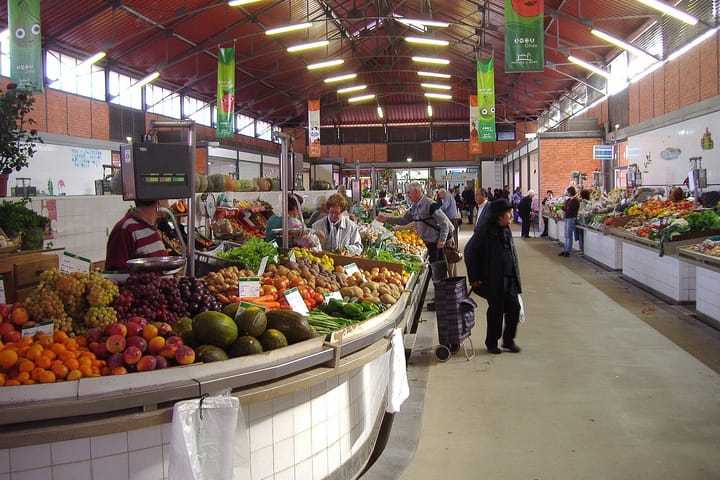
Where to buy. Municipal markets, local fairs, delicatessens, and supermarkets all sell Portuguese cheese. Many producers sell direct, especially in the cheese regions. Prices vary a lot by cheese, age, and shop, so compare.
Serving a soft cheese. For a buttery cheese such as Serra da Estrela or Azeitão, many people cut a lid from the top crust and spoon out the centre. Let it come to room temperature first.
Storing. Keep cheese in the fridge, wrapped in paper rather than cling film, and let it warm up before you eat it. Eat soft, buttery cheeses soon after you open them.
With wine and food. Local pairings are a good start: Azeitão with a Setúbal Moscatel, a Beira cheese with a red from the same region, or an Alentejo cheese with bread and olive oil.
This guide is general information. Product rules can change; check the DGADR or EU register for the current specification.
Sources
This guide is written from official sources and, where relevant, organisations' own websites.
- European Commission, geographical indications and quality schemes explained: https://agriculture.ec.europa.eu/farming/geographical-indications-and-quality-schemes/geographical-indications-and-quality-schemes-explained_en (PDO and PGI definitions), checked 2 October 2026
- European Commission, eAmbrosia register of geographical indications: https://ec.europa.eu/agriculture/eambrosia/geographical-indications-register/ (EU register of protected names), checked 2 October 2026
- DGADR, traditional products, DOP list (pages 3 and 4): https://tradicional.dgadr.gov.pt/pt/produtos-por-regime-de-qualidade/dop-denominacao-de-origem-protegida?start=40 and https://tradicional.dgadr.gov.pt/pt/produtos-por-regime-de-qualidade/dop-denominacao-de-origem-protegida?start=60 (the 11 cheese DOPs and the two requeijão DOPs), checked 2 October 2026
- DGADR, traditional products, IGP list (page 4): https://tradicional.dgadr.gov.pt/pt/produtos-por-regime-de-qualidade/igp-indicacao-geografica-protegida?start=60 (Queijo Mestiço de Tolosa IGP), checked 2 October 2026
- DGADR, Queijo Serra da Estrela DOP: https://tradicional.dgadr.gov.pt/pt/cat/queijos-e-produtos-lacteos/31-queijo-da-serra-da-estrela (breeds, thistle, 45 and 120 days, 18 municipalities), checked 2 October 2026
- DGADR, Queijos da Beira Baixa DOP: https://tradicional.dgadr.gov.pt/pt/cat/queijos-e-produtos-lacteos/97-queijos-da-beira-baixa-dop-queijo-de-castelo-branco-queijo-picante-da-beira-baixa-e-queijo-amarelo-da-beira-baixa (three cheeses, milks, 45 and 120 days, area), checked 2 October 2026
- DGADR, Queijo Rabaçal DOP: https://tradicional.dgadr.gov.pt/pt/cat/queijos-e-produtos-lacteos/92-queijo-rabacal-dop (mixed milk, animal rennet, 20 days, area), checked 2 October 2026
- DGADR, Queijo Terrincho DOP: https://tradicional.dgadr.gov.pt/pt/cat/queijos-e-produtos-lacteos/239-queijo-terrincho-dop (breed, animal rennet, 30 and 90 days, 13 municipalities), checked 2 October 2026
- DGADR, Queijo de Cabra Transmontano DOP: https://tradicional.dgadr.gov.pt/pt/cat/queijos-e-produtos-lacteos/32-queijo-de-cabra-transmontano (Serrana goats, animal rennet, 60 days, 10 municipalities), checked 2 October 2026
- DGADR, Queijo de Azeitão DOP: https://tradicional.dgadr.gov.pt/pt/cat/queijos-e-produtos-lacteos/33-queijo-de-azeitao (raw sheep's milk, thistle, 20 days, Palmela, Sesimbra, and Setúbal), checked 2 October 2026
- DGADR, Queijo Serpa DOP: https://tradicional.dgadr.gov.pt/pt/cat/queijos-e-produtos-lacteos/237-queijo-de-serpa-dop (thistle, 30 days, 16 municipalities), checked 2 October 2026
- DGADR, Queijo de Évora DOP: https://tradicional.dgadr.gov.pt/pt/cat/queijos-e-produtos-lacteos/95-queijo-de-evora-dop (Merino sheep, thistle, 30 and 90 days, 16 municipalities), checked 2 October 2026
- DGADR, Queijo de Nisa DOP: https://tradicional.dgadr.gov.pt/pt/cat/queijos-e-produtos-lacteos/83-queijo-de-nisa-dop (Merino sheep, thistle, two-stage curing, eight municipalities), checked 2 October 2026
- DGADR, Queijo Mestiço de Tolosa IGP: https://tradicional.dgadr.gov.pt/pt/cat/queijos-e-produtos-lacteos/91-queijo-mestico-de-tolosa-igp (sheep's and goat's milk, three to four weeks, Portalegre district), checked 2 October 2026
- DGADR, Queijo S. Jorge DOP: https://tradicional.dgadr.gov.pt/pt/cat/queijos-e-produtos-lacteos/85-queijo-sao-jorge-dop (raw cow's milk, animal rennet, 90 days, taste), checked 2 October 2026
- DGADR, Queijo do Pico DOP: https://tradicional.dgadr.gov.pt/pt/cat/queijos-e-produtos-lacteos/88-queijo-do-pico-dop (raw cow's milk, animal rennet, 17 to 30 days), checked 2 October 2026
Last verified October 2026. Rules and fees change; check the official source before acting.