Riding the Douro Line from Porto to Pocinho
Fares, timetables, the tiled station at Pinhão, and the heritage train on Portugal's scenic railway.
Last verified: September 2026.
Who this is for
- Residents of Porto and the north planning a day trip or weekend up the Douro valley.
- Newcomers anywhere in Portugal who want a cheap, scenic rail trip.
- Residents hosting visitors who want to see the wine country without driving.
Not for you if: you want rail travel across the whole country. Read Getting around Portugal by Train instead.
Updated September 2026. Trains between Marco de Canaveses and Régua returned on 2 April 2026 after five months of replacement buses.
The Douro Line (Linha do Douro) is a regular train line run by CP, the national rail operator. It runs east from Porto along the Douro river to Pocinho, deep in the wine country. The full trip takes about 3 hours 20 minutes. A single ticket from Porto Campanhã costs €14.95 to Pocinho, €12.35 to Pinhão, and €10.90 to Régua. You do not need to book ahead. From June to October, CP also runs a heritage train between Régua and Tua.
The route and where to get off
Direct trains to Pocinho leave from Porto Campanhã station. Slower Regional trains and some connections start at Porto São Bento, in the city centre.
The first hour is suburban. The line reaches the river after Marco de Canaveses and follows the water most of the way to Pocinho. These are the stops most people use:
- Régua (Peso da Régua). The largest town on the line, about 1 hour 55 minutes from Campanhã. It has the Douro Museum (Museu do Douro) and is the start of the heritage train.
- Pinhão. About 2 hours 20 minutes from Campanhã. A small riverside village among the vineyards, known for its tiled station.
- Tua. A former junction, where the heritage train turns round.
- Pocinho. The end of the line, about 3 hours 20 minutes from Campanhã.
The stretch between Régua and Pinhão is the classic view: the river below, and stone-walled vineyard terraces above. The valley is part of the Alto Douro Wine Region, a UNESCO World Heritage Site.
Timetable
The current timetable started on 5 August 2026. Direct InterRegional trains leave Porto Campanhã for Pocinho every day at:
- 07:30 (arrives Pocinho 10:50)
- 09:30 (arrives 12:45)
- 13:30 (arrives 16:44)
- 15:25 (arrives 18:41)
- 17:30 (arrives 20:53)
Other trains run only as far as Régua or Pinhão, or need a change at Marco de Canaveses.
Coming back, trains leave Pocinho at 07:09, 11:15, 13:08, 17:12, and 19:26. The first four connect at Régua into trains that reach Porto Campanhã between 10:30 and 20:30. The last one needs a change at Marco de Canaveses and reaches Campanhã at 23:35.
Timetables change several times a year. Check the CP website or app the day before you travel.
What it costs
These are CP's full adult fares for a single journey in 2026. InterRegional trains are faster and make fewer stops. Regional trains stop everywhere, but only run as far as Régua.
| From Porto Campanhã to | InterRegional | Regional |
|---|---|---|
| Régua | €10.90 | €9.90 |
| Pinhão | €12.35 | not served |
| Tua | €13.10 | not served |
| Pocinho | €14.95 | not served |
From Porto São Bento, each fare is €0.10 to €0.20 higher. A return trip is simply two single tickets.
Discounts:
- Children aged 4 to 12 pay half fare.
- People aged 65 and over pay half fare.
- Under-25s get 25% off.
Seats are not reserved on these trains. On summer weekends and during the grape harvest, trains to Régua and Pinhão fill up, so arrive early for a window seat.
Travelling with the Green Rail Pass
If you live in Portugal, the Green Rail Pass (Passe Ferroviário Verde) covers the whole Douro Line. It costs €20 for 30 days and is valid on all Regional and InterRegional trains in the country. One return trip from Porto to Pocinho already costs €29.90 in single tickets, so the pass pays for itself in a single outing.
To get it:
- Get a CP Card at a station ticket office, if you do not already have one.
- Load the pass onto the card at a ticket office, on the CP website, or in the CP app.
- Carry the card when you travel. The pass starts on the day you choose and runs for 30 days.
The pass is for residents of Portugal, Portuguese or foreign. It does not cover the heritage train. For other passes, see Public Transport Passes in Portugal.
Buying tickets
You can buy ordinary tickets:
- On the CP website or CP app, up to 60 days ahead.
- At station ticket offices.
- By phone on 210 900 032, available 24 hours a day.
Buy your ticket before you board. Travelling without a valid ticket can lead to a fine.
The Douro Historical Train
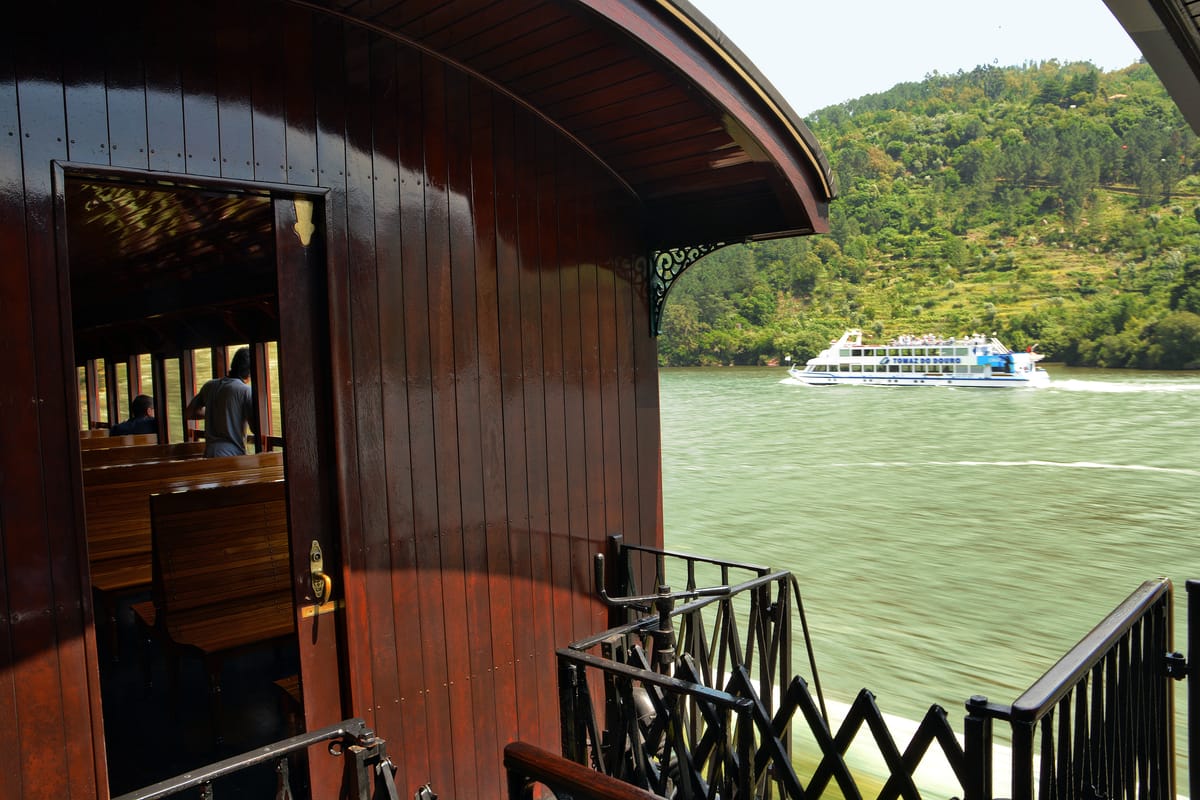
CP runs the Douro Historical Train (Comboio Histórico do Douro) between Régua and Tua. Five restored carriages from the early 20th century are pulled by a diesel locomotive in its original colours. It is not a steam train.
When it runs in 2026: Saturdays, Sundays, and some Wednesdays, from 6 June to 18 October. The dates left this season are:
- Saturdays 26 September and 3, 10, and 17 October.
- Sundays 27 September and 4, 11, and 18 October.
- Wednesday 30 September.
What happens on the day:
- 15:00: welcome at Régua station, with a glass of Port and regional music.
- 15:32: departure for Tua, with music on board.
- 16:35: arrival at Tua, with local producers selling regional products.
- 17:07: departure from Tua.
- 17:25 to 17:50: stop at Pinhão to see the station tiles.
- 18:22: arrival back at Régua.
What it costs: €60 for adults, €32 for children aged 4 to 12, and €56 each for groups of 10 or more. Buy at CP ticket offices or on the CP website.
Heritage train tickets are valid only for the date and route shown. CP does not exchange or refund them. If CP cancels a trip, you get a full refund.
To reach Régua for the 15:00 welcome, take the 11:30 InterRegional from Porto Campanhã, which arrives at 13:32. The 13:30 arrives at 15:19, in time for departure but not the welcome. The 18:37 train from Régua gets you back to Campanhã by 20:30.
Pinhão station and its tiles
Pinhão station is covered in blue and white tile panels (azulejos). They show the Douro landscape, the grape harvest, and the flat-bottomed rabelo boats that once carried Port wine down the river. The station building also has a wine shop.
It is worth getting off at Pinhão even on an ordinary train. You can walk the village, take a river trip, or visit a wine estate (quinta), then catch a later train. Check the last train back before you set off.
Engineering works on the line
Infraestruturas de Portugal, the state rail infrastructure company, is electrifying and modernising the line between Marco de Canaveses and Régua. Trains on that stretch were replaced by buses from 3 November 2025 to early April 2026.
Some works continue. The current timetable warns that one early train (Monday to Saturday) may run as a replacement bus between Marco de Canaveses and Régua. Further closures are usually announced a few weeks ahead on the CP website.
Tips for the trip
- Sit on the river side. Once the train reaches the water, the river stays on one side for long stretches. Look at a map as you board.
- Go early. The best window seats fill quickly on summer weekends.
- Go in autumn if you can. In late September and October the vines turn gold and red during the grape harvest, and the heritage train still runs.
- Pack light. Regional trains have little luggage space.
- Bring some cash. Small wine estates and village cafés do not always take cards.
- Combine it with a boat. Many people take the train one way and a river cruise the other, changing at Régua or Pinhão.
Sources
This guide is written from official Portuguese and EU sources and, for prices and contact details, the providers' own websites.
- CP, Douro Line timetable from 5 August 2026: https://www.cp.pt/info/documents/d/cp/comboios-regionais-porto-regua-douro (departure and arrival times, replacement bus note, customer line)
- CP, Regional and InterRegional fares Porto to Pocinho, valid from 1 January 2026: https://www.cp.pt/info/documents/d/cp/precos-regional-interregional-porto-pocinho (single fares from Campanhã and São Bento)
- CP, Age group discounts: https://www.cp.pt/info/en/age-groups (child, senior, and under-25 discounts)
- CP, Green Rail Pass: https://www.cp.pt/info/en/w/green-rail-pass (price, validity, trains covered, CP Card)
- CP, Douro Historical Train: https://www.cp.pt/info/en/w/douro-historical (2026 dates, times, prices, ticket conditions, Pinhão tiles)
- CP, The Douro Historical Train returns with 51 trips between June and October: https://www.cp.pt/info/en/w/institucional/historical-train-2026 (2026 season, 6 June to 18 October, locomotive and carriages)
- Infraestruturas de Portugal, Works on the Douro Line suspend trains between Marco and Régua until April: https://www.ippatrimonio.pt/pt-pt/trabalhos-na-linha-do-douro-suspendem-circulacao-no-troco-marco-regua-ate-abril (electrification works and the November 2025 to April 2026 closure)
- CP, Douro Line timetable from 2 April 2026: https://www.cp.pt/info/documents/d/cp/horarios-douro-02-04-2026 (return of trains between Marco de Canaveses and Régua)
- UNESCO World Heritage Centre, Alto Douro Wine Region: https://whc.unesco.org/en/list/1046 (World Heritage status)
Last verified September 2026. Rules and fees change; check the official source before acting.