Emerald Ash Borer Crosses Into the EU for the First Time, and Portugal's Plant Health Service Asks Nurseries and Councils to Watch Their Ash Trees
The emerald ash borer, a beetle that has killed millions of ash trees in North America, has been found in Hungary and Slovakia. It has never been detected in Portugal, but DGAV wants suspected cases reported at once. Here is what to look for.
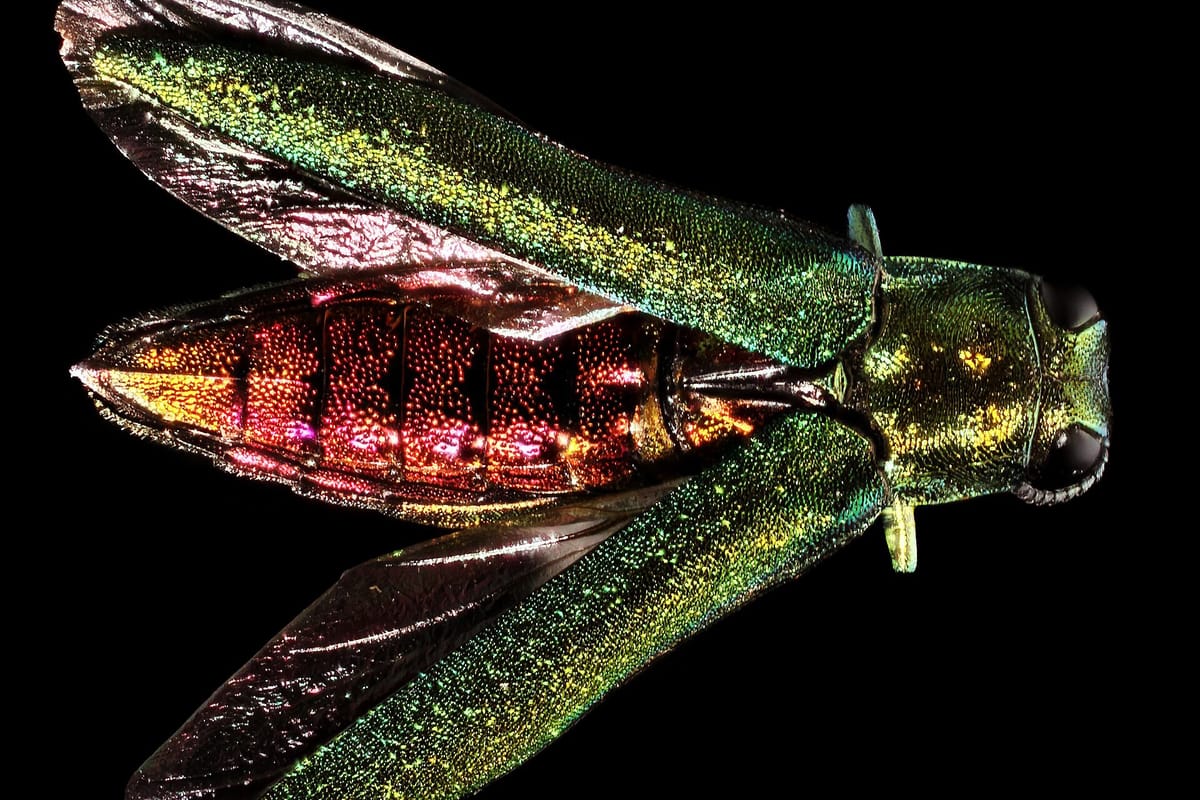
Portugal's plant-health authority, the Direção-Geral de Alimentação e Veterinária (DGAV), has asked nurseries, foresters, councils and anyone who manages parks and gardens to watch out for the emerald ash borer (broca-do-freixo, Agrilus planipennis), after the beetle was found inside the European Union for the first time. The pest has never been detected in Portugal, but DGAV says the new findings confirm the risk that it could reach the country.
The alert, posted on Friday, follows detections confirmed in June 2026 in Hungary and Slovakia, near the border with Ukraine. Until then the beetle's European range was limited to Russia, Belarus and Ukraine. The news was reported by Lusa via Notícias ao Minuto.
Why ash trees are at risk
The DGAV alert calls the beetle one of the most destructive pests of ash trees in the world. Its larvae tunnel under the bark and cut off the flow of sap, so the crown declines and the tree often dies. In North America it has killed millions of ash trees. The EU lists it as a priority quarantine pest because it is so hard to eradicate once established.
DGAV's 2026 contingency plan says all European ash species are susceptible, including the narrow-leaved ash (Fraxinus angustifolia). Portugal has surveyed for the beetle since 2016 on the mainland, the Azores and Madeira, and the plan records that it has never been found here.
Demarcated areas have been drawn around the Hungarian and Slovak finds. Their buffer zones are large enough to reach into Poland and Romania, and movement of host material is restricted there.
How it spreads
Over long distances the beetle travels in people's goods: plants for planting, ash wood, bark, firewood and wood chips from infested trees. Adults also fly, which spreads it locally. An ICNF fact sheet adds that beetles can hitch a ride on people and vehicles, a route that has carried it up to 41 km a year in Russia.
What to look for
According to the ICNF fact sheet:
- The adult is a metallic green beetle, 7 to 13.5 mm long, with a coppery red abdomen under its wing cases.
- Exit holes in the bark are D-shaped and about 3 to 4 mm across.
- Under cracked bark there are winding larval tunnels packed with sawdust.
- The crown yellows from the top, leaves are small, branches die back from the tips, and new shoots sprout lower on the trunk.
Symptoms often appear only 4 to 10 years after the beetle arrives, so an early report matters.
What it means for you
- Report a suspicion. DGAV asks anyone who suspects the pest to contact DGAV or ICNF (the forestry and nature institute) straight away so they can take samples for laboratory confirmation. ICNF's forest plant-health division is at [email protected] (213 507 900). Under Decree-Law 67/2020, anyone who learns of a suspected EU quarantine pest must report it.
- Buying ash plants. Ash plants moving within the EU need a plant passport, a label from a registered supplier. The exemption for sales direct to the final user does not cover distance sales such as online orders.
- Firewood and wood. The alert adds no new rules inside Portugal, but it names firewood and bark from infested ash as the main way the pest spreads.
Animal health saw a comparable warning last month, when vets were put on alert after a cattle virus surfaced on five Portuguese farms.