Condominium Managers Want One Insurance Policy Per Building, Not One Per Flat, After €5 Billion in Storm Damage Clogged the System
APEGAC wants the law changed so a whole building carries a single policy, arguing this winter's €5 billion storm season exposed how badly the current one-policy-per-fraction model handles common-area damage.
Portugal's condominium managers are pressing the government to overhaul how apartment buildings are insured, arguing that the record damage caused by this winter's storms exposed a system that turns even routine repairs into an administrative ordeal.
The Associação Portuguesa de Empresas de Gestão e Administração de Condomínios (Portuguese Association of Condominium Management and Administration Companies, or APEGAC) wants the law rewritten so that an entire building can be covered by a single insurance policy, rather than the current arrangement in which each individual fraction — each flat, shop or garage — carries its own separate policy.
The distinction sounds technical, but its consequences are anything but. When a shared area such as a roof, stairwell or facade is damaged, every owner's policy has to be triggered independently. “It is necessary that there be 100 participations,” APEGAC president Vítor Amaral said of a 100-unit building, describing the paperwork a single leak can generate. Because the fractions are often insured with different companies, coverage is interpreted inconsistently, deductibles vary from one policy to the next, and the quality of the eventual repair can suffer — in one case cited by the association, discontinued roof tiles were replaced with mismatched materials.
The storms that broke the system
The push for reform has been sharpened by the winter of 2026. The tempests Kristin, Leonardo and Marta, which swept central Portugal between January and March, caused more than €5 billion in damage and generated thousands of insurance claims, many of them still unresolved. With insurers' resources funnelled toward the largest storm losses, APEGAC says smaller claims are now waiting months simply for an inspector to visit.
A single building-wide policy, the association argues, would collapse dozens of parallel claims into one, standardise coverage and deductibles across the whole property, and speed up repairs to the common parts that every resident shares. It would also spare condominium administrators — often unpaid volunteers or small management firms — the task of coordinating claims across a dozen different insurers after every incident.
No takers yet in government
So far, APEGAC reports little enthusiasm for the idea. The association says it has found no receptiveness from the Secretaria de Estado da Habitação (State Secretariat for Housing), the Associação Portuguesa de Seguradores (Portuguese Insurers Association) or the parliamentary groups it has approached about changing the law.
For the roughly three million people who live in apartment buildings across Portugal — including a large share of the foreign residents who buy into Lisbon and Porto condominiums — the debate is more than academic. Insurance on the building's common parts is mandatory, and the bill is split among owners through their monthly condominium charges. How efficiently that money translates into an actual repaired roof, the managers argue, is exactly what the current model gets wrong.
Whether the government revisits the rules may depend on how long this winter's backlog of claims takes to clear. With another storm season only months away, APEGAC's warning is that a system already struggling with one €5 billion year is in no shape to absorb a second.
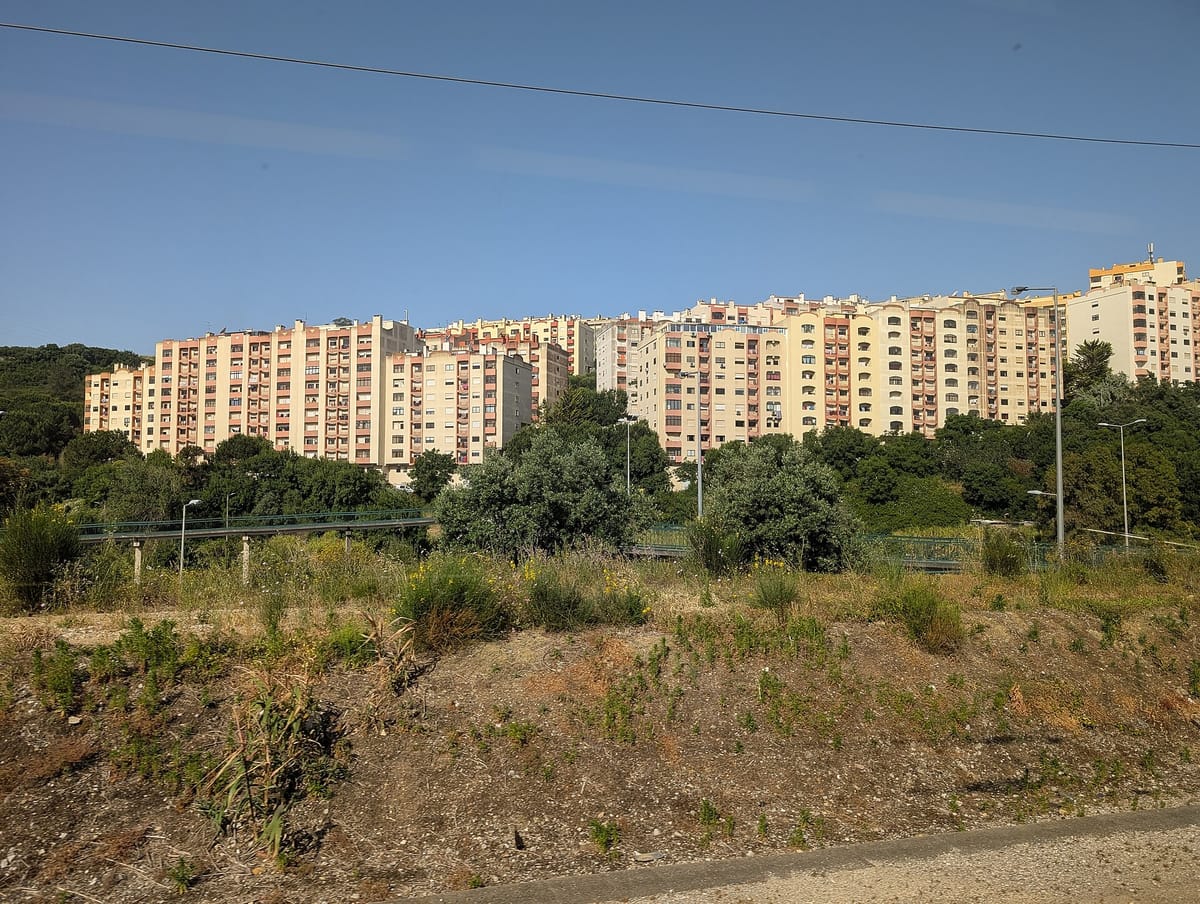
Image: apartment blocks on the outskirts of Lisbon. Photo by Philip Mallis (Wikimedia Commons, CC BY-SA 4.0). On the everyday-nuisance side of the file, our guide to Portugal's noise law and what to do about a loud neighbour sets out the hours building work is banned, what the police can order after 23:00, and the fines that follow. On the cheaper route for a civil claim below 15,000 euros, the julgados de paz, Portugal's small local courts, which settle civil claims below 15,000 euros with nothing to pay up front and a 70 euro fee that falls on the losing party sets the latest reference. If your insurer refuses or delays a claim, our guide to complaining about an insurer or insurance agent in Portugal explains the 20-working-day deadline, the ombudsman, the ASF and arbitration.