A Young Welsh Rider Is Killed in a Collision at the Volta a Portugal, and the GNR Revises Its First Account
Finlay Tarling, a 19-year-old Welsh cyclist, died after being hit by a car on the eighth stage of the Volta a Portugal near Ponte de Lima. The GNR later clarified the vehicle was in its correct lane but travelling opposite to the race, which was suspended.
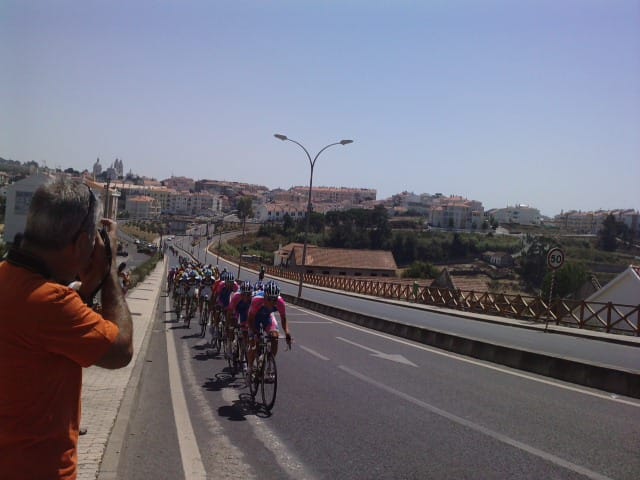
The Volta a Portugal, the country's biggest cycling race, was plunged into mourning on Thursday when a 19-year-old British rider was killed in a collision with a car during the eighth stage. Finlay Tarling, a Welsh cyclist racing for the Swiss NSN Development Team, died after being struck on a descent near Ponte de Lima, and organisers immediately suspended the stage.
The crash happened on the EN306 road at Arcozelo, in the municipality of Ponte de Lima, roughly 20 kilometres from the finish of the stage in Fafe, according to Público and RTP. The eighth stage of the 87th edition of the race, run from Melgaço to Fafe, was called off, and the podium ceremony was cancelled as a mark of respect. The Volta resumed the following day, its organisers said, "in deep mourning."
In the immediate aftermath, early reports suggested the car had been travelling on the wrong side of the road. A day later, the GNR — the national police force responsible for the roads — set out a more careful account that revised that first impression. Speaking on 15 August, Lieutenant-Colonel Carlos Canatário said the vehicle "was not driving in the wrong lane. It was in the right-hand lane, on its own side. What it was doing was travelling in the direction opposite to that of the race." The driver, he explained, had asked bystanders whether he could proceed once the peloton had gone by. Tarling, who had fallen behind the main group, was descending at speed and cut across a curve into the oncoming car's lane.
The distinction matters both for the investigation and for how the tragedy is understood: not a car recklessly on the wrong side of the road, in the police account, but a fatal convergence of a fast, isolated descent and a vehicle moving legally against the flow of a race that had, for that stretch, already passed. The GNR's inquiry into the exact circumstances continues.
Tarling was one of the young riders the Volta's development-team category is designed to showcase — cyclists in their late teens and early twenties chasing a route into the professional ranks. His death is among the darkest moments in the modern history of a race that each August draws crowds to roadsides across the north and centre of the country, and it has prompted an outpouring of tributes from within the sport.
The accident also lands amid a wider debate about safety on Portuguese roads. It came days after the country's president, José Luís Seguro, warned that road deaths could not be treated as an inevitability, and it underscores the particular vulnerability of cyclists on the fast, winding rural roads that make the Volta both spectacular and dangerous. For the large community of recreational and competitive cyclists in Portugal — many of them foreign residents drawn by the climate and the terrain — it is a sobering reminder of how quickly a descent can turn to catastrophe when a road is shared. On the Portuguese micromobility rulebook, our guide to riding an electric bike in Portugal, covering the 1.0 kW and 25 km/h line in article 112 of the Código da Estrada, the immediate-seizure rule, and why no insurance or licence is required sets the latest reference.